Unit 10
Weight and capacity
Weigh things in kilograms and grams, measure liquids in litres, and find out why a big thing can be light.
Read
How heavy? How much?
At the market, Kabir's mother buys a bag of rice and a bottle of oil. The shopkeeper does not use a ruler. He puts the rice on scales to find out how heavy it is. For the oil, he uses a measuring jug to find out how much it is.
Rulers measure length. There are two more things we measure all the time: how heavy something is, and how much a container holds.
How heavy: kilograms and grams
How heavy something is, is called its mass, though in everyday life we usually say weight. We measure it in kilograms (kg) and grams (g).
A gram is tiny: a paper clip is about 1 g. A kilogram is about a bag of sugar or a litre bottle of water. We use grams for light things (a pencil, a spoon of salt) and kilograms for heavy things (a bag of rice, a child).
Balance scales
Balance scales have two pans. Put the thing you want to weigh on one pan and weights on the other. When the pans are level, the thing weighs the same as the weights.
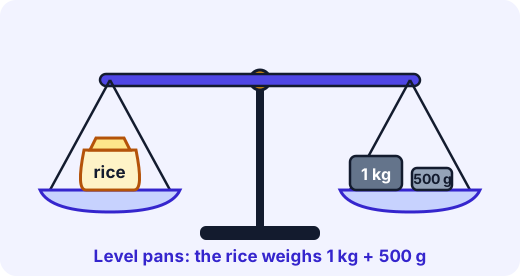
The bag of rice weighs 1 kg + 500 g = 1000 g + 500 g = 1500 g, which we also say as 1 kg 500 g.
The heavier side goes down. If the pan with the rice is down, the rice is heavier than the weights.
Dial scales
A kitchen scale or bathroom scale has a pointer on a dial. Read the number the pointer points to, and the unit written on the dial.
Look at the little marks to see what each one is worth. If the pointer is on the third mark after 0 and every mark is 1 kg, the mass is 3 kg.
Big does not mean heavy
Which is heavier: a big balloon or a small stone? The stone! Heavy depends on how much stuff is packed in, not on how big it looks.
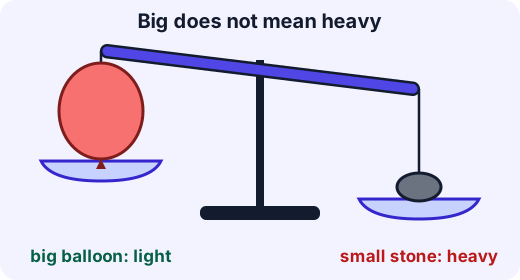
And 1 kg of feathers weighs exactly the same as 1 kg of stones. The feathers just take up more room.
How much a container holds: litres
How much a container can hold is its capacity. We measure it in litres (l). A smaller unit is the millilitre (ml).
Milk and water bottles often hold 1 litre. A teaspoon holds about 5 ml. A bucket might hold 10 litres.
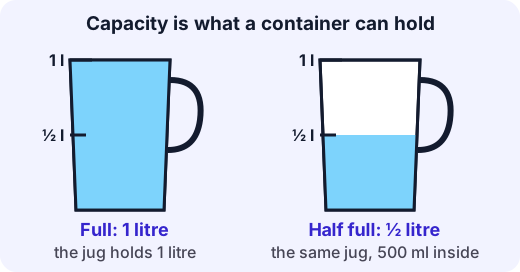
Capacity and how much is inside are different. The jug above has a capacity of 1 litre. On the right it has only a half litre in it.
Example. A jug holds 2 litres. You pour in half-litre cups. Two cups make 1 litre, so 4 cups fill the jug: litres.
Example. A 3-litre pot has 1 litre of water in it. To fill it you need more litres.
Which tool?
To find... Use... Unit how long ruler or tape cm, m how heavy scales g, kg how much a container holds jug or measuring cup ml, l Mistakes to watch for
- Thinking big means heavy. Weigh it or balance it to find out.
- Mixing up weight and capacity. Kilograms are for how heavy; litres are for how much liquid.
- Forgetting the unit. "3" could be 3 g, 3 kg or 3 l.
- Mixing units. Change kilograms to grams before you add: 1 kg + 200 g = 1000 g + 200 g = 1200 g.
For the grown-up helping
Let your child weigh groceries on kitchen scales and pour water between cups and a measuring jug. Ask "Which do you think is heavier? Let's check." Do the pouring at the sink or outdoors. Heavy bags: let your child feel 1 kg of rice so they have a sense of what it is like. Helping with cooking is a perfect place to read scales and jugs.
Lab
Balance and jug
Balance parcels on scales using 1 kg, 500 g and 100 g weights, and say how heavy each one is. Then fill a jug using litres and half litres.
Your goals
- Balance three parcels with weights and say each mass in grams.
- Fill a jug to 3 litres and to 2 and a half litres.
- Find how many half-litre cups fill a 2-litre jug.
The interactive lab opens once you register. Register to do this.
Activity
Weigh and pour
Your child guesses which things are heavier, weighs them on kitchen scales, and pours water between containers to compare capacities. About 30 minutes.
You'll need
- Kitchen scales (or bathroom scales)
- A measuring jug marked in millilitres or litres
- 3 or 4 containers of different shapes (cup, bowl, bottle, pan)
- Household things to weigh, such as a bag of rice or sugar, an apple, a book and a spoon
- Water, a tray or sink, and a towel
- Paper and a pencil
Steps
- Pick four things. Your child guesses the order from lightest to heaviest and writes it down. Then weigh each one and write the mass in grams or kilograms. Was the guess right? Was the biggest thing the heaviest?
- Hold a 1 kg bag of rice or sugar in one hand and something else in the other. Say "heavier" or "lighter" before you check with the scales.
- Do the pouring at a sink or outside. Fill the measuring jug to 1 litre and pour it into each container in turn. Does it fit? Which container could hold more than a litre?
- Guess how many cups of water fill the jug to 1 litre. Then fill a cup and pour it in, counting. How many cups?
- Find the capacity of one container by filling it from the jug. Write the answer in ml or l.
- Fill a container to a line marked on the jug and then to half of it. Say how much is in the container.
Safety
- Do the water play at a sink, outside or on a tray so no one slips on a wet floor, and wipe up spills.
- Do not use cleaning products, medicine bottles or anything hot. Use plain cold water only.
- An adult carries heavy bags. Keep all weighed things light enough for your child.
- Do not weigh or fill anything with breakable glass.
Keeping a log of the activity is for registered learners. Register to do this.
Quick check
Weight and capacity check
Seven questions about weight and capacity.
1.What does the scale show, in kilograms?
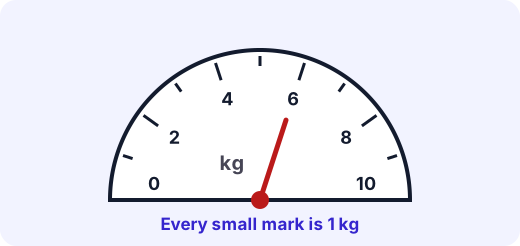
Answer with a number
2.How many grams are in 1 kilogram?
Answer with a number
3.Which is heavier, 1 kg of feathers or 1 kg of stones?
- The feathers
- The stones
- They weigh the same
Choose one
4.Which unit is best for the amount of water in a bucket?
- Kilograms
- Litres
- Centimetres
Choose one
5.A parcel balances with a 1 kg weight and a 200 g weight. How many grams does it weigh?
Answer with a number
6.A jug holds 2 litres. How many half-litre cups of water fill it?
Answer with a number
7.Match each tool to what it measures.
- Scales
- Measuring jug
- Ruler
Match each to: How much liquid a container holds · How long something is · How heavy something is
Answering and checking are for registered learners. Register to do this.
Quick check
New puzzles
Use kilograms, grams and litres in new places.
1.Neha carries two bags of rice, 5 kg each, and 3 kg of dal. How many kilograms does she carry in all?
Answer with a number
2.A bucket holds 10 litres. A jug holds 2 litres. How many full jugs of water fill the bucket?
Answer with a number
3.A big balloon is on one pan of a balance and a small iron ball is on the other. Which pan goes down?
- The balloon pan, because it is bigger
- The iron ball pan, because it is heavier
- Neither, they balance
Choose one
4.Aman buys 1 kilogram of flour and uses 400 grams. How many grams are left?
Answer with a number
5.Zara pours 1 litre of water into a 3-litre jug. How many more litres does she need to fill it?
Answer with a number
Answering and checking are for registered learners. Register to do this.
Activity
Tell it back
Your child explains the difference between how heavy something is and how much a container holds. About five minutes.
Steps
- Show a big, light thing (a balloon or an empty box) and a small, heavy thing (a stone or a tin). Ask "Which is heavier? How can we find out?" Check by holding or on the scales.
- Ask "What do we use to measure how heavy something is? What units?" Then ask "What do we use to measure how much water a bottle holds? What units?"
- Ask "How are weight and capacity different?" Write down what your child says in their own words.
Keeping a log of the activity is for registered learners. Register to do this.
Like what you see?
Register for free to answer the quick checks, do the activities and save your work. Your work is saved on your device and syncs to your account.