Unit 11
Time to five minutes
Learn why the 7 on a clock means 35 minutes, and tell the time to five minutes with a.m. and p.m.
Read
The minute hand counts in fives
Zara's school bus comes at 7:35. Her brother Imran says, "It is seven thirty-five. That is when the long hand is on the 7!" Zara looks at the clock. The long hand is on the 7. But 7 is not the number of minutes. How can 7 mean 35?
The answer is that the minute hand counts in fives.
Counting round the clock
A clock face has 12 numbers. The minute hand moves from one number to the next in 5 minutes. So it goes 5, 10, 15, 20, and so on. After 12 jumps it is back at the top, and a whole hour has passed:
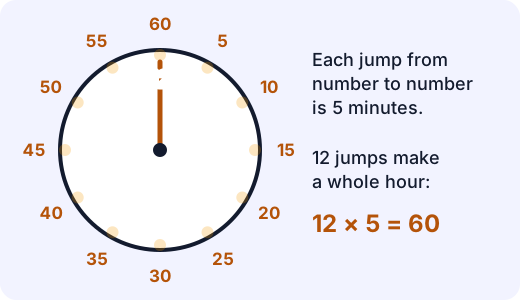
You already know some jumps: the hand on the 12 is "o'clock", on the 3 is 15 minutes (a quarter past), on the 6 is 30 minutes (half past) and on the 9 is 45 minutes (a quarter to the next hour). The rest you can skip count: the hand on the 7 is .
So: 1 is 5, 2 is 10, 3 is 15, 4 is 20, 5 is 25, 6 is 30, 7 is 35, 8 is 40, 9 is 45, 10 is 50 and 11 is 55.
Reading a clock: hour first, then minutes
- Look at the short hour hand. Say the hour it has just passed.
- Look at the long minute hand. Count in fives to the number it points to.
- Write the hour, a colon, then the minutes. A single-digit minute gets a 0 in front: 8:05.
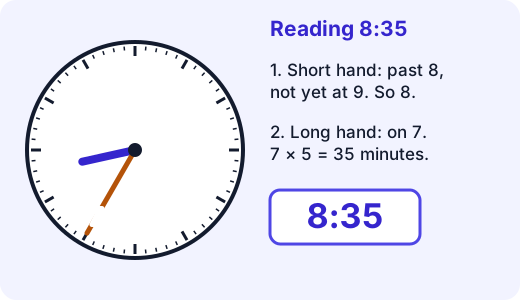
Example. The short hand is between 8 and 9. It has passed 8, so the hour is 8. The long hand is on 7, and . The time is 8:35.
Try it: Look at a clock at home. What is the hour? Where is the long hand? Say the time out loud, then write it.
Watch out. At 4:50 the short hand is almost on the 5. But it has not reached 5 yet, so the hour is still 4. The time is 4:50, not 5:50. When the long hand is on the 10, the short hand is close to the next number. That is how clocks work.
On a real clock the long hand is not always exactly on a number. Then we say the time to the nearest five minutes, and say "about". If the long hand is just past the 7, it is about 7:35.
a.m. and p.m.
The short hand goes round the clock twice in one day. So 7:35 happens twice! We add a.m. or p.m. to say which one.
- a.m. is from midnight (12:00 at night) to noon (12:00 in the middle of the day). Breakfast at 7:35 a.m.
- p.m. is from noon to midnight. Dinner at 7:35 p.m.
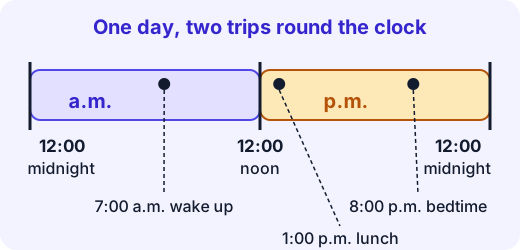
So Zara's bus at 7:35 a.m. is a morning bus. At 7:35 p.m. she is getting ready for bed.
For the grown-up helping
Use a real clock with moving hands, such as a wall clock or a paper-plate clock, and keep a digital clock covered while your child reads. Say the hour first, then count in fives with your finger on the numbers. Children often say "seven" for a long hand on the 7. Ask "How many minutes is that?" and count together. Expect hour-hand slips (4:50 read as 5:50) and fix them by looking where the short hand is going and has been.
Lab
The clock workshop
Set the hands of a clock to the time you are given, read clocks that are already set, and decide whether a time is a.m. or p.m. Press the numbers round the clock and watch the minutes count in fives.
Your goals
- Set the clock to three times, such as 3:20 and 8:45, by moving the minute hand in fives.
- Read three clocks and type the hour and the minutes.
- Choose a.m. or p.m. for three times of day.
The interactive lab opens once you register. Register to do this.
Activity
Make a clock and tell the time
Your child makes a paper-plate clock with a long minute hand and a short hour hand, then shows and reads five times. About 25 minutes.
You'll need
- A paper plate or a circle of card about the size of a plate
- Card for two hands, and a pencil or marker
- A split pin (paper fastener) or a pencil with an eraser to push through
- Scissors and a ruler
- A real clock with hands to copy from
Steps
- An adult cuts out the two hands from card, one long and one short. Your child writes the numbers 1 to 12 round the plate like a real clock.
- Your child writes the minutes outside the numbers, 5 beside the 1, 10 beside the 2, and so on up to 60 beside the 12. Say them together while pointing, "5, 10, 15 ...".
- An adult pushes the split pin through the centre of the hands and the plate so the hands turn. Check that the short hand is the thick one.
- Call out a time, such as "twenty past four". Your child sets the hands. Do 5:10, 8:45, 11:25, 2:55 and 6:30. Ask "Where is the long hand? Where has the short hand got to?"
- Now set the hands yourself and let your child say and write the time, for example 9:35. Ask "How do you know it is not 9:07?"
- Ask your child "Is it a.m. or p.m. when we eat breakfast? When we go to sleep?" and write each time with a.m. or p.m.
Safety
- An adult cuts the card and pushes in the split pin. Flatten the ends of the pin so they are not sharp.
- Keep scissors and split pins away from young children.
Keeping a log of the activity is for registered learners. Register to do this.
Quick check
Time check
Seven questions about clocks. Say the hour first, then count the minutes in fives.
1.What time does this clock show?
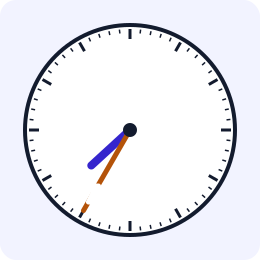
- 7:35
- 7:07
- 8:35
Choose one
2.What time does this clock show?
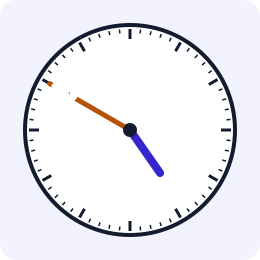
- 4:50
- 5:50
- 4:10
Choose one
3.The long hand points to the 9. How many minutes past the hour is it?
Answer with a number
4.The time is 3:20. Which number is the long hand pointing to?
Answer with a number
5.Kavya eats her dinner at 8:00 at night. How do we write the time?
- 8:00 a.m.
- 8:00 p.m.
Choose one
6.Put these in order, from the earliest in the day to the latest.
- Wake up at 6:30 a.m.
- Bedtime at 9:00 p.m.
- Lunch at 12:30 p.m.
- School starts at 8:00 a.m.
Put these in order
7.Match the place of the long hand to the minutes.
- Long hand on 2
- Long hand on 4
- Long hand on 6
- Long hand on 11
Match each to: 10 minutes past · 30 minutes past · 55 minutes past · 20 minutes past
Answering and checking are for registered learners. Register to do this.
Quick check
New puzzles
Clocks turn up in new places. Can you use what you know about counting in fives?
1.Meera starts her homework at 5:10. She stops 25 minutes later. Which number is the long hand on when she stops?
Answer with a number
2.Which time is the same as "a quarter to 7"?
- 6:45
- 7:45
- 6:15
Choose one
3.Ravi wakes up at 12:30 in the middle of the night, just after midnight. How do we write the time?
- 12:30 a.m.
- 12:30 p.m.
Choose one
4.This clock shows the time Rani's bus leaves. How many minutes is it until 3 o'clock?
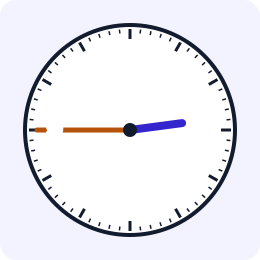
Answer with a number
Answering and checking are for registered learners. Register to do this.
Activity
Tell it back
Your child explains how the minute hand counts and what a.m. and p.m. mean. About five minutes.
Steps
- Show a clock with the long hand on the 7. Ask "What time is it? The long hand is on the 7. Is it 7 minutes?" Let your child explain, using a clock if they like. Do not give the answer.
- Ask "How does the minute hand count?" and listen for "in fives".
- Ask "Why do we say a.m. and p.m.? What is the difference between 7:30 a.m. and 7:30 p.m.?" Write down what your child says in their own words.
Keeping a log of the activity is for registered learners. Register to do this.
Like what you see?
Register for free to answer the quick checks, do the activities and save your work. Your work is saved on your device and syncs to your account.