Unit 12
Money problems
Add prices, compare them, and count up to give the right change.
Read
Price, total and change
Asha goes to the corner shop with a ₹100 note. She wants a notebook for ₹35 and a pencil box for ₹28. The shopkeeper adds up the bill and gives her some money back. How does he know how much?
Shopping uses three words. Let us learn them.
- The price is what one thing costs.
- The total is all the prices added together.
- The change is the money you get back when you pay with more than the total.
Finding the total
To find the total, add the prices. Break each number into tens and ones to make it easier.
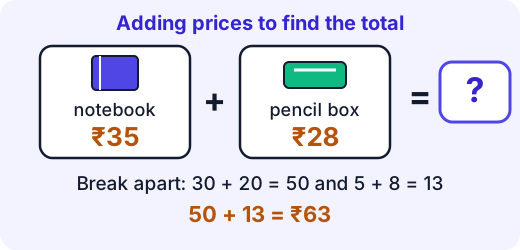
Example. Notebook ₹35 and pencil box ₹28.
Asha's total is ₹63.
Comparing prices
"Which costs more?" is easy: the bigger number. "How much more?" asks for the difference. Subtract, or count up from the smaller price to the bigger one.
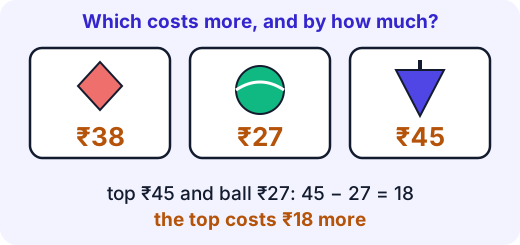
Example. The top costs ₹45 and the ball costs ₹27. How much more is the top? Count up from 27 to 30 (+3), then from 30 to 45 (+15). . The top costs ₹18 more.
Finding the change
The shopkeeper does not usually subtract. He counts up from the price to the note you gave. Each step adds a little money, and you stop when you reach the note.
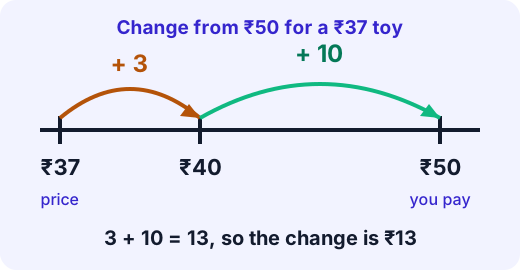
Example. A toy costs ₹37. Raj pays with a ₹50 note. Count up: , then . The change is ₹13.
Asha's change from ₹100 for ₹63 is: , then . ₹37. You can check it by adding: .
Try it: Pretend a pencil costs ₹18 and you pay with a ₹50 note. Count up from 18. What is your change?
Two things to buy, then change
Many shopping problems have two steps. First find the total of everything you buy. Then find the change from your note.
Example. Tara has ₹100. She buys a book for ₹27 and a pen for ₹45. Step 1: . Step 2: , so her change is ₹28.
Mistakes to watch for
- Giving too much change because you subtracted the wrong way round. The change is always less than the note.
- Forgetting the ₹ sign. A number alone is not an amount of money.
- Forgetting the second step. The total is not the change.
For the grown-up helping
Let your child handle real coins and notes when you shop, and ask them to find the total of two things and the change from a note. Play shop at home with price tags. Encourage counting up for change, which is how shopkeepers do it. If your child struggles to add two-digit prices, go back to adding tens first, then ones.
Lab
The corner shop
Run a corner shop. Add up bills, work out how much more one thing costs than another, and give change from a note by tapping coins as you count up.
Your goals
- Find the total of two prices, and the cost of three of one thing.
- Work out how much more one price is than another, and how much money is left after buying.
- Give the exact change from a note three times, counting up from the price.
The interactive lab opens once you register. Register to do this.
Activity
Play shop
Your child runs a pretend shop with price tags, adds up bills and gives change. About 25 minutes.
You'll need
- 8 to 10 small things from home to sell, such as a spoon, a toy or a book
- Paper for price tags and a pencil
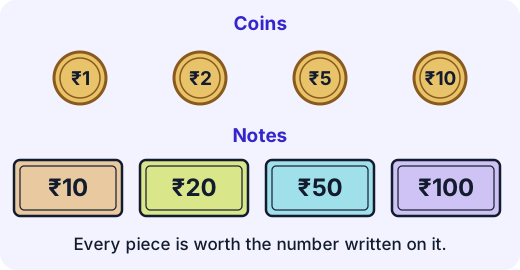
- Play money, or paper notes and coins you make yourself (₹1, ₹2, ₹5, ₹10, ₹20, ₹50, ₹100)
- A paper bag
Steps
- Your child writes a price tag for each thing. Use prices from ₹5 to ₹60 so the sums stay within 100.
- You are the customer. Pick two things, and ask your child "What is the total?" Let them add it on paper and say how they did it.
- Pay with a ₹100 note (or a ₹50 note for smaller totals). Ask "How much change do I get?" Your child counts it out by counting up from the price to the note, putting coins down as they go.
- Do four shopping trips. In one of them, ask "Which of these two costs more? How much more?"
- Swap roles. You are the shopkeeper and make one mistake on purpose, such as the wrong change. Can your child find it?
- Ask "How do you check your change?" Listen for adding the price and the change to see if they make the note.
Safety
- Use play money. If you use real coins, keep them away from babies and toddlers, who might put them in their mouths.
Keeping a log of the activity is for registered learners. Register to do this.
Quick check
Money check
Seven questions about prices, totals and change.
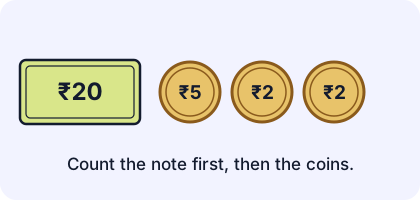
1.How much money is there? Give the answer in rupees.
Answer with a number
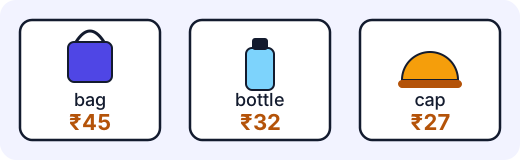
2.Sam buys the bottle and the cap. What is the total, in rupees?
Answer with a number
3.Which two things together cost exactly ₹72?
- The bag and the cap
- The bag and the bottle
- The bottle and the cap
Choose one
4.A comb costs ₹34. Mina pays with a ₹50 note. How much change does she get, in rupees?
Answer with a number
5.A bag costs ₹64 and a bottle costs ₹46. How much more does the bag cost, in rupees?
Answer with a number
6.Match each word to what it means.
- Price
- Total
- Change
Match each to: The money you get back · All the prices added together · What one thing costs
7.Put the prices in order, from the cheapest to the most expensive.
- ₹39
- ₹30
- ₹93
- ₹90
Put these in order
Answering and checking are for registered learners. Register to do this.
Quick check
New puzzles
Money problems come in many shapes. Use what you know about totals and change.
1.Tara buys a book for ₹38 and a pen for ₹24. She pays with a ₹100 note. How much change does she get, in rupees?
Answer with a number
2.Rohan has ₹60. A toy costs ₹85. How much more money does he need, in rupees?
Answer with a number
3.A bus ticket costs ₹15. Three children each buy a ticket. How much do they spend in all, in rupees?
Answer with a number
4.Dev has ₹50. Which pair of things can he buy with his ₹50?
- A ₹26 thing and a ₹25 thing
- A ₹30 thing and a ₹19 thing
- A ₹33 thing and a ₹18 thing
Choose one
Answering and checking are for registered learners. Register to do this.
Activity
Tell it back
Your child explains how to find the change from a note. About five minutes.
Steps
- Say "A pen costs ₹43. I pay with a ₹50 note. How do you find my change?" Let your child explain, using coins or a number line on paper if they like.
- Ask "Why is the change less than the ₹50 note? How can you check your answer?" Write down what your child says in their own words.
Keeping a log of the activity is for registered learners. Register to do this.
Like what you see?
Register for free to answer the quick checks, do the activities and save your work. Your work is saved on your device and syncs to your account.