Unit 13
Shapes and their parts
Count sides, corners, faces and edges, and draw shapes that have the features you ask for.
Read
Sides, corners, faces and edges
Leela is building shapes with drinking straws and little balls of clay. She joins three straws with three clay balls and gets a triangle. "Three straws, three balls," she says. "What if I use five?"
Every shape is made of parts. If you can name and count the parts, you can describe any shape, and even build or draw it.
Flat shapes: sides and corners
A flat shape has sides and corners.
- A side is a straight line that is part of the edge of the shape.
- A corner is a point where two sides meet.
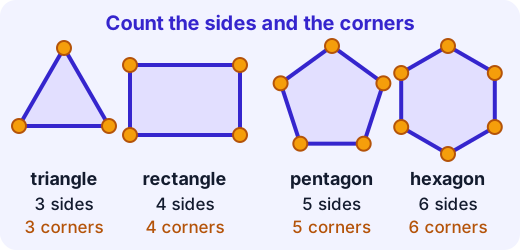
A flat shape always has as many corners as sides. A triangle has 3 sides and 3 corners. A pentagon has 5 and 5. A hexagon has 6 and 6.
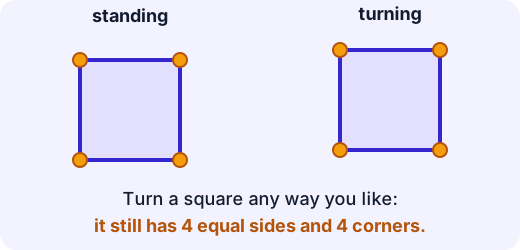
A square has 4 sides that are all the same length and 4 square corners. A rectangle also has 4 square corners, but only the opposite sides match, so it can be long and thin. Every square is a rectangle, but most rectangles are not squares.
Watch out. A shape does not change if you turn it. A square turned like a diamond is still a square. Its sides and corners are the same.
Solid shapes: faces, edges and corners
A solid shape takes up space, so it has more parts:
- A face is a flat surface.
- An edge is where two faces meet.
- A corner is where edges meet.
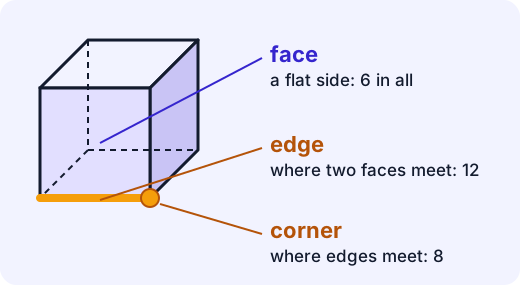
A cube has 6 faces (all squares), 12 edges and 8 corners. A box shape, called a cuboid, has the same numbers: 6 faces, 12 edges and 8 corners. Some of them are hidden behind the shape, so count carefully. Dashed lines show the edges you cannot see.
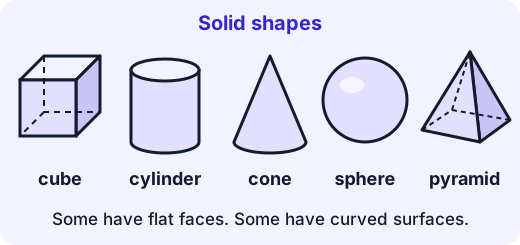
Solid shape Flat faces Edges Corners Cube 6 12 8 Square pyramid 5 8 5 Cylinder (a tin) 2 2 curved 0 Cone 1 1 curved 1 Sphere (a ball) 0 0 0 Curved surfaces are not flat faces. A tin has a flat top, a flat bottom and one curved side, so it has 2 flat faces.
Drawing a shape with given features
To draw "a shape with 5 sides", draw five straight sides that join up and close. Count the corners as you draw. You should get 5 as well. To draw "a shape with 4 equal sides and 4 square corners", draw a square.
Try it: Find a tin, a box and a ball at home. How many flat faces does each have? How many corners?
For the grown-up helping
Build shapes with straws and clay, or sticks and blobs of putty, so your child can feel the sides and corners. Ask your child to point to and count each part, one at a time, touching it as they go. Hidden faces and edges are the hard part: turn the box round to find them. If your child says a turned square is "a different shape", turn a paper square on the table to show it is the same.
Lab
The shape workshop
Draw shapes on a dot grid by tapping the corners, and see what the sides must be like. Then count the faces, edges and corners of a cube, a pyramid and a cylinder.
Your goals
- Draw shapes with 3, 4, 5 and 6 sides, and a rectangle that is not a square.
- Count the faces, edges and corners of a cube and a pyramid.
- Count the flat faces and corners of a cylinder.
The interactive lab opens once you register. Register to do this.
Activity
Straw and clay shapes
Your child builds flat shapes and a cube from straws and clay, counts their parts, then hunts for solid shapes at home. About 30 minutes.
You'll need
- About 25 drinking straws or short sticks of the same length (an adult cuts some in half)
- Clay, play dough or putty, rolled into about 20 small balls
- Paper and a pencil
- A tin, a cardboard box, a ball and anything shaped like a cone (such as a paper party hat)
Steps
- Your child joins 3 straws with 3 clay balls to make a triangle. Ask "How many sides? How many corners?" Do the same with 4 straws (a square), 5 (a pentagon) and 6 (a hexagon). Write the counts in a table.
- Ask "What do you notice about the number of sides and corners?" Press the square a little so it leans over. Ask "Is it still a shape with 4 sides and 4 corners?"
- Build a cube from 12 straws and 8 balls. Let your child work out how many they need before they start. Touch and count the faces, the edges and the corners.
- Show a box, a tin, a ball and a cone. For each, ask "How many flat faces? How many corners?" Roll them and stack them to see which do which.
- Your child draws a shape with 5 sides, and then one with 4 equal sides and 4 square corners.
- Hunt round the house for one cube or box shape, one cylinder and one sphere.
Safety
- An adult cuts the straws. Cut ends can be sharp or pointy, so do not poke them at faces.
- Clay balls are a choking risk for babies and toddlers, so keep them away from small children.
Keeping a log of the activity is for registered learners. Register to do this.
Quick check
Shapes and their parts check
Seven questions about the parts of shapes. Count carefully, and remember the dashed lines.
1.How many corners does this shape have?
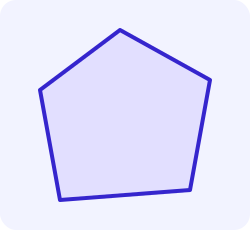
Answer with a number
2.How many sides does this shape have?
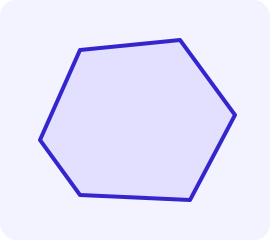
Answer with a number
3.How many edges does this cube have? The dashed lines are edges too.
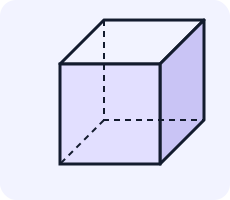
Answer with a number
4.How many faces does this pyramid have? Count the bottom face too.
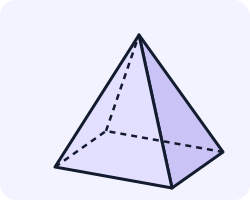
Answer with a number
5.Which solid shape has no corners at all?
- Cube
- Cone
- Square pyramid
- Cylinder
Choose one
6.A flat shape has 4 sides that are all the same length and 4 square corners. Which shape is it?
- A square
- A rectangle that is longer than it is wide
- A triangle
- A hexagon
Choose one
7.Match each flat shape to its number of corners.
- Triangle
- Square
- Pentagon
- Hexagon
Match each to: 4 corners · 6 corners · 3 corners · 5 corners
Answering and checking are for registered learners. Register to do this.
Quick check
New puzzles
Shapes are everywhere. Use what you know about faces, edges, sides and corners.
1.Rani has a gift box shaped like a cube. She covers every face with a different square of wrapping paper. How many squares does she need?
Answer with a number
2.Dev draws a flat shape with 7 sides. How many corners does his shape have?
Answer with a number
3.Meena makes the skeleton of a cube. She uses one straw for each edge. How many straws does she need?
Answer with a number
4.A solid shape has 2 flat circle faces, 1 curved surface and no corners. Which shape is it?
- A cone
- A cylinder
- A sphere
Choose one
Answering and checking are for registered learners. Register to do this.
Activity
Tell it back
Your child explains the parts of a shape, using a real box. About five minutes.
Steps
- Give your child a cardboard box. Ask "Show me a face, an edge and a corner. How many of each are there?" Let them point and count.
- Ask "How is a tin different from a box?" and "How is a triangle different from a square? Which parts can you count?" Write down what your child says in their own words.
Keeping a log of the activity is for registered learners. Register to do this.
Like what you see?
Register for free to answer the quick checks, do the activities and save your work. Your work is saved on your device and syncs to your account.