Unit 2
My region and country
Find where you live inside your region, country and continent, and name your neighbours, big cities and rivers.
Read
Places inside places
Mira writes her address on a parcel for her cousin abroad. First she writes the house number and the street. Then the city. Then the state. Then the country. The postman in another country has never heard of her street, but he knows where India is, and that is where he starts.
Every address works like this: it begins with something big and gets smaller and smaller until it reaches your door. Places sit inside bigger places. This unit is about learning where your place sits.
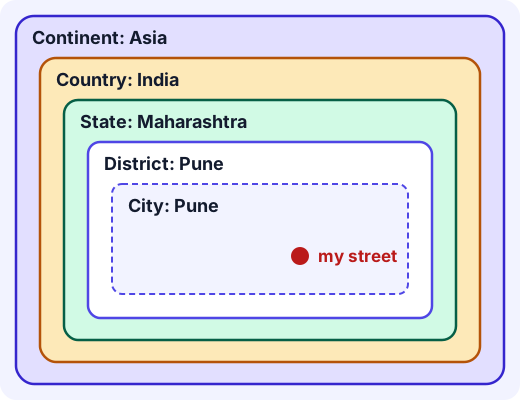
From small to big
Level Example Street or neighbourhood Karve Road City, town or village Pune District Pune district State (or province) Maharashtra Country India Continent Asia A region is an area of land that shares something: the same kind of land, the same weather, the same languages or traditions. A region can be a whole state or just part of one, or it can reach over several states. People often speak of North India, South India, the North-East, or the Deccan. If you ask three people where the "edge" of a region is, you may get three answers, because regions are not drawn with sharp lines the way a country's border is.
A country is a large area with its own government and borders. It has a capital, the city where the national government sits. The capital of India is New Delhi. India has 28 states and 8 union territories, and each state has its own capital too (the capital of Maharashtra is Mumbai, for example).
A common mix-up. The capital is not always the biggest or best-known city. The capital of Australia is Canberra, not Sydney. The capital of Brazil is Brasília, not Rio de Janeiro. Always check!
Neighbours
The countries or regions that touch yours are your neighbours. India's land neighbours include Pakistan, China, Nepal, Bhutan, Bangladesh and Myanmar. Two more neighbours are across the sea: Sri Lanka lies just off the southern tip, and the Maldives are islands further south-west. A country with no coast at all, such as Nepal or Bhutan, is called landlocked. Neighbours matter. People trade, travel, share rivers and sometimes share languages with them.
India on the map
Use the sketch to practise finding places. It is simplified, so borders are only roughly drawn: use an atlas or a globe for exact lines.
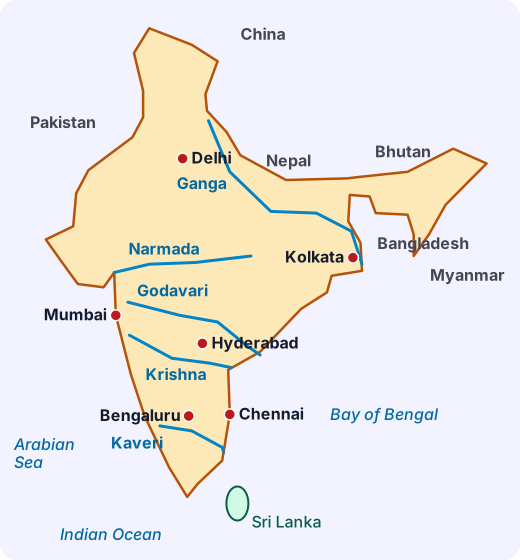
Big cities Delhi (the national capital region, in the north), Mumbai (west coast, Maharashtra), Kolkata (east, West Bengal), Chennai (east coast, Tamil Nadu), Bengaluru (south, Karnataka) and Hyderabad (centre-south, Telangana).
Main rivers The Ganga flows from the Himalaya across the northern plain to the Bay of Bengal. The Godavari, Krishna and Kaveri flow east across the peninsula, also into the Bay of Bengal. The Narmada flows west into the Arabian Sea.
Example. Describe where Chennai is, from big to small.
- Continent: Asia.
- Country: India, in the south-east of the country.
- State: Tamil Nadu. Region: South India.
- It is a coastal city on the Bay of Bengal, on the east coast. Its neighbour to the west is Bengaluru, about 350 km away by road.
- Nearby river: the Kaveri flows in the same state, further south.
If you live in another country
You can do all of this for your own country. Find out its name, its capital, the countries that touch it (or the seas around it, if it is an island), three big cities and two big rivers. Then write your address from small to big, and find each place in an atlas or on a globe.
Try it: Use an atlas, a globe or a map app. Find your street, your town or village, your state, your country and your continent. Say them aloud, going from smallest to biggest.
Activity
My place, from small to big
Use an atlas, a globe or a map to find where you live and build a poster of nested places. About 40 minutes.
You'll need
- An atlas, a globe or a map of your country (or a map app with an adult)
- Several sheets of paper, scissors, coloured pencils
- A pencil and a notebook
Steps
- Write your address from small to big: street, town or village, district, state or province, country, continent.
- Find your country in the atlas or on the globe. Write its name, its capital, and the countries or seas that touch it.
- Find your state or region and write its main cities. Mark your own town or village with a red dot.
- Find two big rivers in your country. Trace each one from where it starts to where it ends (a sea, a lake or another river).
- On the biggest paper draw your continent as a big shape. Cut smaller papers for your country, state, district and town, and stack them, smallest on top. Label every layer.
- On your country layer, mark the capital with a star and write the names of its neighbours around the edge.
- Show your poster to a family member and tell them how it works, from the top layer down.
Safety
- Ask an adult before using the internet or a map app.
- An adult helps with scissors if you are under 8; cut away from your body.
Keeping a log of the activity is for registered learners. Register to do this.
Quick check
Region and country check
Seven questions about places inside places, and about India. The sketch map in the reading may help.
1.Put these places in order, from the smallest to the biggest.
- A city
- A street
- A country
- A state
- A continent
Put these in order
2.What is the capital of India?
- Mumbai
- Kolkata
- New Delhi
- Chennai
Choose one
3.Which of these countries share a land border with India? Pick all that do.
- Nepal
- Bhutan
- Sri Lanka
- Japan
- Bangladesh
Choose all that apply
4.Match each city to its state.
- Chennai
- Kolkata
- Bengaluru
- Hyderabad
Match each to: West Bengal · Tamil Nadu · Telangana · Karnataka
5.Which of these rivers flows east into the Bay of Bengal?
- Narmada
- Godavari
- Tapi
Choose one
6.India is in which continent?
Answer with a word or phrase
7.Look at the sketch map. Which of these big cities is on the west coast?
- Mumbai
- Kolkata
- Chennai
- Hyderabad
Choose one
Answering and checking are for registered learners. Register to do this.
Quick check
New puzzles
Use what you know about places inside places in situations from other parts of the world.
1.Jaipur is a city in the state of Rajasthan, in India, in Asia. Put these in order from the biggest to the smallest.
- India
- Jaipur
- Rajasthan
- Asia
Put these in order
2.Bolivia, in South America, has no coast at all. What do we call a country like this?
- A landlocked country
- An island country
- A peninsula
- A capital
Choose one
3.A river starts high in the Himalaya, flows across the northern plain past Varanasi and ends at the Bay of Bengal. What is its name?
Answer with a word or phrase
4.Maria lives in Lima, the capital of Peru, in South America. Which sentence is right?
- Lima is a city inside Peru, and Peru is inside South America
- Peru is a city inside Lima
- South America is a country inside Peru
- Lima, Peru and South America are all the same size
Choose one
5.Ben says, "Sydney is the biggest city in Australia, so it must be the capital." What is the best reply?
- Not necessarily. A capital is where the national government sits, and Australia's capital is Canberra
- Yes, the biggest city is always the capital
- Australia has no capital
- Sydney is a country
Choose one
Answering and checking are for registered learners. Register to do this.
Your turn
Where is my place?
A pen-friend from another country has never heard of the place where you live. Write her a short letter (6 to 10 sentences) that tells her exactly where you are. Your letter should:
- Say what your place is, then the district, state or province, country and continent it sits inside (smallest to biggest).
- Name your country's capital, and at least two of its neighbours (countries or seas).
- Name at least two big cities or two rivers in your country, and say where they are (north, south, east or west).
- Explain in one sentence what "places sit inside bigger places" means, using your own address as the example.
How it's judged
- Locating my place
- Facts about the country
- Explaining nesting
Writing and submitting your answer is for registered learners. Register to do this.
Like what you see?
Register for free to answer the quick checks, do the activities and save your work. Your work is saved on your device and syncs to your account.