Unit 5
Reading new words
Sound out any regular word and slide the sounds together, and see how a silent e changes cap into cape.
Read
Slide the sounds together
Grown-up: let your child do the work. Point to each letter, wait, and only help if they are stuck. Sounds are in slashes, like /k/.
Zara is at her aunt's shop. A tin on the shelf has a word on it that Zara has never seen: jam.
She doesn't need anyone to tell her. She knows the code. j says /j/. a says /a/. m says /m/. She says them slowly, /j/ ... /a/ ... /m/, and slides them together: jam!
That is decoding: working out a word by turning its letters into sounds and blending the sounds. It means you can read a word you have never seen before.
The four steps
- Look at the word from left to right.
- Say the sound for each letter (or letter pair).
- Slide the sounds together, faster and faster.
- Check: is it a real word that makes sense?
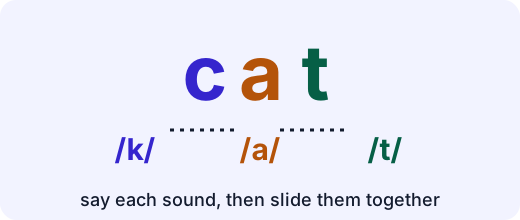
Try one. Example. Read pig.
- Look: p, i, g.
- Say: /p/ ... /i/ ... /g/.
- Slide: /p/-/i/-/g/ ... pig.
- Check: a pig is an animal. It makes sense.
Try it: Sound out these words: sun, bed, hop, bus. (A word that is only a short vowel between two consonants is easy to blend.)
Longer words, same steps
Words with more sounds work the same way. Keep going, one sound at a time.
Word Sounds Count frog /f/ /r/ /o/ /g/ 4 jump /j/ /u/ /m/ /p/ 4 ship /sh/ /i/ /p/ 3 duck /d/ /u/ /ck/ 3 Remember the letter pairs from the last unit: sh, ch, th, ck are each one sound. So ship is three sounds, not four.
The magic of a silent e
Now look at these two words: cap and cape. They have the same letters, except cape has an e on the end. Say both.
- cap: /k/ /a/ /p/. The a is short, as in apple.
- cape: /k/ /ā/ /p/. The a says its own name, "ay". We call this a long vowel.
The e at the end does not say anything. It is silent. But it tells the vowel before it to say its name. It is a silent helper.
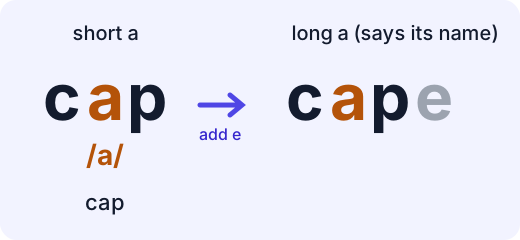
Here are more pairs. Say each one aloud.
Short vowel With a silent e The vowel says cap cape "ay" kit kite "eye" hop hope "oh" cub cube "yoo" pin pine "eye" tap tape "ay" Example. Read bike.
- Look: b, i, k, e. The last letter is a silent e, so the i will say its name.
- Say: /b/ ... /ī/ ... /k/.
- Slide: bike.
- Check: a bike is a thing you ride. Yes!
The silent e jumps over one consonant to reach the vowel. In bike it jumps over the k. In snake it jumps over the k too, and snake has four sounds, /s/ /n/ /ā/ /k/, though it has five letters.
Common mix-ups
Don't guess from the first letter. If you see ship and say "shop" because you looked only at the start, you will be wrong. Look at every letter, left to right.
Don't sound out the silent e. Say kite, not "kit-ee". The e stays quiet.
Not every word follows the pattern. Have and love have a silent e, but the vowel is short. These are tricky words you simply learn. Most words do follow the pattern, so it is a great place to start.
For the grown-up helping
Let your child do the sounding-out, even when it is slow. If they are stuck, cover all but the first letter and slide the cover along. Praise the strategy ("You looked at every sound!") rather than only the answer. Never tell them to guess from a picture or the first letter; it makes later reading harder. When the sounds are known but blending is hard, practise with continuous sounds first (/s/ /m/ /f/ /n/ stretch out nicely) and hold the sound before moving on. A silent e word like cake may need several days: say "the e tells the a to say its name".
Lab
Word slider
Sound out words letter by letter and slide them together, then pick the picture. In the second half, a silent e changes the word. A grown-up can help read the letters.
Your goals
- Sound out six words and pick the picture that matches each one.
- Choose the right word, with or without a silent e, for five pictures.
The interactive lab opens once you register. Register to do this.
Activity
Word-building cards
Your child builds and reads real and made-up words with letter cards, and turns short words into silent e words. About 15 minutes.
You'll need
- Paper or card cut into small squares by the grown-up (about 20)
- A thick marker
Steps
- Write one letter on each square: a, i, o, u, e, plus c, p, t, m, s, n, k, b, d, h, and one card with sh.
- Build a word with three squares, such as m-a-p. Point to each square, say the sounds, then slide your finger along as you blend: map. Your child does the next one: s-u-n.
- Change just one square and read the new word: map becomes mat, then met, then men. Let your child make three changes and read each word.
- Make a made-up word on purpose, such as d-o-p. Say 'It is not a real word, but you can still read it!' Reading made-up words proves your child is decoding, not guessing.
- Silent e: build c-a-p and read it. Add the e card at the end, c-a-p-e, and read it again. Ask 'What did the e do to the a?' Try kit and kite, hop and hope.
Safety
- The grown-up does all the cutting. Keep small squares away from babies and toddlers.
Keeping a log of the activity is for registered learners. Register to do this.
Quick check
Reading new words check
Seven questions. Sound out each word, slide the sounds together, then answer.
1.Blend the sounds /m/ /a/ /p/. Which word do you read?
- map
- mop
- mat
Choose one
2.How many sounds are in the word "jump"?
Answer with a number
3.Which word says "ay", like the a in "cake"?
- cap
- cape
- cat
Choose one
4.Which word is this picture?

- cub
- cube
- cup
Choose one
5.Match each short word to the word you get when you add a silent e.
- kit
- tub
- hop
- pin
Match each to: hope · tube · kite · pine
6.How many sounds are in the word "kite"?
Answer with a number
7.You see a new word you have not read before. What should you do first?
- Look at the first letter and guess
- Say the sound for each letter from left to right, then blend them
- Skip it
Choose one
Answering and checking are for registered learners. Register to do this.
Quick check
New puzzles
Read words you have never seen, even made-up ones, by using the code.
1.A made-up word is "mipe". How does the i sound?
- Short, like the i in "sit"
- Long, like the i in "kite"
- Like the e in "bed"
Choose one
2.How many sounds are in the word "snake"?
Answer with a number
3.Mia wants to write the word for the thing you jump over when you skip. She wrote "rop". What should she do?
- Add a silent e on the end, to make rope
- Double the p, to make ropp
- Take away the o
Choose one
4.Add a silent e to "cub". Type the new word.
Answer with a word or phrase
Answering and checking are for registered learners. Register to do this.
Activity
Tell it back
Your child explains how they read a word they have never seen. Three minutes.
Steps
- Write a made-up word on paper, such as zeb or lote. Ask 'Can you read this? It is not a real word, so you have never seen it.'
- Let your child read it, then ask 'How did you work it out?' Don't give hints at first. If they are stuck, ask 'What does each letter say?'
- Ask 'What does a silent e do?' using the word lote, or compare cap and cape. Write down what your child says, in their words.
Keeping a log of the activity is for registered learners. Register to do this.
Like what you see?
Register for free to answer the quick checks, do the activities and save your work. Your work is saved on your device and syncs to your account.