Unit 4
Letters and their sounds
Crack the code. Learn the sound each letter makes, and the letter pairs sh, ch, th and ck that team up to make one sound.
Read
The secret code of letters
Grown-up: read this together. Sounds are written between slashes, like /s/. Always say the sound itself ("sss"), not the letter's name ("ess"). Say it crisp and short.
Imagine a secret code. Every symbol in the code stands for a sound. If you know the code, you can turn marks on paper into words you can say. If you know the code the other way round, you can turn words you say into marks on paper.
That secret code is real, and you already know some of it. The marks are letters.
One letter, one sound
Each letter is a code for a sound. Here is the whole alphabet, with a picture-word to help you remember each sound.
Letter Sound Think of Letter Sound Think of a /a/ apple n /n/ nest b /b/ bat o /o/ octopus c /k/ cat p /p/ pig d /d/ dog q /kw/ queen e /e/ egg r /r/ rain f /f/ fish s /s/ sun g /g/ goat t /t/ tap h /h/ hat u /u/ umbrella i /i/ igloo v /v/ van j /j/ jam w /w/ web k /k/ kite x /ks/ box l /l/ lamp y /y/ yak m /m/ moon z /z/ zip The letters a, e, i, o, u are the vowels. Their sounds are the ones in apple, egg, igloo, octopus, umbrella. Every word needs a vowel sound. The other twenty-one letters are consonants.
Notice that c and k both say /k/ here (cat, kite). Some letters have a second sound too, like the c in city. You will meet those later. For now, learn the first sound of each letter well.
Try it: Point to a letter in the table, say its sound, then say a word that starts with it. For m: /m/, moon... mango, mouse, mat.
Letters that team up
Sometimes two letters stand together and make one sound. These are letter pairs. Four are very common.
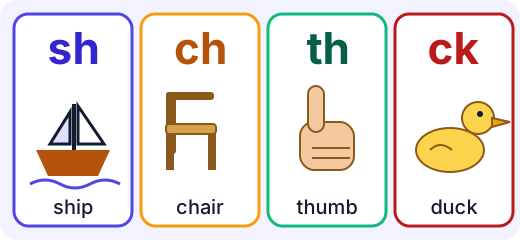
Pair Sound Where you hear it sh /sh/ ship, shell, fish ch /ch/ chair, cheese, chick th /th/ thumb, three, bath ck /k/ duck, sock, clock The pair ck comes at the end of a short word, right after a short vowel (duck, sock, pick). The pair th has two slightly different sounds: a soft one in thumb, and a buzzing one in this. Both are spelled th.
Two letters, one sound
This is the big idea of the unit, and the place where many learners get stuck. Look at ship.
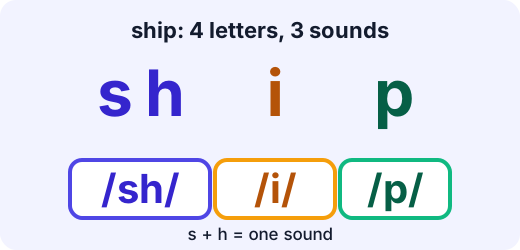
Ship has four letters: s, h, i, p. But if you listen, it has three sounds: /sh/ /i/ /p/. The letters s and h are glued together. You do not say /s/ then /h/. You say one sound, /sh/.
Example. How many sounds are in chick?
- Look for letter pairs. ch is one pair. ck is another pair.
- So the sounds are /ch/ /i/ /k/.
- Chick has five letters, but only three sounds.
A common mix-up
"Why isn't sh just /s/ and /h/?" Because the pair is a code of its own. If you said /s/ /h/ /i/ /p/, it would sound like "s-hip", not ship. When you see s and h side by side, read them as a team.
And a letter's name is different from its sound. The letter b is called "bee", but its sound is /b/, as in bat. When you read, you need the sound.
For the grown-up helping
Teach a few letters at a time, and keep revisiting them, a minute or two each day. Say pure sounds: /m/ not "muh", /s/ not "suh", so that blending works later. Use pictures and real objects (a toy pig for /p/). Mixing up look-alike letters (b and d, p and q) is very common at this age and gets better with practice and with writing the letters. If your child is learning to read in a language such as Hindi first, that is a strength: they already know that marks stand for sounds. Praise effort, not speed.
Lab
Sound match
Ten word puzzles. Finish each word by picking the missing letters, then hunt for letter pairs in three picture rounds. A grown-up can read the words aloud.
Your goals
- Finish ten words by picking the letter or letter pair for the missing sound.
- Find the pictures that contain the pair sh, ck and th.
The interactive lab opens once you register. Register to do this.
Activity
Sound hunt at home
Your child hunts for things that start or end with a sound, then matches them to letter cards, including the pairs sh, ch, th and ck. About 15 minutes.
You'll need
- Paper or index cards, cut into 10 pieces by the grown-up
- A thick pencil or marker
- Small household things with different sounds in their names (spoon, cup, shoe, sock, comb, pen, bag, key, dish)
Steps
- The grown-up writes one letter on each card: s, c, p, b, m, t, plus the pairs sh, ch, th and ck (use lower-case letters). Lay them out.
- Say a letter's sound (not its name). Your child says it back and points to the card. Do all of them.
- Treasure hunt: say a card's sound, such as /sh/, and send your child to find something in the house with that sound in its name (shoe, shelf, dish). Say the word together and listen for the sound.
- Back at the cards, hold up an object, such as a sock. Ask 'What sound do you hear at the end?' and let your child choose the card (ck). Do five objects.
- Ask 'Why do we need two letters for the sound at the end of sock?' Listen to the answer.
Safety
- The grown-up cuts the paper. Choose objects that are not sharp, breakable or small enough to swallow.
Keeping a log of the activity is for registered learners. Register to do this.
Quick check
Letters and sounds check
Seven questions. A grown-up can read the words aloud. Think about the sounds, not the letter names.
1.What sound does the letter m make?
- /m/ as in moon
- /n/ as in nest
- /w/ as in web
Choose one
2.Which two letters stand for the first sound in "ship"?
- sh
- ch
- th
Choose one
3.How many sounds are in the word "chick"?
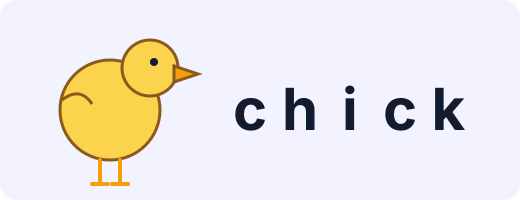
Answer with a number
4.Which letters finish the word "fish"?
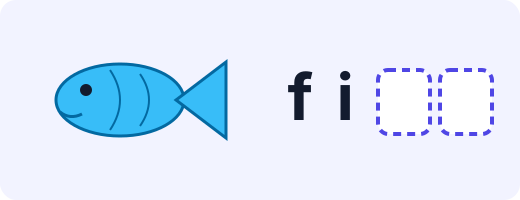
- sh
- ch
- ck
Choose one
5.Which words start with the sound /th/ as in "thumb"? Pick all that do.
- thumb
- three
- shop
- chip
Choose all that apply
6.Match each word to the letter pair that is in it.
- chair
- thumb
- sock
- shell
Match each to: th · sh · ch · ck
7.Which letter is the code for the first sound in "van"? Type it.
Answer with a word or phrase
Answering and checking are for registered learners. Register to do this.
Quick check
New puzzles
Use the letter code on words you have not seen before.
1.How many sounds are in the word "thick"? (It has two letter pairs.)
Answer with a number
2.A robot says /sh/ /o/ /p/. Which word should you write?
- shop
- chop
- thop
Choose one
3.Why does "rock" have four letters but only three sounds?
- The letters c and k together make one sound, /k/
- The letter o is silent
- The letter r does not make a sound
Choose one
4.A made-up creature has a name that sounds like /th/ /i/ /k/. Its name has a letter pair at the start and a letter pair at the end, and it rhymes with kick. Which spelling fits?
- thick
- chick
- shick
Choose one
Answering and checking are for registered learners. Register to do this.
Activity
Tell it back
Your child explains, in their own words, what a letter and a letter pair are for. Three minutes.
Steps
- Write the word ship on paper. Ask 'How many letters? How many sounds?' Let your child say it slowly and count both.
- Ask 'Why are there fewer sounds than letters?' Don't give the answer. If they get stuck, point to s and h and ask 'What do these two do together?'
- Ask 'What is a letter for?' Write down what your child says, in their own words.
Keeping a log of the activity is for registered learners. Register to do this.
Like what you see?
Register for free to answer the quick checks, do the activities and save your work. Your work is saved on your device and syncs to your account.