Unit 6
Common words at a glance
Some words show up on almost every page. Learn to know the, said, was and their friends by sight.
Read
Words you see everywhere
Grown-up: read this together and point to the words as you go. Sounds are in slashes, like /s/.
Here is a sentence from a story:
He said the cat was in the box and I can see it.
Count the words. There are thirteen. Now count the words that you will see in almost every book you ever read: he, said, the, was, in, the, and, I, can, see, it. That is eleven of the thirteen! Only cat and box are special to this sentence.
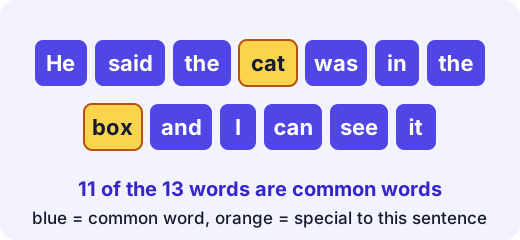
Some small words are used again and again. These are called common words (some people say high-frequency words or sight words). Just a hundred or so of them make up about half of everything we read. If you can read them quickly, without stopping to sound them out, you keep moving through the sentence and it makes sense.
Know them like your own name
You don't sound out your own name. You see it and you know it straight away. Common words can be like that. After enough practice, you see the and you just know it.
Here are some common words, grouped to learn a few at a time.
Group Words Tiny words a, I, is, it, in, on, at, to, up, go, no, so, we, he, me, be Little helpers the, and, of, you, was, are, for, my, his, she, they Doing words said, can, see, look, come, play, like, have, want More little words one, two, here, there, this, that, with, from Many of these are easy to sound out: it, in, up, and, not. You can decode them and know them by sight.
Heart words
But some common words don't follow the code. They have a tricky part that you have to learn by heart. We call them heart words.
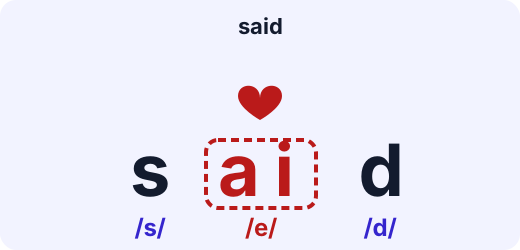
Look at said. It is spelled s-a-i-d, but we say /s/ /e/ /d/, like bed. The tricky part is ai, which says /e/ here. The s and the d work as usual, so only part of the word is a surprise.
More heart words:
Word The tricky part the said "thuh" or "thee", not /th/ /e/ was the a says /o/ and the s says /z/: "woz" of the f says /v/: "ov" you ou says "oo" one said "wun" are said "ar" Try it: Cover the words with your hand, then show one at a time. Say each word as fast as you can. Which ones did you know right away? Which ones need more practice?
Look-alikes
Some common words look a lot like each other. Look at every letter.
Word Don't mix it up with was saw they then, them, the of off, if to too, two said sad Example. Which word fits: "Pip ___ hello"?
- Try said: "Pip said hello." That makes sense.
- Try sad: "Pip sad hello." That doesn't make sense.
- So the word is said.
When two words look alike, the sentence tells you which one makes sense.
A common mix-up
"I can sound out was, w-a-s, so why isn't it 'wass'?" Because was is a heart word: the a and s are not what you'd expect. When a word seems to say something different from its letters, stop and check: is it one of the heart words? That's why you learn them by sight.
For the grown-up helping
Learn three or four new common words at a time. Make cards, read them out of order, and read them again in real sentences and books. Don't drill for hours: five minutes a day is plenty. For heart words, say the word, say the sounds you can hear, and point to the tricky part ("a surprise!"). Mixing up look-alikes such as was/saw is normal and fades with reading practice and with noticing meaning. If your child reads very slowly even on common words after several weeks, mention it to their teacher; a simple check of their eyesight and hearing is worth doing.
Lab
Pick the common word
Choose the common word that makes each sentence work, then sort ten words into "sound it out" and "know it by heart". A grown-up can read the sentences aloud.
Your goals
- Pick the right look-alike word for eight sentences.
- Sort ten words into sound-it-out words and heart words.
The interactive lab opens once you register. Register to do this.
Activity
Word cards and snap
Make word cards for eight common words and play two quick games to know them at a glance. About 15 minutes.
You'll need
- Paper or card cut into 16 small cards by the grown-up
- A thick marker
Steps
- Pick eight words: the, said, was, you, of, they, one, and. Write each on two cards (a pair of each).
- Show each word, say it together, and look at the tricky part. Ask 'Which part is a surprise?' (said: the ai; was: the a and s; of: the f).
- Snap: shuffle all 16 cards and share them. Take turns putting a card down and reading it aloud. If it matches the card before, both players shout 'Snap!'
- Hide and find: hide one card of each pair around the room. Your child finds a card, reads it, then finds its pair on the table.
- Sentence time: put three or four cards together to make a sentence, such as 'You said one'. Read it. Then swap and let your child make one for you.
Safety
- The grown-up does all the cutting. Hide cards only inside the house.
Keeping a log of the activity is for registered learners. Register to do this.
Quick check
Common words check
Seven questions. A grown-up can read the sentences aloud. Look carefully at every word.
1.In the word "said", which part is the tricky part?
- ai, because it says /e/
- s, because it is silent
- d, because it says /t/
Choose one
2.Which word is "was"?
- was
- saw
- has
Choose one
3.Which of these are heart words, with a tricky part you learn by sight? Pick all that do.
- said
- cat
- of
- sit
- you
Choose all that apply
4.In this sentence, how many words are common words? (The blue ones.)
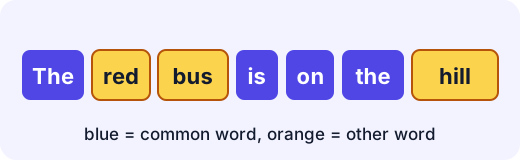
Answer with a number
5.Match each sentence to the word that fits the gap.
- The dog ___ big.
- I ___ a bird fly.
- She ___ hello.
Match each to: said · saw · was
6.Why is it a good idea to know common words by sight?
- They are in almost every sentence, so reading them quickly keeps you moving
- They are the longest words
- They can never be sounded out
Choose one
7.Put the words in order to make a sentence.
- cat
- was
- big
- The
Put these in order
Answering and checking are for registered learners. Register to do this.
Quick check
New puzzles
Use what you know about common words on sentences you have not seen before.
1.Here is a new sentence: "We are at the park." Which words are common words you can know by sight?
- We
- are
- at
- the
- park
Choose all that apply
2.Which sentence is right?
- A bag of rice.
- A bag off rice.
- A bag if rice.
Choose one
3.How many times does the word "the" come in this sentence? "The cat sat on the mat by the door."
Answer with a number
4.Which of these words would you sound out, letter by letter, rather than know by heart?
- said
- sit
- you
- was
Choose one
Answering and checking are for registered learners. Register to do this.
Activity
Tell it back
Your child teaches you a tricky word and says why some words are worth knowing by sight. Three minutes.
Steps
- Write the word said on paper. Say 'Pretend I am just learning to read. Can you teach me this word?'
- Listen to how your child explains it. Ask 'Which part is the surprise?' and 'Why can't I just sound it out?'
- Ask 'Why do we learn some words by heart?' Write down what your child says, in their words.
Keeping a log of the activity is for registered learners. Register to do this.
Like what you see?
Register for free to answer the quick checks, do the activities and save your work. Your work is saved on your device and syncs to your account.