Unit 7
Reading aloud smoothly
Read a short story out loud with the right words, a steady pace and a voice that shows what it means.
Read
Reading that flows
Grown-up: listen first, then read the passage together. Sounds are in slashes, like /k/.
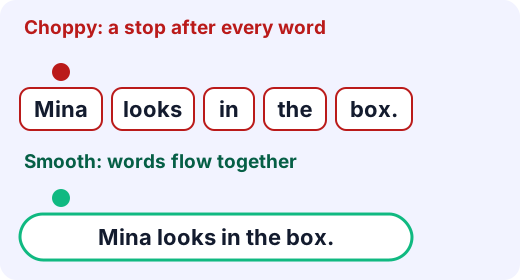
Dev reads a line to his grandmother. He reads it like a robot: "Mi. na. looks. in. the. box." Every word is right, but Grandmother has to listen hard to work out what it means.
Then Dev tries again. "Mina looks in the box." The words roll along like a ball down a hill. Now Grandmother smiles. She understood it right away.
Both times Dev read the same words. The second time he read smoothly.
Three parts of smooth reading
Reading aloud smoothly is called fluency. It has three parts.
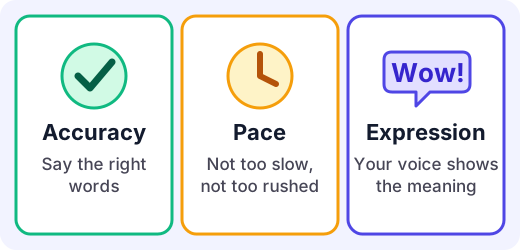
- Accuracy. You say the words that are really on the page. You sound out new words and you know the common ones.
- Pace. Not too slow, not too fast. A good pace sounds like talking.
- Expression. Your voice shows what the words mean: calm, excited, or asking.
Fast is not the same as fluent. If you rush and skip words, you lose the first part, and the sentence stops making sense. Get the words right first. The speed comes later, with practice.
Your voice follows the marks
The little marks in a sentence tell your voice what to do.
Mark What your voice does Example . full stop Falls a little, and you take a short breath The hen sits in the sun. , comma A tiny pause Mina looks in the box, then in the bed. ? question mark Goes up at the end Where is my hen? ! exclamation mark Stronger and more excited Look! Example. Read these two lines aloud. They have the same words, but the marks change how they sound.
- "The hen is in the hut." (calm: you tell a fact)
- "The hen is in the hut!" (surprised: you found her!)
Read in phrases
Good readers do not read one word at a time. Their eyes take in a small group of words, a phrase, and their voice says it in one smooth piece.
The hen sits | in the sun.
Mina looks | in the box.
A line (|) is where you could take a tiny breath. You do not stop at every word, only where the meaning stops.
Try a passage
Read this aloud. First slowly, to get every word right. Then again, smoother. Then once more, with your voice showing the feelings.
Mina has a red hen. The hen sits in the sun. One day the hen is not there. Mina looks in the box. She looks in the bed. "Where is my hen?" she asks. Then Mina hears a sound. Peep! Peep! The hen is in the hut. Look! She has six little chicks.
That is 53 words. Where does your voice go up? Where is it excited? (Look at the marks.)
Try it: Ask a grown-up to time you for one minute. How many words can you read, with all the words right? Do not race. Then try again tomorrow. You will almost always read a little more smoothly the second time.
Why practise the same text again?
Reading it again is not boring, it is the way. The first time, you work out the words. The second time, you know them, so your voice can start to sound natural. The third time, you can think about what is happening and show it with your voice. Each time, reading gets easier.
Why does it matter?
If your mind is busy working out every word, it has no room left to think about what the story means. When the words come easily, your mind is free to enjoy the story. That is the point of fluency.
A common mix-up
"The fastest reader is the best reader." Not so! A reader who rushes and skips words reads less well than one who reads at a steady pace and gets every word right. Aim for right words, steady pace, voice that fits.
For the grown-up helping
Listen to your child read short, easy passages two or three times in a row. Praise what you hear: "You read every word," "I loved your excited voice at the end." If they get stuck on a word, wait a few seconds, then say "Sound it out," not the word. Do not tell them to hurry. Model a good reading yourself first, with your finger under the words, so they know what smooth sounds like. Short and cheerful works best: five minutes a day is better than a long session.
Lab
Voice and pauses
Read each sentence, then pick how your voice should sound. After that, tap the places where you would stop for a breath. A grown-up can read the words with you.
Your goals
- Choose the right voice (falls, rises or strong) for six sentences.
- Tap the right places to pause in three lines.
The interactive lab opens once you register. Register to do this.
Activity
Read it three times
Your child reads one short passage aloud three times, a little better each time, and you record the third reading. About 15 minutes.
You'll need
- The passage below, written or printed large
- A pencil and paper to count mistakes
- A phone or tablet to record the third reading (optional)
- A clock or timer
Steps
- The passage (41 words): Raju has a bag. It is big and green. He runs to the bus stop. The bus is not there! Raju sits and waits. Then he hears a horn. Honk! Honk! The bus is here. Raju jumps up and gets on.
- Read the passage aloud to your child first, with your finger under the words. Pause at the full stops and make your voice strong and excited for the ! marks.
- Reading 1: your child reads it slowly, pointing to each word. Do not hurry them. Make a small tick for each word they needed help with, and tell them the word if they are stuck for more than five seconds.
- Practise the words that got ticks. Ask your child to sound them out or find them in the passage.
- Reading 2: read it again. Ask for a steady pace, like talking. Say 'Take a breath at the full stops.'
- Reading 3: read it a third time with expression. Ask 'Where is Raju worried? Where is he happy?' Record this reading if you can.
- Count: with a timer, how many seconds did Reading 3 take? Write down the times for all three readings and see if they get quicker and smoother.
Safety
- Stay close and keep it cheerful. If your child is tired or upset, stop and try again tomorrow.
Keeping a log of the activity is for registered learners. Register to do this.
Quick check
Reading aloud smoothly check
Seven questions. Read each sentence in your head or aloud first.
1.Which three things make reading aloud smooth?
- Saying the right words
- A steady pace, not too slow and not too rushed
- A voice that shows the meaning
- Reading as loudly as you can
- Reading as fast as you can
Choose all that apply
2.How should your voice sound when you read this sentence?

- Flat and sleepy
- Strong and excited
- Going up, like a question
Choose one
3.What does your voice do at the end of this sentence?

- Goes up
- Falls and stops
- Gets very loud
Choose one
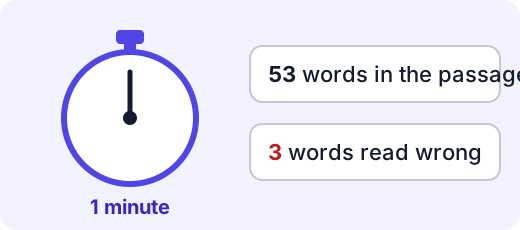
4.The child reads the passage in one minute. How many words did the child read correctly?
Answer with a number
5.Match each sentence to what your voice does.
- Pip sat down.
- Is Pip sad?
- Pip, stop!
Match each to: Falls and you take a breath · Strong and excited · Goes up at the end
6.Zed reads very fast, but he skips two words in every line. What is the best advice?
- Go even faster, then it will sound smooth
- Slow down a little so every word is right, then practise again
- Stop reading aloud
Choose one
7.Why is it useful to read smoothly?
- So you can win a race
- Your mind is free to think about what the words mean
- So other people can hear you in the next room
Choose one
Answering and checking are for registered learners. Register to do this.
Quick check
New puzzles
Use what you know about smooth reading in new places.
1.Zoya reads "The bus is here!" in a flat, sleepy voice. What could she do to read it better?
- Say it with a stronger, excited voice
- Say it much more slowly
- Whisper it
Choose one
2.Asha reads 50 words in a minute but makes 12 mistakes. Beena reads 30 words and makes none. What is good advice for Asha?
- Read even faster
- Slow down a little so every word is right, then read it again
- She is perfect, change nothing
Choose one
3.Put these in the best order for practising a passage.
- Read a third time with your voice showing the feelings
- Read again, smoother, at a steady pace
- Read slowly and get every word right
Put these in order
4.Which of these sentences end with your voice going up?
- Is it raining?
- It is raining.
- Why is the sky dark?
- The sky is dark!
Choose all that apply
Answering and checking are for registered learners. Register to do this.
Activity
Tell it back
Your child explains what makes reading smooth and why it is worth practising. Three minutes.
Steps
- Read one line two ways: first like a robot, one word at a time, then smoothly. Ask 'Which one was easier to understand? What was different?'
- Ask 'What three things should a good reader do?' Give a hint if needed: right words, steady pace, voice that fits.
- Ask 'Why is it good to read smoothly?' Write down what your child says, in their words.
Keeping a log of the activity is for registered learners. Register to do this.
Like what you see?
Register for free to answer the quick checks, do the activities and save your work. Your work is saved on your device and syncs to your account.