Unit 3
Talking with others
Tell a short story about yourself, then take turns asking and answering questions.
Read
Listen first, then talk
Grown-up: read this aloud together, and try the "Try it" boxes as you go.
Imran and Sara were sitting together at lunch. Imran was so excited to tell Sara about his weekend that he started talking before she had finished her sentence.
"I went to the river and I saw..."
"But I was saying..." said Sara.
"...a big bird!" said Imran, still talking.
Sara looked down at her lunch box. She did not want to talk any more.
What went wrong? Imran had lots to say. But he did not listen. And a conversation needs both.
A conversation has turns
A conversation is when two or more people talk and listen to each other. It is a bit like passing a ball. One person has the ball, which means they talk. The others wait. Then they pass it on.
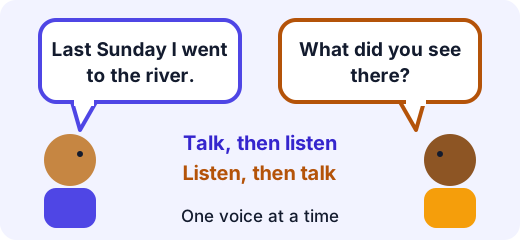
Here is how to be a good partner in a conversation.
- Look at the person who is talking, or turn towards them.
- Listen to every word. Keep your mouth quiet and your ears open.
- Wait until they have finished. Then it is your turn.
- Say something that goes with what they said.
Try it: Play "the talking stone". Pick up a stone. Only the person holding it may talk. Tell your partner what you had for breakfast. Then pass the stone. What did they have?
Asking and answering
Good conversations have questions and answers. A question is a way to find out something. When someone tells you something, you can ask a question to learn more.
Some question words are very useful.
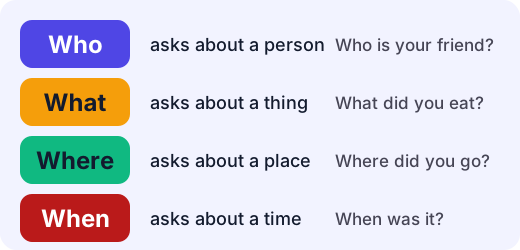
Example. Priya says, "We went to my aunt's house."
- A good question: "Where does your aunt live?" It matches what Priya said.
- Not a good question: "I like cricket." That is not a question, and it does not match.
When someone asks you a question, give an answer that fits. If someone asks "Where did you go?" the answer is a place: "To the market." If you say "Tuesday", you have answered a different question.
Telling a short story about yourself
You can tell a story about something that happened to you. Remember the three parts from stories: beginning, middle, end. Use first, then and last.
Last Sunday I went to the river with my uncle. I saw a heron catch a fish. Then we went home for lunch.
Look: it says who, where, what happened, and it goes in order. That is a good story about yourself. Speak clearly, loud enough to be heard, and not too fast.
A common mix-up
"If I do not talk straight away, I will forget." Many people worry about this. It is fine to wait. A good idea does not melt away. If you really are afraid you will forget, hold up one finger to say "I have something to say next", and keep waiting.
For the grown-up helping
Model good talking yourself: look at your child, wait until they finish (even if it takes a while), and ask a follow-up question that shows you listened ("What did the heron look like?"). Children of this age often interrupt, or answer a question with something unrelated. That is normal and shrinks with practice; gently say "Wait for me to finish", then give them the turn right after. Shy children should never be forced: start with talking to a toy or to you alone.
Activity
The talking stone
Your child tells a short story about themselves, then you take turns asking and answering questions with a talking stone. About 15 minutes.
You'll need
- A smooth stone, a soft toy or a spoon (the talking object)
- A second family member or a toy as audience, if you like
Steps
- Sit facing each other. Show the talking object. Say "Only the person holding it talks. The other person listens and waits."
- Your child holds it first and tells a short story about themselves, such as a trip, a game or a funny moment. Remind them to use first, then and last. You listen with your eyes on them and say nothing until they pass the object back.
- Take the object. Ask one question about their story that uses a question word, such as "Where were you?" or "What did you do then?" Pass the object back. Your child answers.
- Swap roles. Now you tell a very short story and your child asks you a question. Help if needed with "Who...? What...? Where...?"
- Do three rounds of ask and answer. Notice whether your child waits for the object before talking. If they forget, smile and say "Stone, please", with no scolding.
- Finish by asking "What is the most important thing to do when someone else is talking?"
Safety
- Use a stone that is smooth and too big to be put in a mouth, or use a soft toy.
Keeping a log of the activity is for registered learners. Register to do this.
Quick check
Talking and listening check
Six questions about talking with other people. A grown-up can read them aloud.
1.Kabir is telling a story. Priya wants to say something. What should Priya do?
- Wait until Kabir has finished, then talk
- Talk right away so she does not forget
- Walk away
Choose one
2.Which of these are questions? Pick all that are.
- What did you do today?
- I like mangoes.
- Where is your bag?
- It is blue.
Choose all that apply
3.Someone asks, "What is your favourite game?" Which answer fits?
- Kabaddi is my favourite game.
- I am six.
- Yes.
Choose one
4.Put the sentences of this short story about me in the right order.
- Then we went home for lunch.
- Last Sunday I went to the river.
- I saw a heron catch a fish.
Put these in order
5.Match each question word to what it asks about.
- Who
- Where
- When
Match each to: A place · A time · A person
6.When a friend is talking, where should your eyes go?
- To your friend
- To the floor
- To a toy
Choose one
Answering and checking are for registered learners. Register to do this.
Quick check
New puzzles
Real talking gets tricky. Can you use what you know?
1.Three friends all want to tell about their weekend at once. What works best?
- All three talk at the same time
- One talks while the others listen, then the next person has a turn
- The loudest person talks and the others stay quiet
Choose one
2.Neha says, "I got a puppy!" Which is the best thing to say next?
- What is its name?
- I like cats.
- My bag is red.
Choose one
3.Neha asks Om, "Where did you go?" Om says, "Tuesday." Did Om answer the question Neha asked?
- Yes
- No. Tuesday is a time, but she asked about a place
Choose one
4.Which of these show good listening? Pick all that do.
- Look at the person who is talking
- Wait until they finish
- Talk over them to say your idea first
- Look away and play with something
Choose all that apply
5.Your friend says, "My cousin is coming to visit." You want to know the day. Which question do you ask?
- When is she coming?
- Who is she?
- Where is the station?
Choose one
Answering and checking are for registered learners. Register to do this.
Activity
Tell it back
Your child explains, in their own words, how a good conversation works. Two or three minutes.
Steps
- Ask "Imagine two friends who both talk at the same time. What happens? How could they fix it?"
- Then ask "What do you do when someone is talking to you? What do you do when it is your turn?"
- Write down what your child says, in their words. Do not correct; ask "What else?" instead.
Keeping a log of the activity is for registered learners. Register to do this.
Like what you see?
Register for free to answer the quick checks, do the activities and save your work. Your work is saved on your device and syncs to your account.