Unit 8
Understanding what you read
Ask who, what, where and why, and use clues to work out how a character feels.
Read
Reading is understanding
Grown-up: read the story with your child, then ask the questions. Let them look back at the page to find the answers.
Imagine reading this: "Zorp blinked the glub." You can say every word. But what does it mean? Nothing! You said the words, but you did not understand.
Real reading is more than saying words. Reading is understanding. When you read, a picture should appear in your mind, like a little film.
Here is a story. Read it, and watch the film in your head.
Asha and the Rain
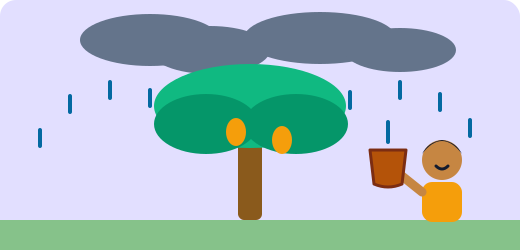
It was a hot day in the village. Asha was on her way to the well with a big pot. Dark clouds came over the hills. Then drip, drip, drop! The rain began.
Asha ran under the old mango tree. She held her pot out in the rain. It filled up fast. Her little brother Kabir came running with a smile. "The rain is here!" he said. Asha laughed, and they danced under the tree.
When the rain stopped, Asha did not need to walk to the well. She carried the full pot home. Her mother was glad.
Four helpful questions
Good readers ask questions as they read. Four of the best start with who, what, where and why.
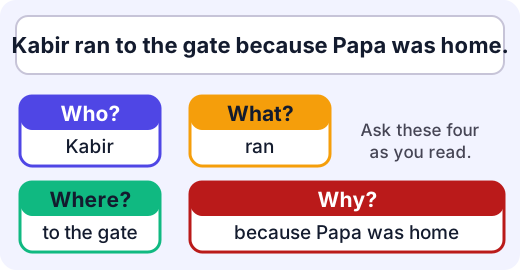
Question Asks about Asha's story Who? a person or animal Asha (and her brother Kabir) What? what happened The rain came and filled her pot Where? the place Under the old mango tree Why? the reason The pot filled with rain, so she did not need to walk to the well Example. Why did Asha not need to walk to the well?
- Look back at the story. Find the part about the pot.
- "She held her pot out in the rain. It filled up fast."
- So the rain filled the pot. That is the reason.
Notice that you found the answer in the words. Always go back to the page and point to the sentence that tells you. That is your evidence.
How did the character feel?
Stories are about people (or animals), and people have feelings. The story does not always say "Asha felt happy". Sometimes it gives you clues, and you work out the feeling.
- "Asha laughed, and they danced." Laughing and dancing are clues. She feels happy.
- "Her mother was glad." The story tells us this one straight out.
Here is a short story where you have to look for clues.
Tara drew a picture of a cow. Ben looked at it and said, "That is a funny dog!" Tara's face went red. She put her head down and did not say a word.
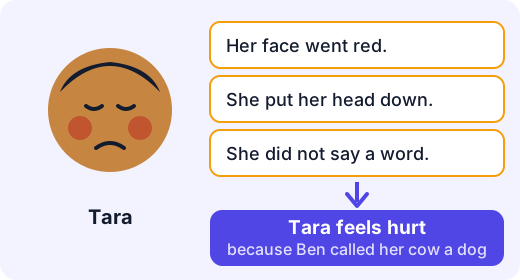
How does Tara feel? Look at the clues: her face went red, her head went down, and she said nothing. Tara feels hurt (or sad). And why? Because Ben said her cow was a funny dog.
Try it: Think of a time you felt happy or hurt. What did your face and body do? Those are the same kinds of clues a writer uses.
Check yourself
Good readers stop now and then and ask: "Do I know what is happening?" If not, they go back and read again, slowly, and ask who, what, where and why.
A common mix-up
"I read all the words, so I understood it." Not always! You can say every word and still miss the meaning. The test is: can you tell someone what happened? If you can say who it was about, what happened, where, and why, you understood.
For the grown-up helping
Ask the questions after reading, in a friendly way, and always say "Show me where it says that." If your child answers wrongly, do not say "no". Say "Let's look again." For feelings, ask "What did she do? What does that tell us?" Most learners need to hear the same story more than once. Reading aloud together, then letting your child read it alone, works well. Ask "why" questions often; they are the hardest and the most valuable.
Lab
Story detective
Read the story. Answer each question, then tap the sentence in the story that proves your answer. A grown-up can read it with you.
Your goals
- Answer who, where, what, why and feeling questions about two short stories.
- Find the sentence in the story that proves each answer.
The interactive lab opens once you register. Register to do this.
Activity
Ask me about the story
Your child reads a short story and answers who, what, where and why questions, and says how a character felt. About 15 minutes.
You'll need
- The story below, written or printed in large letters
- Paper and a pencil
Steps
- Write out this story: Grandpa grew a pumpkin. It grew and grew until it was too big to lift. Grandpa and his granddaughter Meera pushed it. It did not move. Then the neighbours came to help. Everyone pushed together, and the pumpkin rolled out of the garden. Grandpa gave everyone a slice. They all smiled.
- Your child reads the story aloud, slowly. Help with any word they cannot sound out, then read it a second time together.
- Ask: Who is the story about? What was the problem? Where was the pumpkin? Why did Grandpa need help?
- After each answer say 'Show me where it says that.' Your child points to the sentence that proves it.
- Ask about feelings: How did Grandpa and Meera feel when the pumpkin would not move? How did everyone feel at the end? What is the clue?
- Now swap. Your child makes up one question about the story and asks you. Answer it, and point to the words that tell you.
- Draw a quick picture of the part your child liked best, and write one sentence about it.
Safety
- Keep the pencil away from small siblings. Ask a question, wait, and do not rush the answer.
Keeping a log of the activity is for registered learners. Register to do this.
Quick check
Understanding what you read check
Seven questions. Look carefully at the pictures and the words.
1.Asha holds her pot out in the rain. Why does she do it?
- So the rain will fill it with water
- To hide from the rain
- To wash the tree
Choose one
2.Which question word asks about a person or an animal?
- Who
- Where
- Why
Choose one
3.Match each question word to what it asks about.
- Where
- Why
- What
Match each to: A reason · What happened · A place
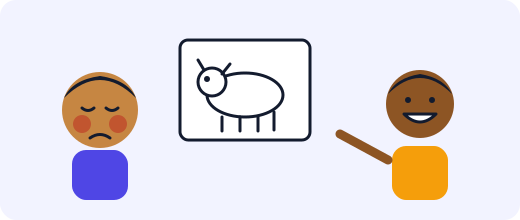
4.Look at Tara in the picture. How does she feel?
- Proud
- Hurt
- Sleepy
Choose one
5.Why does Tara feel that way?
- The boy laughed at her drawing
- She lost her pencil
- It started to rain
Choose one
6.Sam stamped his foot and shouted, "No!" Which word fits how Sam feels?
- Happy
- Angry
- Sleepy
Choose one
7.Ria reads every word of a story perfectly, but cannot say what it was about. What should she do?
- Read it even faster
- Read it again slowly and ask who, what, where and why
- Nothing, she understood it
Choose one
Answering and checking are for registered learners. Register to do this.
Quick check
New puzzles
Read this little story, then answer. Nita's grandmother gave her a warm shawl. It was cold outside, and Nita's nose was red. She pulled the shawl around her shoulders and smiled.
1.Why did Nita pull the shawl around her shoulders?
- It was cold outside
- It was a hot day
- She wanted to dance
Choose one
2.Who gave Nita the shawl?
Answer with a word or phrase
3.How did Nita feel at the end of the story? Pick the answer that uses a clue from the story.
- Warm and happy, because she smiled
- Angry, because her nose was red
- Scared, because it was cold
Choose one
4.What colour was the shawl?
- Red
- Blue
- The story does not say
Choose one
5.Sana ran to the gate, jumped up and down and shouted, "Papa is home!" How does Sana feel?
- Excited and happy
- Sad
- Bored
Choose one
Answering and checking are for registered learners. Register to do this.
Activity
Tell it back
Your child explains how they know what a character felt, and what it means to understand what you read. Three minutes.
Steps
- Read this together: 'Sam stamped his foot and said No. His face was red.' Ask 'How does Sam feel? How do you know?'
- Ask 'What are the four question words we use to check a story?' (who, what, where, why.) Help with a hint if needed.
- Ask 'If you can say every word but cannot tell me what happened, did you understand?' Write down what your child says, in their words.
Keeping a log of the activity is for registered learners. Register to do this.
Like what you see?
Register for free to answer the quick checks, do the activities and save your work. Your work is saved on your device and syncs to your account.