Unit 9
Naming and doing words
Find nouns, verbs and adjectives, and use capital letters, full stops, question marks and commas so your reader knows how to read.
Read
Words have jobs, marks have jobs
Look at these two sentences. They have the same words.
Let's eat Grandma.
Let's eat, Grandma.
In the first one, Grandma is on the menu! In the second, someone is calling Grandma to come and eat. One tiny mark, the comma, changed everything. Words and marks have jobs. When you know the jobs, your writing says exactly what you mean.
Three kinds of words
Every word in a sentence does a job. Here are three important jobs.
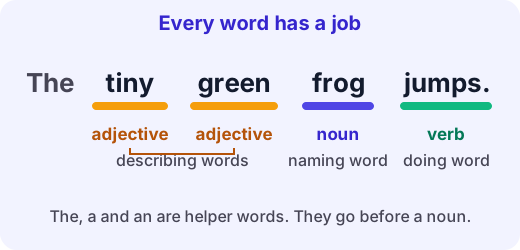
A noun is a naming word. It names a person, a place, an animal or a thing: teacher, Delhi, frog, kite, river.
A verb is a doing word. It tells what someone or something does: jump, sing, cook, sleep, read. Some verbs tell what something is: is, are, was.
An adjective is a describing word. It tells more about a noun: tiny, green, loud, sticky, cold.
Example. In "Priya baked sweet bread":
- Priya names a person: noun.
- baked tells what she did: verb.
- sweet describes the bread: adjective.
- bread names a thing: noun.
A trick: to find the verb, ask "What is happening?" To find a noun, ask "Who or what?" To find an adjective, ask "What is it like?"
Four marks that help the reader
Capital letters. Use a capital letter for the first word of a sentence, for the names of people and places (Asha, Kenya, Chennai), for days and months (Monday, March), and for the word I.
Full stop. A full stop ends a sentence that tells something. Your voice goes down.
Question mark. A question mark ends a sentence that asks something. Your voice goes up.
Comma in a list. Put a comma between the things in a list, to show a small pause. We do not need one before the word and.
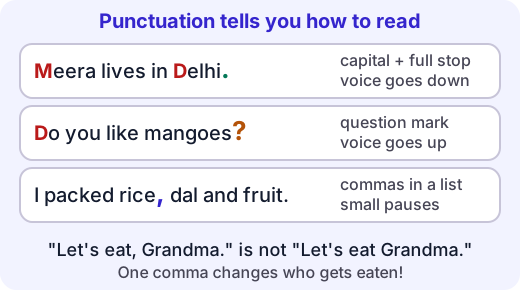
Read these aloud.
Meera packed rice, dal and fruit.
Did Meera pack rice, dal and fruit?
Your voice tells a different story each time. That is what punctuation does: it tells the reader how to read. Without it, a reader has to guess.
Fix a sentence
Here is a sentence with no help for the reader:
on sunday tomas and ling saw a lion a zebra and a giraffe in kenya
Example. Fix it step by step.
- Capital letters: On, Sunday, Tomas, Ling, Kenya.
- Commas in the list of animals: a lion, a zebra and a giraffe.
- It tells us something, so add a full stop at the end.
On Sunday Tomas and Ling saw a lion, a zebra and a giraffe in Kenya.
Be careful!
- Not every noun gets a capital. Only names do. dog is lower-case; Bruno the dog gets a capital.
- Some verbs do not look like action. Sleep, sit and is are verbs too.
- A comma is not a full stop. A comma is a small pause. A full stop ends the sentence.
- No comma is needed before and in a list: write rice, dal and fruit, not rice, dal, and fruit (at this level), and never put a comma after the last item.
- A question needs a question mark, even a short one: Are you ready?
Try it: Find the noun, verb and adjective in "The loud drum shakes." Then punctuate: "can you see the red blue and yellow kites". (Noun: drum. Verb: shakes. Adjective: loud. "Can you see the red, blue and yellow kites?")
For the grown-up helping
At this age, grammar is best learned by playing with sentences rather than memorising definitions. When your child writes, ask them to read a sentence aloud and listen for where their voice stops, rises or pauses. Praise the marks they remembered before pointing to the ones they forgot. Talk about "naming", "doing" and "describing" jobs, so the terms noun, verb and adjective feel natural.
Lab
The sentence doctor
First label the nouns, verbs and adjectives in three sentences. Then be the sentence doctor and fix five sentences that have no capital letters or punctuation.
Your goals
- Label every noun, verb and adjective in three sentences.
- Add the capital letters, commas, full stops and question marks to five sentences.
The interactive lab opens once you register. Register to do this.
Activity
Word hunt and sentence building
Your child hunts for nouns, acts out verbs, collects describing words, and writes sentences with the right marks. About 30 minutes.
You'll need
- Paper and a pencil
- Three coloured pencils or crayons (optional)
Steps
- Walk around one room or the garden. Your child writes down five nouns they can see (names of things, people, animals or places).
- Now act out verbs. Say 'show me a doing word' and your child mimes it (hop, stir, yawn, pull) while you guess. Your child writes down five verbs.
- For three of the nouns, your child writes two describing words each (for example: rough, brown, old for a tree). These are adjectives.
- Your child writes three sentences, each using at least one noun, one verb and one adjective from the lists. One sentence should ask a question.
- Together, check each sentence for a capital letter at the start, capitals on any names, and the right ending mark.
- Write one more sentence that lists three things, such as what is in a school bag. Your child puts commas in the right place.
Safety
- Choose a clear space for acting out verbs. No jumping on furniture.
- Stay in sight of a grown-up if you go into the garden.
Keeping a log of the activity is for registered learners. Register to do this.
Quick check
Naming and doing words check
Seven questions about word jobs and punctuation.
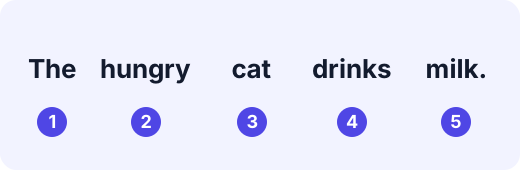
1.Which numbered word is the verb (the doing word)?
- 2 (hungry)
- 3 (cat)
- 4 (drinks)
- 5 (milk)
Choose one
2.Which numbered word is the adjective (the describing word)?
- 2 (hungry)
- 3 (cat)
- 4 (drinks)
- 5 (milk)
Choose one
3.Pick both nouns (naming words) in the sentence.
- hungry
- cat
- drinks
- milk
Choose all that apply
4.Which sentence is written correctly?
- we saw a lion in kenya.
- We saw a lion in Kenya.
- we saw a Lion in Kenya
Choose one
5.Which sentence has the commas in the right places?
- We bought, apples, pears and plums.
- We bought apples, pears and plums.
- We bought apples pears and plums.
Choose one
6.Which mark goes at the end of this sentence? Where do you keep the paints
- A full stop ( . )
- A question mark ( ? )
- A comma ( , )
Choose one
7.Match each word to its job.
- teacher
- jump
- sticky
Match each to: verb · noun · adjective
Answering and checking are for registered learners. Register to do this.
Quick check
New puzzles
New sentences to read, mend and think about.
1.In the sentence 'Rain drums on the tin roof.' which word is the verb?
- Rain
- drums
- tin
- roof
Choose one
2.Which sentence needs a question mark at the end?
- Please close the door
- Who left the door open
- The door is open
Choose one
3.Which words need a capital letter? on friday, ravi and his sister visit chennai.
- on
- friday
- ravi
- sister
- visit
- chennai
Choose all that apply
4.Which sentence calls a boy named Leo to come and eat?
- Come and eat, Leo.
- Come and eat Leo.
Choose one
Answering and checking are for registered learners. Register to do this.
Activity
Tell it back
Your child explains, in their own words, why punctuation matters and what nouns, verbs and adjectives do. Three minutes.
Steps
- Write 'Let's eat, Grandma.' and 'Let's eat Grandma.' (or 'Come and eat, Leo.' and 'Come and eat Leo.') on paper. Ask 'What is different? What does the mark do?'
- Ask 'If a book had no full stops, question marks or commas, what would be hard for the reader?'
- Ask your child to say what a noun, a verb and an adjective do, and to give an example of each from the room.
- Write down what your child says, in their words.
Keeping a log of the activity is for registered learners. Register to do this.
Like what you see?
Register for free to answer the quick checks, do the activities and save your work. Your work is saved on your device and syncs to your account.