Unit 6
Comparing two versions of a story
Read two tellings of a tale about a mouse who frees a trapped creature, and say what is the same and what is different.
Read
One idea, two tellings
Long ago, people told stories out loud, again and again. A grandmother told a tale to her grandchildren, who told it to their friends, who told it to their own children. Each time, the tale changed a little. Many countries ended up with tales that are alike in some ways and not in others.
Here are two versions of tales about a mouse. The first is from Greece, told by the storyteller Aesop. The second is from India, in the Panchatantra. These are short retellings in our own words.
Version 1: The Lion and the Mouse
A lion lay asleep in a forest. A little mouse ran across his nose and woke him. The lion caught her under his paw. "Please let me go," squeaked the mouse. "One day I may help you." The lion laughed at the idea of such a tiny helper, but he let her go.
Some days later, hunters set a net in the forest and the lion walked into it. He roared and roared but could not get out. The mouse heard him. She ran to the net and gnawed the ropes with her sharp little teeth until the lion was free.
"I laughed at you," said the lion, "but now I know that even a small friend can be a great help."
Version 2: The Pigeons and the Mouse
A flock of pigeons, led by their king Chitragriva, saw rice grains scattered under a tree in a forest. They flew down to eat, and a hunter's net closed over them all. Each pigeon pulled a different way, and the net did not move.
"Stop!" said the king. "If we pull apart, we are lost. If we pull together, we can lift the net." On his word, all the pigeons flapped at once and rose into the sky, carrying the net with them. They flew to the hole of Hiranyaka the mouse, an old friend of the king.
Hiranyaka gnawed through the ropes. The king asked him to free the others first, so the mouse freed every pigeon, and then the king. They all thanked their friend and flew home.
Same and different
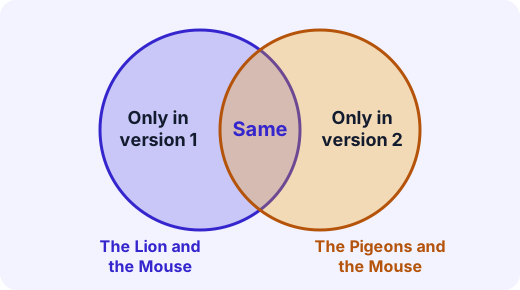
When you compare two versions, you ask two questions: What is the same? What is different?
Version 1: lion Version 2: pigeons Trapped by A hunter's net A hunter's net Who is trapped? One lion A whole flock Who frees them? A mouse, by gnawing the ropes A mouse, by gnawing the ropes Why does the mouse help? The lion once let her go He is the king's old friend What helps them most? A small friend Pulling together, then a friend The same: a hunter's net, a trapped creature and a mouse who gnaws through the ropes.
Different: who is trapped, why the mouse helps, and how the story ends.
The moral
A moral is the lesson of a story. Both tales say, in their own way, that friends help each other, and a small helper can matter a great deal. The lion tale adds: do not laugh at someone small. The pigeon tale adds: working together makes us strong.
So the same idea can be told in different ways, with different animals, places and events.
Be careful!
- Different does not mean wrong. Neither version is the "real" one. Both are good tellings.
- Changing the names is not changing the story. Look at what happens and what the tale teaches.
- Same does not mean copied. Two groups of people can come up with a similar idea.
- Check both before you decide. Do not guess what is in the second version from the first.
Try it: Think of a tale you know that is told in two ways, such as the Hare and the Tortoise. What is the same in both? What is different? (A hint: in many tellings, the slow, steady one wins; how the fast one loses time can change.)
For the grown-up helping
Read or tell both versions aloud, with a pause between them. Then ask "What is the same? What is different?" and let your child answer. If you know a version told in your own language or family, tell that one too; there is no single right version. It is fine if your child names small details; those count as differences too.
Lab
The same-and-different sorter
Read the two versions of the tale about the mouse. Then sort nine cards into only version 1, both versions, or only version 2.
Your goals
- Sort all nine cards correctly.
- Say what is the same in both versions and what is different.
The interactive lab opens once you register. Register to do this.
Activity
Two tellings of one tale
Your child hears a tale told two ways and fills in a two-circle diagram of what is the same and different. About 25 minutes.
You'll need
- Two versions of one tale. Good choices are the Hare and the Tortoise, or a tale you tell at home and the same tale in a book
- A large sheet of paper
- A pencil and a cup or bowl to trace circles
Steps
- Tell or read the first version aloud. Then tell or read the second one. If you only have one version in a book, ask a grandparent, a neighbour or a teacher to tell their version.
- Trace two overlapping circles on the paper. Write the name of version 1 under the left circle and version 2 under the right one.
- Ask 'What is the same in both?' and write each answer in the overlap. Ask 'What happens only in the first one?' and 'only in the second one?' and write those in the outer parts.
- Ask 'What lesson, or moral, does each one teach? Is it the same?'
- Let your child pick which version they like better and say why.
Safety
- Use pencils and crayons only, with no scissors needed.
Keeping a log of the activity is for registered learners. Register to do this.
Quick check
Two versions check
Seven questions about The Lion and the Mouse and The Pigeons and the Mouse.
1.What happens in both versions?
- A mouse frees the trapped ones by gnawing the ropes.
- The trapped ones fly away with the net.
- The trapped one laughs at the mouse.
Choose one
2.Look at the diagram. Which card belongs in the middle, where the circles overlap?
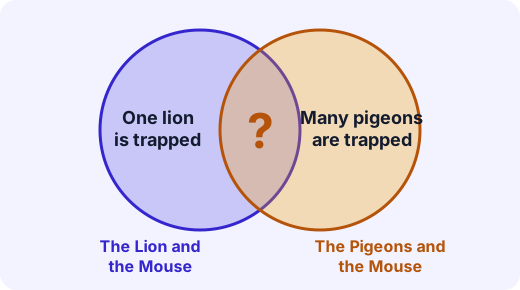
- A mouse gnaws through the ropes.
- The trapped one laughs at the mouse.
- The trapped ones carry the net away.
Choose one
3.In the first version, who is caught in the hunter's net?
- A lion
- A flock of pigeons
- The mouse
Choose one
4.In the second version, what does the pigeon king teach his flock?
- Pulling together works better than pulling apart.
- Each pigeon should escape on its own.
- Never eat rice grains.
Choose one
5.Which of these are the same in both versions? Choose all that apply.
- A hunter's net
- A mouse who helps
- The trapped one is a lion
- A whole flock is trapped
Choose all that apply
6.Put the events of The Lion and the Mouse in order.
- Hunters set a net and the lion is caught
- The mouse gnaws the ropes
- The lion learns that a small friend can help
- The lion catches the mouse and lets her go
Put these in order
7.Which lesson fits both versions?
- Friends help each other, and even a small helper matters.
- Never walk in a forest.
- Always sleep in the shade.
Choose one
Answering and checking are for registered learners. Register to do this.
Quick check
New puzzles
Here are two new tellings of the Hare and the Tortoise. Version 1: A hare laughed at a slow tortoise and challenged her to a race. Halfway, the hare lay down under a tree for a nap. The tortoise kept walking, slow and steady, and crossed the line first. Version 2: In a village, a hare and a tortoise raced to the old mango tree. The hare was so sure he would win that he kept stopping to show off to his friends. The tortoise never stopped, and she touched the tree first.
1.What is the same in both versions?
- The slow, steady tortoise wins because the hare wastes time.
- The race happens in a village.
- The hare wins in the end.
Choose one
2.How does the hare lose time in each version?
- In version 1 he takes a nap; in version 2 he stops to show off.
- In both versions he takes a nap.
- In both versions he stops to show off.
Choose one
3.Which lesson fits both versions?
- Steady effort beats being fast but careless.
- Always run as fast as you can.
- Never race a friend.
Choose one
4.A storyteller wants to tell the Hare and the Tortoise again but still tell the same tale. Which things can change? Choose all that apply.
- Where the race happens
- Small details, such as why the hare stops
- The names of the animals
- The lesson, so that the hare is the hero
Choose all that apply
5.Which two stories could be versions of the same tale?
- A story in India where a small mouse chews through ropes to free a trapped lion, and a story in Greece where a small mouse chews through a net to free a trapped lion.
- A story about a fisherman at sea, and a story about a girl planting a garden.
- A story about a lost key, and a story about a hungry crow who finds the key.
Choose one
Answering and checking are for registered learners. Register to do this.
Activity
Tell it back
Your child explains, in their own words, how two tellings of a tale can be alike and different. Three minutes.
Steps
- Ask your child to tell you the Lion and the Mouse and the Pigeons and the Mouse in one or two sentences each.
- Ask 'What is the same in both stories? What is different?'
- Ask 'Can two stories be different and still teach the same lesson? How?' Write down what your child says in their own words.
Keeping a log of the activity is for registered learners. Register to do this.
Like what you see?
Register for free to answer the quick checks, do the activities and save your work. Your work is saved on your device and syncs to your account.