Unit 5
Reading to find out
Use titles, headings, pictures and captions to find facts fast, and say what a paragraph is mostly about.
Read
How information books help you
Rohan wants to know one thing: what do bees eat?
He has a thick book about insects. Does he have to read every page from the start to find the answer? No! A story is meant to be read from the beginning to the end. An information book is built differently. It is built to help you find things.
The parts of an information page
Here is a page from a book about honey bees.
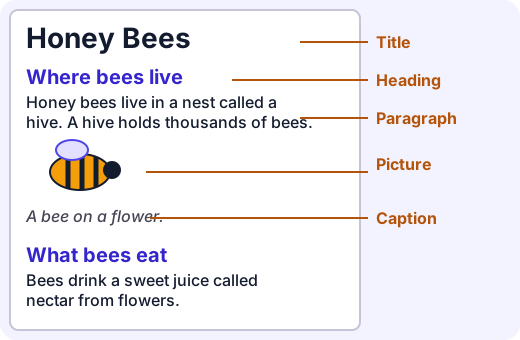
- The title tells you what the whole page is about: Honey Bees.
- A heading tells you what one part is about: Where bees live, What bees eat.
- A paragraph is a group of sentences about one idea. It starts on a new line.
- A picture shows you something. Its caption is the short line under it, saying what it shows.
A fact is something true that you can check. "Bees drink nectar from flowers" is a fact.
Finding the answer fast
Here is the whole page, written out.
Honey Bees
Where bees live. Honey bees live together in a nest called a hive. A hive can hold thousands of bees. Beekeepers keep hives in wooden boxes, but wild bees often build theirs in hollow trees.
What bees eat. Bees drink a sweet juice called nectar from flowers. They also eat pollen, a yellow powder from flowers, which helps them grow.
Making honey. Worker bees carry nectar back to the hive. There, they turn it into honey and store it in small wax cells. Honey is food for the bees when there are few flowers.
Example. Rohan's question: What do bees eat?
- Title: Honey Bees. This is the right page.
- Headings: Where bees live, What bees eat, Making honey. The second one matches his question.
- Read that paragraph only. Bees drink nectar and eat pollen. Found it, and he did not need to read the rest.
What is a paragraph mostly about?
Every paragraph has a main idea: the one thing the paragraph is mostly about. The details are the facts that explain it.
Take the paragraph Making honey. It tells how workers carry nectar, turn it into honey and store it. All those facts are about one idea: how bees make honey. A heading often gives you the main idea in a few words.
Ask yourself: If I had to say what this paragraph is about in just a few words, what would I say?
Finding a page in a big book
A big book has a contents page near the front. It lists the parts of the book and the page where each one starts.
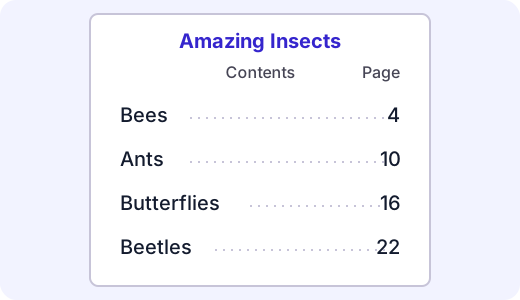
If you want to read about ants, look at the contents: Ants, page 10. Turn to page 10. Many books also have an index at the back, which lists small topics in ABC order with page numbers.
Be careful!
- You do not have to read every page. Use the title, headings and contents to go straight to the part you need.
- A heading is not the answer. It tells you where to look. The facts are in the paragraph under it.
- A main idea is not just the first fact. It is the idea that all the facts in the paragraph are about.
- A picture alone is not enough. Read the caption to know what it shows.
Try it: Using the page above, which heading would you use to find out where wild bees build their hives? (Answer: Where bees live. It says wild bees often build theirs in hollow trees.)
For the grown-up helping
Next time your child has a question ("Why is the sky blue?", "How big is a whale?"), look in a children's information book together. Ask "What does the title say? Which heading might help? Let's read just that part." Do not worry if your child skips parts; skipping to find a fact is exactly what these books are for. Also let them hold the book and turn the pages.
Lab
The fact finder
Use a book page about honey bees. For each question, tap the title, heading, paragraph or caption that helps you answer it.
Your goals
- Answer six questions by tapping the right part of the page.
- Say what the paragraph about making honey is mostly about.
The interactive lab opens once you register. Register to do this.
Activity
Fact hunt in a real book
Your child uses the contents page, headings and captions of a real information book to find three facts. About 20 minutes.
You'll need
- A children's information book (about animals, space, plants or your town) from home, school or a library
- Paper and a pencil
Steps
- Show your child the cover. Ask 'What does the title tell us the book is about?'
- Open the contents page. Ask your child to pick one topic and find its page. Turn to it together.
- On that page, ask your child to point to the title or main heading, a smaller heading, one paragraph and a picture with its caption.
- Make up three questions the page can answer. Your child must find each answer by looking at headings first, then reading only the paragraph that matches.
- Your child writes each answer as a short sentence and says which heading helped.
- Ask 'What is this paragraph mostly about?' and write what your child says.
Safety
- Wash hands before handling library books, and keep drinks away from them.
Keeping a log of the activity is for registered learners. Register to do this.
Quick check
Reading to find out check
Seven questions about titles, headings, paragraphs and facts. Look at the pictures carefully.
1.What is the title of this page?
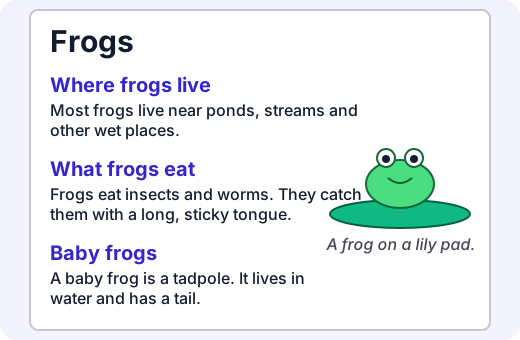
- Frogs
- Baby frogs
- A frog on a lily pad
Choose one
2.How many headings does the page have?
Answer with a number
3.Which heading would you read under to find out what a tadpole is?
- Where frogs live
- What frogs eat
- Baby frogs
Choose one
4.Which of these facts can you find on the Frogs page? Choose all that apply.
- Frogs eat insects and worms.
- A tadpole has a tail.
- Frogs live only in deserts.
- Frogs have wings.
Choose all that apply
5.The paragraph under 'What frogs eat' is mostly about...
- what frogs eat and how they catch it
- where frogs live
- how a tadpole grows
Choose one
6.You want to read about butterflies. On which page does that part of the book start?
Answer with a number
7.What is a caption?
- A short line that tells you what a picture shows
- The name of the person who wrote the book
- The last page of a book
Choose one
Answering and checking are for registered learners. Register to do this.
Quick check
New puzzles
New pages, new questions. Use headings and main ideas to find your way.
1.A book about rain forests has these headings: 'Where rain forests grow', 'Animals of the forest' and 'Why the trees matter'. You want to learn about jaguars and monkeys. Which heading do you read under?
- Where rain forests grow
- Animals of the forest
- Why the trees matter
Choose one
2.Read this paragraph. 'Camels can go many days without drinking. The hump stores fat, not water, and this fat gives the camel energy when food is hard to find. A camel can even close its nostrils to keep out blowing sand.' What is the paragraph mostly about?
- how a camel body helps it live in a dry, sandy place
- how camels race each other
- how baby camels are born
Choose one
3.A page called 'Our School Garden' says: 'The garden has 4 rows of beans, 3 rows of carrots and 2 rows of spinach.' How many rows of vegetables does the garden have in all?
Answer with a number
4.A thick book has 200 pages. You want to know quickly if it has anything about volcanoes. What is the fastest way?
- Read from page 1 until you find it
- Look in the contents or the index for volcanoes
- Look only at the picture on the cover
Choose one
5.Under a photo in an information book is the line: 'A baby elephant drinks with its trunk.' What does the line tell you?
- What the photo shows
- Who the author is
- That the book is finished
Choose one
Answering and checking are for registered learners. Register to do this.
Activity
Tell it back
Your child explains how an information book helps you find things. Three minutes.
Steps
- Hold up an information book. Ask 'You want to find out how big a whale is. Do you have to read the whole book? What would you do?'
- Let your child answer. Ask follow-up questions: 'What does the contents page do? What does a heading tell you?'
- Ask 'How is an information book different from a story book?' Write down what your child says in their own words.
Keeping a log of the activity is for registered learners. Register to do this.
Like what you see?
Register for free to answer the quick checks, do the activities and save your work. Your work is saved on your device and syncs to your account.