Unit 7
Writing a story
Plan and write a story with a beginning, a middle and an end, and use time words so readers know what happened in what order.
Read
Plan it, then tell it in order
Read this "story".
A big yellow sunflower opened. Anil clapped. He watered the pot every morning. He found a packet of seeds.
Did you get lost? The story says the flower opened before Anil found the seeds! The ideas are there, but they are in the wrong order. A reader cannot follow what happened.
When you write a story, you are the one who decides the order. Readers cannot ask you "What came first?" They only have your words. So a story needs to be told in order, and it helps to give clues about the order.
Three parts
Every story you write has three parts.
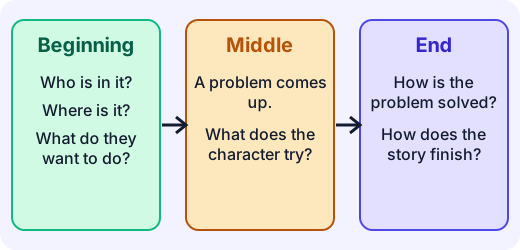
- Beginning: who is in the story, where it happens, and what they want to do.
- Middle: a problem comes up and the characters try to fix it.
- End: the problem is solved, and the story finishes.
Plan these three parts before you write. A plan can be just three short notes.
Time words
Time words tell the reader when something happens. They keep events in order.
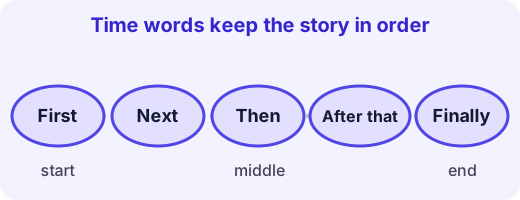
Use first near the start and finally near the end. In the middle, use words such as next, then, after that, later and suddenly. Put a comma after a time word at the start of a sentence: First, he dug a hole.
A model story
Here is the story about Anil again, now in order.
The Sunflower
One sunny Saturday, Anil found a packet of sunflower seeds in the kitchen drawer. First, he dug a small hole in an old pot and pushed one seed in.
Then he watered it every morning. But for a whole week nothing happened, and Anil wanted to give up. Next, Grandmother told him, "Seeds grow slowly. Be patient." After that, he kept watering. A few days later, a green shoot pushed out of the soil.
Finally, the shoot grew into a tall plant, and a big yellow sunflower opened. Anil clapped.
Example. Let us find the three parts.
- Beginning: Anil finds seeds and plants one. (Who, where, what he does.)
- Middle: Nothing happens for a week; he wants to give up, but Grandmother helps him keep going. (A problem and how it is handled.)
- End: The sunflower opens, and Anil is happy.
How to write your own
- Plan. Write three notes: beginning, middle, end.
- Write the beginning. Say who, where and what happens first.
- Write the middle. Show the problem and what the character does. Use time words.
- Write the end. Say how it was solved. Finish with a feeling or a picture.
- Read it aloud. Does it make sense in order? Are there capital letters and full stops?
Be careful!
- Do not write "and then... and then... and then". Use different time words.
- Do not skip the problem. "Anil planted a seed. A flower grew." has an order, but nothing goes wrong, so it is not much of a story.
- Do not end too early. "Then he went home. The end." does not tell us how the problem was solved.
- Comma after the time word. Write First, Meena ran, not First Meena, ran.
Try it: Plan a story about a girl who loses her umbrella. Write three notes: beginning, middle, end. (For example: Beginning: Zoya takes her red umbrella to school on a rainy day. Middle: She leaves it on the bus. Next she asks the driver. End: Finally, the driver returns it the next morning.)
For the grown-up helping
Let your child tell the story out loud before writing it. Ask "What happens first? Then what? How does it end?" while they speak. Plan on paper with three boxes. Do not worry about spelling at first; get the story down in order, then check capital letters and full stops together. Praise the plan as well as the writing.
Lab
The story builder
Joseph's sandcastle story is jumbled. Put the sentences in order with the arrows. Then choose a time word for each sentence.
Your goals
- Put six sentences in the order they happened.
- Start the story with First, end with Finally, and use different time words in the middle.
The interactive lab opens once you register. Register to do this.
Activity
Plan and write your own story
Your child plans a story in three boxes, writes it with time words, and reads it aloud. About 30 minutes.
You'll need
- Paper and a pencil (two sheets)
- Crayons for drawing the plan (optional)
Steps
- Fold one sheet into three boxes and write Beginning, Middle and End above them. Pick a topic together, such as a lost toy, a rainy day, or a visit to the market.
- Your child tells you the story out loud while you point to each box. Ask 'Who is in it? Where? What goes wrong? How is it fixed?' Your child draws or writes a few words in each box.
- On the second sheet, your child writes the story in 5 to 8 sentences. They must use at least three time words, such as first, then, next, after that, later and finally.
- Your child reads the story aloud. Ask 'Does it go in order? Did the problem get solved?' Fix anything that is out of order.
- Check together for capital letters, full stops, and a comma after a time word at the start of a sentence.
Safety
- Use pencils and crayons only. No scissors are needed.
Keeping a log of the activity is for registered learners. Register to do this.
Quick check
Writing a story check
Seven questions about beginnings, middles, ends and time words.
1.These sentences from Hira's story are jumbled. Put them in the order they happened.
- Hira put on her new red shoes.
- A puppy ran up, carrying her shoe.
- Hira laughed and thanked the puppy.
- At the park she could not find one shoe.
- She searched under the bench and by the swings.
Put these in order
2.Which time word fits best at the start of the very last sentence of a story?
- First
- Finally
- Next
Choose one
3.Which is the best beginning for a story?
- One rainy morning in Pune, Hira put on her new red shoes and ran to the park.
- And that is how the story ended.
- Then she went home.
Choose one
4.Look at the plan. Which sentence belongs in the empty Middle box?
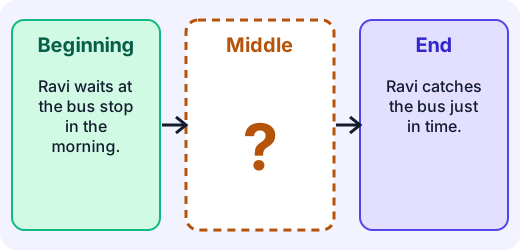
- Ravi remembers he left his lunch at home and runs back to get it.
- Ravi is at the bus stop.
- The end.
Choose one
5.Which of these are time words? Choose all that apply.
- first
- then
- finally
- happy
- pencil
Choose all that apply
6.Why do we use time words like first, next and finally in a story?
- They tell the reader what happened in what order.
- They make the story longer.
- They show how to spell hard words.
Choose one
7.Which sentence is written correctly?
- First, Maya opened the box.
- First Maya, opened the box.
- first, maya opened the box.
Choose one
Answering and checking are for registered learners. Register to do this.
Quick check
New puzzles
New stories to plan, fix and finish.
1.Which version tells the events more clearly?
- Meera ate. She cooked the rice. She washed the rice.
- First, Meera washed the rice. Then she cooked it. Finally, she ate.
Choose one
2.Put these sentences about a storm in order.
- At first, the sky was bright blue.
- Next, big drops of rain began to fall.
- Finally, the rain stopped and a rainbow appeared.
- Then dark clouds rolled in.
Put these in order
3.A story plan says: Beginning: Ravi finds a puppy on his street. End: Ravi and the puppy are best friends. Which sentence is the best Middle?
- Ravi's mother says the puppy must go back. Ravi promises to feed and walk it every day, and she agrees.
- Ravi had a sandwich for lunch.
- That is the end of the story.
Choose one
4.Fill in the blank with a time word or phrase. It is the very last step: '____, she took the golden cake out of the oven.'
Answer with a word or phrase
5.Which one is a whole story, with a beginning, a middle and an end?
- Sana lost her pencil. She looked everywhere. Then her brother found it in his bag. Sana smiled.
- Sana lost her pencil.
- Sana lost her pencil. The end.
Choose one
Answering and checking are for registered learners. Register to do this.
Activity
Tell it back
Your child explains why a story must be told in order and what time words do. Three minutes.
Steps
- Say this jumbled story aloud: 'Finally, the cake was ready. First, Maya cracked the eggs. Then Maya ate the cake. Next, she mixed the flour.' Ask 'What is wrong with this story?'
- Ask your child to tell the events in the right order.
- Ask 'Why do readers need to know what happened in what order? What do words like first and finally do?' Write down what your child says in their own words.
Keeping a log of the activity is for registered learners. Register to do this.
Like what you see?
Register for free to answer the quick checks, do the activities and save your work. Your work is saved on your device and syncs to your account.