Unit 8
Writing to explain
Write a short fact paragraph that opens with a topic sentence, gives facts, and closes, and learn to tell a fact from an opinion.
Read
Facts first
Two children each write about dogs.
Kabir: Dogs are the best pets in the whole world. They are so much fun!
Lina: Dogs are animals that people keep as pets. A dog has four legs and a tail. A baby dog is called a puppy.
Which one would you use to learn about dogs? Lina's. Kabir tells you how he feels. Lina tells you things you can check. When you write to inform, you give your readers facts so they can learn something.
Fact or opinion?
A fact is something true that you can check. You can look it up, count it, measure it or see it.
An opinion is what someone thinks or feels. People can disagree about it. Words like best, worst, yummy, boring, beautiful and scary often show an opinion.
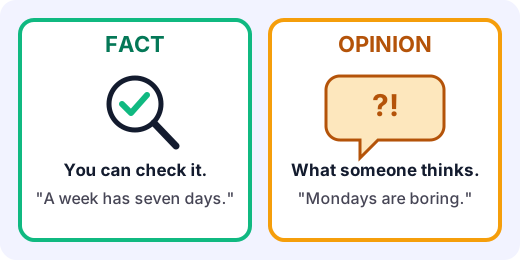
- "A week has seven days." You can count them. Fact.
- "Mondays are boring." Some children love Monday. Opinion.
- "Mangoes grow on trees." You can go and see. Fact.
- "Mangoes taste better than apples." It depends who you ask. Opinion.
Opinions are not bad. We all have them! But a piece of writing that informs keeps them out.
The shape of a fact paragraph
A paragraph is a group of sentences about one idea. A paragraph that explains has three jobs.
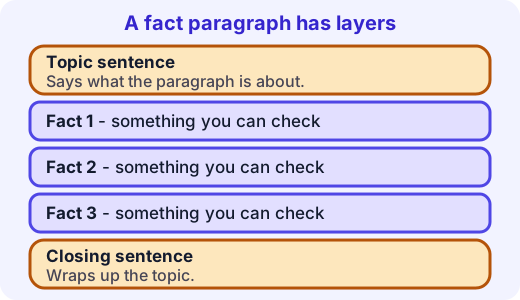
- Topic sentence. It tells the reader what the paragraph is about.
- Facts. Three or so sentences, each with one fact about the topic.
- Closing sentence. It finishes the paragraph by wrapping up the topic.
Here is a model.
Elephants
The elephant is the biggest animal that lives on land. Elephants live in parts of Africa and Asia. An elephant uses its long trunk to smell, to pick up food and to drink. A baby elephant is called a calf. So the elephant is a huge animal with a very useful nose.
Example. Let us take it apart.
- Topic sentence: "The elephant is the biggest animal that lives on land." It says what the paragraph is about.
- Facts: where elephants live, what the trunk does, what a baby is called. Each one can be checked, and each one is about elephants.
- Closing sentence: "So the elephant is a huge animal with a very useful nose." It wraps up.
How to write your own
- Pick a topic you know about, or find out about it first.
- Collect three facts. Use a book, a grown-up, or your own careful looking. Write them as short notes.
- Write the topic sentence. Say what you will tell about.
- Write each fact as its own sentence.
- Write the closing sentence.
- Check. Is every sentence a fact about the topic? Take out opinions and sentences about something else.
Be careful!
- "Lots of people say it" is not a fact. A fact must be true and checkable. "Spiders have six legs" can be checked, and it is wrong: spiders have eight. So it is not a fact.
- A true sentence can still be off topic. "Giraffes have long necks" does not belong in a paragraph about elephants.
- Watch for feeling words. "The tall, beautiful elephant" slips in an opinion. Say "the tall elephant", or give a fact: "an elephant can be three metres tall".
- Do not end with "I like elephants." That is an opinion. Wrap up the facts instead.
Try it: Is this a fact or an opinion? "Rice is a grain." "Rice is boring." Then write one fact about rice. (Rice is a grain: fact. Rice is boring: opinion. A fact about rice: "Rice grows in wet fields called paddies.")
For the grown-up helping
Help your child find three facts in a book or from an adult before writing. Ask "How could we check that?" for each one. If a sentence has a feeling word, ask "Is that something everybody would agree with?" If it is hard to agree, it is probably an opinion. Praise careful facts; do not worry about perfect spelling on the first draft.
Lab
The fact workshop
First sort sentences into facts and opinions. Then build a paragraph about giraffes with a topic sentence, three facts and a closing sentence.
Your goals
- Sort eight sentences into facts and opinions.
- Build a giraffe paragraph with a topic sentence, three true facts and a closing sentence, with no opinions.
The interactive lab opens once you register. Register to do this.
Activity
Write a fact paragraph
Your child chooses a topic, finds three facts, and writes a short paragraph that explains it. About 30 minutes.
You'll need
- Paper and a pencil
- A children's book, an atlas or an encyclopedia about the topic (or a grown-up who knows about it)
Steps
- Choose a topic together that your child knows a little about, such as an animal, a festival, a sport or a fruit.
- Find three facts. Your child looks in a book or asks you. For each fact, ask 'How could we check that?' Write each fact as a short note.
- Your child writes a topic sentence that says what the paragraph is about.
- Your child turns each of the three notes into a full sentence, then writes a closing sentence that wraps up the topic.
- Read it aloud together. Underline any feeling word (best, nice, boring). Ask 'Is that a fact or what someone thinks?' and take out any opinions.
- Check capital letters at the start of every sentence and a full stop at the end.
Safety
- If you look things up online, a grown-up sits with the child and chooses the page.
Keeping a log of the activity is for registered learners. Register to do this.
Quick check
Writing to explain check
Seven questions about facts and fact paragraphs.
1.Which sentence is a fact?
- Rice is a tasty food.
- Rice is a grain that people grow and eat.
- Rice is better than roti.
Choose one
2.Look at the frog paragraph. Match each line to its job.
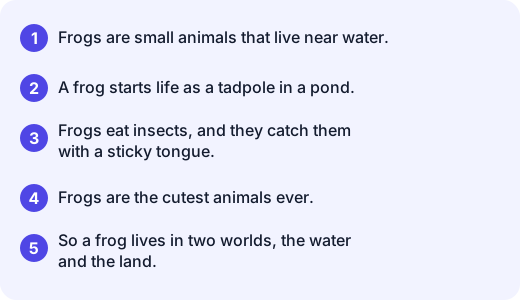
- Line 1
- Line 3
- Line 5
Match each to: A fact · Closing sentence · Topic sentence
3.One line does not belong in a paragraph that explains. Which line should be taken out?
- Line 2
- Line 3
- Line 4
- Line 5
Choose one
4.Pick all the sentences that are facts.
- The Sun is a star.
- Summer is the best season.
- A spider has eight legs.
- Dosa is yummy.
- Water freezes into ice when it gets very cold.
Choose all that apply
5.Put these sentences in order to make a paragraph about camels.
- Camels are animals that live in hot, dry places.
- Its wide feet do not sink into soft sand.
- So a camel is well made for life in the desert.
- A camel stores fat in its hump, which gives it energy when food is hard to find.
Put these in order
6.A paragraph says: Honey bees live in hives. A worker bee collects nectar from flowers. Bees turn nectar into honey. Which is the best closing sentence?
- So honey bees work together to make honey.
- I want to eat some honey right now.
- Flowers come in many colours.
Choose one
7.A sentence that tells what you think or feel, and cannot be checked, is called an ______.
Answer with a word or phrase
Answering and checking are for registered learners. Register to do this.
Quick check
New puzzles
New topics and new paragraphs to fix.
1.Zara wrote 'Tigers are scary.' Which sentence is a fact she could write instead?
- Tigers are the scariest cats.
- A tiger is a large wild cat with stripes.
- I am afraid of tigers.
Choose one
2.Dev is writing a paragraph about elephants. Which sentence is true but does NOT belong?
- Elephants use their trunks to drink.
- A baby elephant is called a calf.
- Giraffes have very long necks.
- Elephants eat plants.
Choose one
3.A paragraph has these facts: Penguins cannot fly. Penguins swim fast. Penguins eat fish. Which is the best topic sentence?
- Penguins are birds that swim instead of flying.
- Penguins are cute.
- I saw a penguin at the zoo.
- Fish live in the sea.
Choose one
4.Maya writes about the Moon. Which sentences can she keep in a paragraph that explains?
- The Moon goes around the Earth.
- The Moon looks lovely at night.
- The Moon has almost no air.
- The Moon is made of cheese.
Choose all that apply
Answering and checking are for registered learners. Register to do this.
Activity
Tell it back
Your child explains, in their own words, the difference between a fact and an opinion. Three minutes.
Steps
- Say two sentences about something your child knows: 'Our school has a gate.' and 'Our school is the nicest one.' Ask 'Which one is a fact? Which is an opinion?'
- Ask 'How do you know?' and 'How could someone check it?' Do not give the answer; wait.
- Ask 'If you were writing to tell a friend about our town, which kind of sentence would you use? Why?'
- Write down what your child says, in their words.
Keeping a log of the activity is for registered learners. Register to do this.
Like what you see?
Register for free to answer the quick checks, do the activities and save your work. Your work is saved on your device and syncs to your account.