Unit 4
How stories work
Find the characters, setting, problem and solution in a story, and notice how a character changes.
Read
Four parts of every story
Here is a very short "story".
Tara woke up. Tara ate breakfast. Tara went to school. Tara came home.
Is that a good story? Not really! Nothing goes wrong, so there is nothing to wonder about. Most stories you love are about a problem, and about how somebody solves it. Here is one.
The Paper Boat
Tara made a paper boat from the last page of her notebook. She was proud of it. After school she carried it to the pond behind the school, where the water was green and the reeds stood tall.
She set the boat on the water. A breeze pushed it straight into the reeds, and there it stuck, far from the bank. Tara reached out with her hand. Too far. She reached with her school bag. Still too far.
"I will never get it back," she sighed. Some older children were playing nearby, and the gardener, Mr. Dutta, was watering plants. But Tara was too shy to ask anyone for help.
Then she thought about her boat, all alone in the reeds. She took a deep breath and walked over to Mr. Dutta. "Please, could you help me?" she said, in a small voice.
Mr. Dutta smiled. He fetched a long bamboo pole, leaned over the water and hooked the boat gently. "Here you are," he said. Tara thanked him with a big smile. The next day, she asked her teacher a question in class for the first time.
The four parts
Almost every story has these four parts.
Part The question it answers In "The Paper Boat" Characters Who is in the story? Tara and Mr. Dutta Setting Where and when does it happen? The pond behind the school, after school Problem What goes wrong? The boat is stuck in the reeds Solution How is it fixed? Tara asks Mr. Dutta, and he hooks the boat with a pole 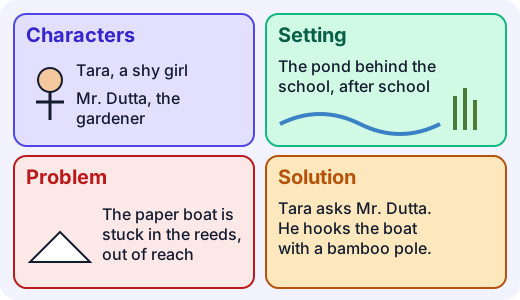
A story map like this helps you remember a story. You can draw one for any story you read.
How a character changes
Look at Tara at the start and at the end.
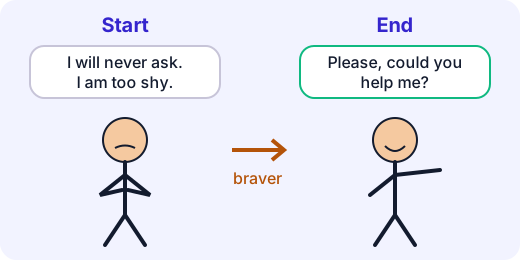
At the start Tara is too shy to ask for help. At the end she asks, and next day she asks her teacher a question too. She has become braver. A character changes because of what happens in the story.
To spot a change, ask: What was the character like at the start? What are they like at the end? What happened in between?
Example. In a different story, Leo laughs when a friend drops the ball. Then Leo drops the winning catch himself and feels awful. Afterwards he says "Never mind, try again!" to a friend who drops one. Leo started unkind and ended kind, because he felt what it is like.
Be careful!
- Characters are not only people. Animals, robots and even toys are characters when they act and talk.
- The setting is "where" and also "when". A cold winter night and a hot summer noon are different settings, even in the same place.
- The problem is not the same as the solution. First something goes wrong; later it is fixed.
- Not every character changes. Look for the one the problem happens to.
Try it: Think of a story you know well, such as the Hare and the Tortoise. Say the characters, the setting, the problem and the solution. (One answer: hare and tortoise; a path to a finish line; the hare brags that nobody can beat him; the tortoise keeps going and wins while the hare sleeps.)
For the grown-up helping
After reading any story together, ask "Who was in it? Where was it? What went wrong? How was it fixed?" These four questions work for picture books, TV and bedtime stories. Do not worry if your child mixes up the problem and the solution at first; asking "what was wrong before? what is fine now?" helps. It is fine if their words differ from the ones here.
Lab
The story sorter
Read a short story about a boy and his goat. Then sort eight cards into Character, Setting, Problem and Solution.
Your goals
- Sort all eight cards into the right story part.
- Notice that every part is there, from who and where to what goes wrong and how it is fixed.
The interactive lab opens once you register. Register to do this.
Activity
Draw a story map
Your child draws a story map of a story they know, and says how a character changed. About 20 minutes.
You'll need
- A story your child knows well (a picture book, a folk tale, or one you tell)
- A big sheet of paper, or the back of a used page
- Pencil and crayons
Steps
- Read or tell the story together. A short one is best, such as a Panchatantra tale, a fable, or a favourite picture book.
- Fold the paper into four boxes. Your child writes a title in each box: Characters, Setting, Problem, Solution.
- Ask the questions one at a time. Who is in it? Where and when does it happen? What goes wrong? How is it fixed? Your child draws and writes a short answer in each box.
- Ask 'How was the main character different at the end?' Your child adds a line or a small picture at the bottom of the page.
- Ask your child to point to each box and tell the story in their own words.
Safety
- Use blunt-tipped scissors if you cut the paper. Keep crayons and pencils away from very young children.
Keeping a log of the activity is for registered learners. Register to do this.
Quick check
How stories work check
Seven questions about the four parts of a story. Think back to "The Paper Boat" and to the story map.
1.In The Paper Boat, which sentence tells the setting?
- It happens at the pond behind the school, after school.
- Tara is shy.
- The boat gets stuck in the reeds.
Choose one
2.What is the problem in The Paper Boat?
- Tara's boat is stuck in the reeds and she cannot reach it.
- Mr. Dutta fetches a long pole.
- Tara asks her teacher a question.
Choose one
3.Look at the story map. Which sentence best fits the empty Solution box?
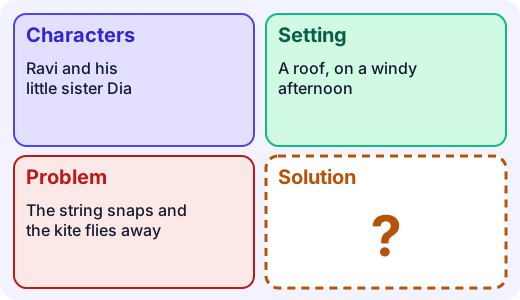
- Ravi and Dia ran after the kite and lifted it down from a low tree.
- Ravi felt very sad.
- It was a windy afternoon.
Choose one
4.At the start, Tara is too shy to ask for help. At the end, she asks Mr. Dutta, and the next day she asks her teacher a question. How has Tara changed?
- She has become braver about asking.
- She has become sadder.
- She has not changed at all.
Choose one
5.On a rainy morning in Delhi, Dev's umbrella blew inside out. He ducked under a shop's awning and waited for the rain to stop. Match each story part to the words from the story.
- Character
- Setting
- Problem
- Solution
Match each to: A rainy morning in Delhi · He ducked under a shop's awning · His umbrella blew inside out · Dev
6.Put the events of The Paper Boat in the order they happen.
- Mr. Dutta hooks the boat with a pole
- Tara tries to reach it but cannot
- Tara asks Mr. Dutta for help
- The breeze pushes the boat into the reeds
- Tara sets her boat on the pond
Put these in order
7.Which of these are characters in a story? Choose all that apply.
- A talking crow
- A brave little robot
- The pond where the story happens
- The rainy day
Choose all that apply
Answering and checking are for registered learners. Register to do this.
Quick check
New puzzles
New stories, new questions. Use the four parts to work them out.
1.The problem in a story is: Rohan's bicycle chain fell off on the way to school. Which sentence is a solution?
- Rohan was late for school.
- A neighbour showed Rohan how to put the chain back on the wheel.
- The road to school was long and dusty.
Choose one
2.Nina woke up. She ate breakfast. She went to school. She came home. She went to bed. What is missing from this story?
- A problem for Nina to solve
- A name for the main character
- A day of the week
Choose one
3.At first, Meena never shared her crayons. Then she was stuck at school with nothing to draw with, and a friend shared hers. After that, Meena always shared. How did Meena change?
- She became more generous.
- She became hungrier.
- She became angrier.
Choose one
4.Which sentence gives the setting of a story?
- On a cold winter night, in a small hut high in the mountains, a family sat by the fire.
- Farida was very brave.
- Then the key was lost.
Choose one
5.In a story, the class plant is drooping because nobody watered it over the holiday. Imran brings water from the tap, and by Monday the leaves stand up again. Which story parts are 'the plant is drooping' and 'Imran brings water'?
- The problem, then the solution
- The setting, then the problem
- A character, then the setting
Choose one
Answering and checking are for registered learners. Register to do this.
Activity
Tell it back
Your child explains, in their own words, why most stories have a problem. Three minutes.
Steps
- Ask 'Tell me a story about a girl who woke up, had breakfast, went to school and came home. Is it a good story? Why, or why not?'
- Let your child answer freely. Then ask 'What could go wrong in that story to make it exciting? And how could it be fixed?'
- Ask 'What are the four parts we find in a story?' Write down what your child says, using their words.
Keeping a log of the activity is for registered learners. Register to do this.
Like what you see?
Register for free to answer the quick checks, do the activities and save your work. Your work is saved on your device and syncs to your account.