Unit 3
Characters and lessons
Work out who a character is from what they do, and find the lesson a fable or folk tale is teaching.
Read
What characters do
Here is a short story. Read it and notice what each bird does.
The Tailorbird and the Sunbird
Siri was a tailorbird, small as a lime. All through the dry weeks she worked on her nest. She poked holes along the edge of a broad leaf with her beak, pulled plant fibre through the holes, and stitched the leaf into a cone, one stitch at a time.
Pinku the sunbird fluttered past, sipping nectar. "Still sewing?" he laughed. "The flowers are full of sweetness today! Why work when you can play?"
"The rains are coming," said Siri. "My eggs will need a dry home."
Pinku shrugged and spent every day among the flowers. Siri stitched on. Soon her nest hung from the branch like a small green pocket, snug and tight.
One evening the sky turned black. Wind shook the trees and the rain came down in sheets. Pinku's wings were soaked in a moment. He clung to a bare twig, shivering, with no roof at all.
Siri saw him from her nest. She remembered his laughing, but she called out all the same: "Come in, Pinku! There is room for two small birds."
Pinku squeezed in beside her, dripping. "I should have built a nest," he said quietly.
"Next dry season," said Siri, "I will show you how to stitch."
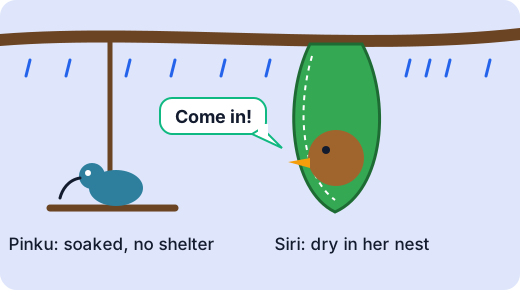
Characters show who they are by what they do
A character is a person or animal in a story. Authors often do not say what a character is like. They show it with actions, and you work it out.
A word that describes what a character is like is a trait: patient, careless, kind, proud. The reason a character does something is their motive. A motive is what the character wants.
Let's look at Siri and Pinku.
What the character does What it shows (trait) Why? (motive) Siri stitches the leaf for weeks, even when she is laughed at Patient, determined She wants a dry, safe home for her eggs Pinku drinks nectar and teases Siri Careless, only thinks about today He wants fun right now Siri invites a soaked Pinku into her nest Kind, forgiving She does not want anyone to suffer To work out a trait, ask yourself: "What kind of person would do this?" To work out a motive, ask: "What did they want?"
Actions drive the plot
Characters are not decoration. What they choose to do makes the plot happen.
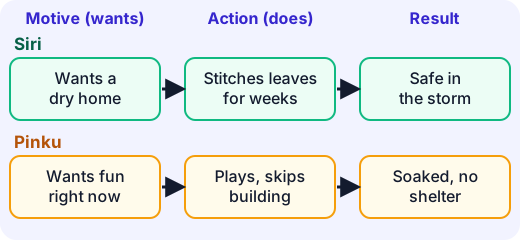
Follow the chain. Siri wants a safe home, so she builds one, so she is dry in the storm. Pinku wants fun, so he skips building, so he is soaked. Take away one action and the story changes. If Pinku had built a nest, there would be no problem at the end. If Siri had been unkind, there would be no kind ending.
A good test is "what if?" What if Siri had stopped stitching when Pinku laughed? Then both birds would have been wet. The plot depends on her action.
Finding the lesson
A fable is a short story, often with animals who act like people, that teaches a lesson. A folk tale is a story told aloud by ordinary people for many generations, from a place or culture. The Panchatantra, the Jataka tales and Aesop's fables are famous collections. Folk tales may have people, magic and tricksters, and the lesson is often not written out.
The lesson is the idea the story wants you to take away. It works for people in real life, not just for the characters. Here is a way to find it.
- What was the problem? Pinku had no shelter in the storm.
- What did each character choose to do? Siri prepared early. Pinku played.
- What happened because of those choices? She was dry. He was soaked.
- What does that teach anyone? Do the work you need to do before the trouble comes.
There may be a second lesson. Siri showed that kindness is worth giving even to someone who laughed at you. A story can teach more than one thing, so check that your lesson is supported by what happens.
Another example. In the folk tale Stone Soup, a hungry traveller tells a village he can make soup from a stone. He puts a stone in a pot of water, and then says it would be even better with a carrot, and then some onions. Each villager adds something, and soon everyone shares a big pot of soup. The traveller's trick works because each person adds only a little. A good lesson is: when everyone shares a little, there is plenty for all.
Misconceptions
- "The lesson is the topic." "Tailorbirds" is a topic. "Do the work before trouble comes" is a lesson.
- "The lesson is what happened." "Pinku got wet" is an event. A lesson goes beyond the story to people in general.
- "The lesson is always written at the end." In many folk tales you have to work it out.
- "A character is only what the author says." A narrator may say "Siri was patient", but what she does is stronger proof.
Try it: Think of a fable or folk tale you know. Choose one character, write one thing they do, the trait it shows, and their motive. Then write the lesson as one sentence that would also be true for people today.
Lab
Same Rafi, different story
Rafi promised to water the school garden. Choose what he does at each point and see how the story changes. At each ending, say what his choices show about him and what lesson the story teaches.
Your goals
- Find at least three of the four endings by making different choices for Rafi.
- At each ending, pick the trait that Rafi's actions show and the lesson of that ending.
The interactive lab opens once you register. Register to do this.
Quick check
Characters and lessons check
Eight questions about what characters do, why they do it, and what a story teaches.
1.Ravi saw the new boy sitting alone at lunch. He picked up his tiffin and sat down beside him. Which word best describes Ravi?
- Kind
- Lazy
- Bossy
Choose one
2.Gita practised her song every evening, even when her friends were playing outside. She wanted to sing at the festival. What is Gita's motive?
- She wants to sing well at the festival.
- She is afraid of her friends.
- She dislikes playing outside.
Choose one
3.Match each action to the trait it shows.
- Zoya finds a purse and hands it back with every coin in it.
- Tom shares his lunch with a classmate who forgot hers.
- After her tower of blocks falls, Mei starts building it again.
Match each to: Determined · Honest · Generous
4.A fox praised a crow's singing until the crow opened her beak to sing and dropped the cheese she was holding. The fox snapped it up. Which is the best lesson?
- Be careful of someone who flatters you because they want something.
- Crows should never sing.
- Foxes are cleverer than crows.
Choose one
5.Which of these are lessons (ideas that teach something)? Pick all that apply.
- Honesty is better than winning by cheating.
- A hare and a tortoise have a race.
- Do not give up when a task is hard.
- Tortoises are slow.
Choose all that apply
6.Tia's mother asked her to close the gate. Tia left it open. A goat wandered into the field and ate the young plants, and Tia spent the evening replanting. Which action drives the plot?
- Tia's mother asked her to close the gate.
- Tia left the gate open.
- Tia replanted the field.
Choose one
7.In the story of the tailorbird Siri and the sunbird Pinku, Siri finishes her nest before the rains and Pinku does not. Which is the best lesson?
- Do the work you need to do before trouble comes.
- Tailorbirds stitch leaves together.
- Sunbirds like flowers.
Choose one
8.The reason a character does something, or what they want, is called their ____.
Answer with a word or phrase
Answering and checking are for registered learners. Register to do this.
Quick check
New puzzles
Read this tale, then answer the questions. Kuku the young goat was crossing a rocky slope when her foot slipped and she landed on a narrow ledge. Old Ram, grazing above, called down, 'Hold on, I will show you the way up.' 'I can do it myself,' said Kuku. She tried the left side and slid back. She tried the right side and slid again. The sun began to set and the ledge grew cold. At last, in a small voice, she said, 'Please, Ram, show me the way.' Step by step he guided her: paws on the flat stone, then the root. Soon she stood on the grass.
1.Which word best describes Kuku at the start of the tale?
- Proud (she does not want to ask for help)
- Cruel
- Lazy
Choose one
2.What is Ram's motive when he calls down to Kuku?
- He wants to help someone who is in trouble.
- He wants Kuku's grass.
- He wants to show off.
Choose one
3.Which action turns the plot towards the happy ending?
- Kuku asks Ram for help.
- The sun begins to set.
- Kuku slips onto the ledge.
Choose one
4.Which is the best lesson of the tale?
- Accepting help when you need it is wise, not weak.
- Goats should keep away from rocky slopes.
- Old animals are always right.
Choose one
Answering and checking are for registered learners. Register to do this.
Your turn
A character, a plot and a lesson
Pick one fable or folk tale you know well. It might be from the Panchatantra, the Jataka tales, Aesop, or a story from your family. Name it at the start of your answer.
Then write about it in three parts.
- A character. Choose one character. Describe two things they do, the trait each action shows, and what the character wants (their motive).
- The plot. Explain how that character's actions make the plot happen. Use the "what if?" test: say what would have been different if the character had acted another way.
- The lesson. Write the lesson as one sentence that would also be true for people today. Explain which events in the story support it.
How it's judged
- Shows who the character is through actions
- Explains how actions drive the plot
- States and supports the lesson
Writing and submitting your answer is for registered learners. Register to do this.
Like what you see?
Register for free to answer the quick checks, do the activities and save your work. Your work is saved on your device and syncs to your account.