Unit 4
Word parts
Break words into prefixes, root words and suffixes to unlock what new words mean.
Read
Breaking words into parts
Meera stared at the library book and frowned. Right in the middle of a sentence sat an enormous word: unhelpfulness.
"Twelve letters!" she whispered to her brother Dev. "How am I supposed to read that?"
Dev smiled and covered the first two letters with his thumb: helpfulness. Then he covered the last four letters: helpful. Then he covered the middle letters: help.
"Look at the centre," Dev said. "What is that word?"
"Help!" said Meera.
"Exactly," said Dev. "Once you find the base word, the giant word is just a little word wearing a hat and shoes."
Words are made of puzzle pieces
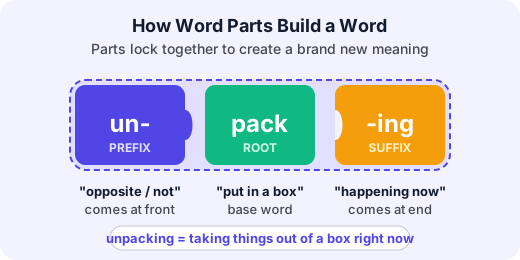
When you meet a long word, you do not have to swallow it whole. Many English words are built from smaller pieces called word parts. The three main parts are the root word, the prefix, and the suffix.
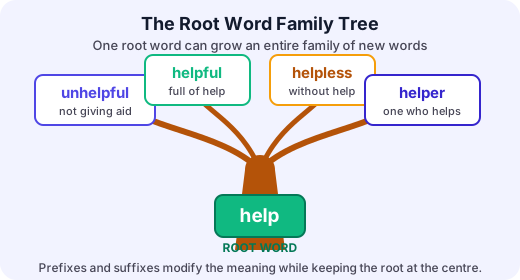
The most important part is the root word (sometimes called the base word). This is the core piece that carries the central meaning. Even on its own, a root word is a real word: pack, care, play, heat, build.
A prefix is a group of letters added to the front of a root word. A prefix changes what the root means.
A suffix is a group of letters added to the end of a root word. A suffix changes the meaning or changes how the word works in a sentence (like turning an action into a person who does it).
Common prefixes and what they mean
Prefixes are like little steering wheels at the front of a word. When you spot one, you know which direction the meaning is turning.
Prefix What it means Root word New word Meaning of the new word un- not; opposite of lock unlock open what was locked un- not; opposite of tidy untidy not tidy; messy re- again; back paint repaint paint something again re- again; back build rebuild build something again dis- not; opposite of agree disagree not agree; have a different opinion pre- before heat preheat heat an oven before baking When you see un-, you know something is the opposite or undone: unhappy means not happy; unpack means take things out of a bag.
When you see re-, think repeat: rewrite means write again; retell means tell again.
Common suffixes and what they mean
Suffixes sit at the end of a word. Two of the most useful suffixes in English are -ful and -less. They are direct opposites!
Suffix What it means Root word New word Meaning of the new word -ful full of; having a lot of cheer cheerful full of cheer; happy -ful full of; having a lot of care careful paying full attention -less without; having none cheer cheerless without cheer; gloomy -less without; having none care careless without care; sloppy -able can be wash washable can be washed -er a person who does teach teacher a person who teaches Notice how careful and careless grow from the exact same root word (care), but the suffix flips the meaning upside down!
Step-by-step: cracking an unfamiliar word
When you run into an unfamiliar long word while reading, use this three-step detective method.
Example. Work out the meaning of fearlessness.
- Find the root word first. Peel off the front and back. The root is fear (being scared).
- Check the suffix. The suffix is -less (without). That gives us fearless = without fear. The ending -ness turns it into a quality or state.
- Assemble the parts. Fearlessness means the quality of being without fear—courage or bravery!
Let's test another one: replanting.
- Root word: plant (put seeds in soil).
- Prefix: re- (again).
- Suffix: -ing (doing it right now).
- Whole meaning: Putting plants into the ground again right now.
Watch out for spelling changes
When a suffix attaches to a root, the spelling sometimes shifts slightly:
- When a root ends in a silent e, you often drop the e before adding a suffix starting with a vowel: make + -ing = making. But before -ful or -less, the e stays: care + -ful = careful.
- When a root ends in a consonant plus y, change the y to i: beauty + -ful = beautiful; plenty + -ful = plentiful.
Mistakes to avoid
- "Every word starting with 'un' has a prefix." No! Think of uncle or under. If you take off un-, you are left with cle or der, which are not English root words. Always check that a real root word remains.
- "Suffix -less means fewer." The word less means smaller in number, but the suffix -less means completely without. A cloudless sky has zero clouds, not just fewer clouds.
- "You can stick any prefix onto any word." While you can invent playful words, real English words follow established patterns. You wouldn't say re-happy because re- belongs on actions, not feelings.
Try it: Look at this sentence: "The fearless climber felt helpless when the path became impassable." Write down each bold word's root, prefix, and suffix on a scrap of paper, and explain what each word means to a partner.
Lab
The Word Parts Workshop
Combine prefixes, roots and suffixes on the workshop bench to build words that match each clue. Solve at least four challenges to complete the lab.
Your goals
- Assemble words from prefixes, roots and suffixes to match each clue.
- Solve at least four word-building challenges correctly.
The interactive lab opens once you register. Register to do this.
Quick check
Word parts quick check
Eight questions on identifying root words, prefixes, suffixes and their meanings.
1.What does the prefix re- mean in the word rebuild?
- To do the action again
- The opposite of building
- To build before someone else
Choose one
2.What is the root word of unfriendly?
- friend
- friendly
- unfriend
Choose one
3.Match each word part to what it means.
- un-
- re-
- -ful
- -less
Match each to: not or opposite of · without · full of · again or back
4.Which of these words contain a real prefix added to a root word? Pick all that apply.
- unfold
- uncle
- repaint
- under
Choose all that apply
5.A rescuer is described as fearless. What does fearless mean?
- Without fear; bold and brave
- Full of fear
- Causing fear in others
Choose one
6.Put the parts of a word in order from front to back.
- Root word
- Suffix
- Prefix
Put these in order
7.A group of letters added to the FRONT of a root word to change its meaning is called a ____.
Answer with a word or phrase
8.Arnav says: 'The word uncle starts with un-, so it has a prefix.' Why is Arnav mistaken?
- If you remove un-, the remaining letters 'cle' do not make a real root word.
- The prefix un- only attaches to animal names.
- Words about family members cannot have prefixes.
Choose one
Answering and checking are for registered learners. Register to do this.
Quick check
New puzzles
Use what you know about word parts to unlock unfamiliar words you have never seen before.
1.To forest an area means to plant trees on it. What does the word reforest mean?
- To plant trees again where trees were lost
- To cut down every tree in a forest
- To clear a forest with fire
Choose one
2.The nurse told Rohan that the medicine drop would be completely painless. What does painless mean?
- Without any pain
- Full of severe pain
- Painful for a long time
Choose one
3.To quench means to satisfy thirst. A character in a folktale had an unquenchable thirst. What does unquenchable mean?
- Cannot be satisfied or put out
- A small, gentle thirst
- Easily quenched with one drop of water
Choose one
4.Read this sentence: 'The untidy puppy chased a useless ribbon across the repainted patio.' How many words in this sentence have a prefix or suffix we studied (untidy, useless, repainted)?
Answer with a number
Answering and checking are for registered learners. Register to do this.
Your turn
Teach word parts
Imagine you are teaching a younger cousin how to break down unfamiliar words using word parts.
Write your response in four parts:
- Dissecting three words. Break each of these words into its parts (prefix, root word, suffix):
- unbreakable
- repacking
- thoughtful
- Explaining the meanings. For each of the three words above, explain in one sentence how the parts work together to give the whole word its meaning.
- The root word rule. Your cousin says: "The word 'unit' starts with un-, so it means 'not it'!" Explain kindly why your cousin is mistaken, and give the rule for spotting a true prefix.
- Invent or explore. Choose the root word cheer or light. Add one prefix and one suffix to it (or create two different forms using prefixes/suffixes) and explain the meaning of each form.
How it's judged
- Breaks words into correct parts
- Explains how parts create meaning
- Explains the root word rule
- Builds and explains new words
Writing and submitting your answer is for registered learners. Register to do this.
- Dissecting three words. Break each of these words into its parts (prefix, root word, suffix):
Like what you see?
Register for free to answer the quick checks, do the activities and save your work. Your work is saved on your device and syncs to your account.