Unit 4
What living things do
Test whether something is alive by asking whether it grows, respires, reproduces, responds and gets nutrition.
Read
Is it alive?
Imagine a gram seed (chana) lying in a kitchen jar. It does not move, eat or make a sound. A candle flame, on the other hand, flickers, grows when you add wax, and seems to "breathe" air. Which one is alive? Most people guess the flame, and they are wrong. The seed is alive, resting; the flame is not alive at all. To decide properly, we need tests that do not depend on whether something moves.
Life is a set of processes
Living things are not made of special stuff. What sets them apart is what they do. Biologists use five main tests. A living thing carries out all of them.
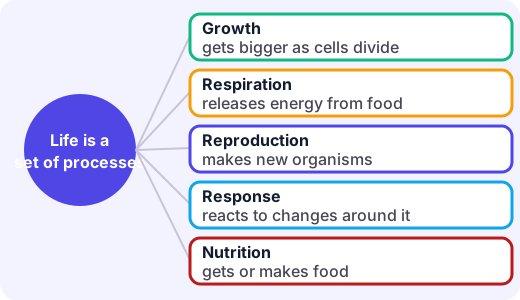
1. Growth. A living thing gets bigger and builds more of its own body. In animals and plants growth happens as cells divide and then enlarge. A kitten becomes a cat, a bean seedling gains leaves.
2. Respiration. Inside every living cell, food is broken down to release the energy the cell needs. This is respiration. It is not the same as breathing: breathing brings air in and out of the body, and respiration is the chemical process in the cells that uses that oxygen. Plants, fungi and tiny single-celled organisms respire too. In summary:
3. Reproduction. Living things make new living things of their own kind: seeds become new plants, hens lay eggs, yeast cells bud. Reproduction keeps the kind going.
4. Response. Living things sense changes (stimuli) in their surroundings and react. A touch-me-not (Mimosa pudica) folds its leaves when brushed; a sunflower bud turns toward light; your pupils shrink in bright light; a cat's ears turn toward a sound.
5. Nutrition. Living things take in or make the materials and energy they need. Animals eat food. Green plants make their own food by photosynthesis, using sunlight, water and carbon dioxide. Fungi such as mushrooms absorb food from dead matter.
Some lists add excretion (getting rid of waste) and movement. Plants move too, but slowly, for instance when a stem bends toward light. These are important, but the five above are enough to test most things.
Worked tests
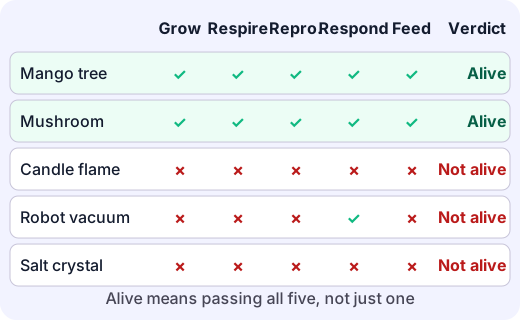
A candle flame. It gets larger if you add fuel, uses oxygen and gives out carbon dioxide and heat. But the flame is not made of cells, it does not grow by building new body parts, it does not make new flames of its own kind in a controlled way, and it is only burning (combustion), a violent reaction that no cell does. It fails.
A robot vacuum. It reacts when it bumps into a chair, so it "responds". It takes in electricity, which is a bit like feeding. But it does not grow, respire or reproduce. Passing one test is not enough.
A salt crystal growing in salty water. It gets bigger, but only by new particles sticking on its outside. A living thing grows from within, using materials it takes in. A crystal does nothing else on the list.
A wooden chair. It was once part of a tree, so it is dead, not "never alive". It no longer respires or grows.
Misconception. "Living things must move." Plants, sponges and mushrooms stay in place and are alive. And things that move (clouds, a rolling stone, a car) may not be.
Careful cases
A dry seed. It looks dead, but a dry chana seed is alive and dormant: it respires extremely slowly. Put it in damp soil and it can germinate, grow, respond to gravity (roots down, shoot up) and use its stored food. That ability to wake up is why we say it is alive. A stone cannot do that.
A mule. A mule (a horse–donkey hybrid) cannot have offspring, but it grows, respires, responds and feeds. The reproduction test applies to living things as kinds. An individual that cannot reproduce is still alive.
A virus. A virus has genetic instructions and makes copies, but only by taking over a living cell. It is not made of cells and has no respiration of its own. Many biologists treat it as a borderline case; whether to call it "alive" is debated. This shows why we use a list of processes carefully rather than a single magic word.
Testing with an experiment
Example: do germinating seeds respire? Put soaked bean seeds in a closed jar, and boiled (dead) seeds in a second, matching jar. After a day, bubble the air from each through limewater (a clear solution that turns milky with carbon dioxide).
- The jar with live seeds turns the limewater milky: carbon dioxide was produced, so the seeds respired.
- The jar with dead seeds stays clear.
A fair test changes one thing (live or dead seeds) and keeps everything else the same.
Example: measuring growth. A bean seedling is 4 cm tall on day 2 and 10 cm on day 6. It grew cm in days, so the average rate is cm per day.
Try it: Soak a spoonful of chana overnight, wrap it in damp cloth, and keep it somewhere warm. Each day measure the length of the root with a ruler (to the nearest millimetre) and note when the first shoot appears. Which of the five processes did you see?
Key ideas
- Life is a set of processes: growth, respiration, reproduction, response, nutrition.
- Respiration is the release of energy from food in cells, not just breathing.
- To count as alive, something must pass all of the tests (with care for dormant seeds and for individuals that cannot reproduce).
- Passing one test (a robot that responds, a flame that "uses oxygen") is not enough.
Lab
Is it alive?
Run five tests on ten candidates, from a mango sapling to a candle flame and a dry seed, then decide whether each one is alive.
Your goals
- Run all five tests (growth, respiration, reproduction, response, nutrition) on each candidate.
- Decide correctly for all ten, including the dormant seed.
The interactive lab opens once you register. Register to do this.
Quick check
What living things do check
Eight questions on the processes of life.
1.Which statement about respiration is correct?
- It is only breathing air in and out.
- It is the release of energy from food inside cells.
- It happens only in animals.
- It is how a plant makes its food from sunlight.
Choose one
2.Match each example to the process of life it shows.
- A kitten becomes a cat
- A touch-me-not folds its leaves when touched
- A green leaf makes sugar from sunlight, water and carbon dioxide
- A hen lays eggs that hatch into chicks
Match each to: Reproduction · Growth · Response · Nutrition
3.Which of these are alive (or dormant but alive)? Pick all that apply.
- A mushroom
- A candle flame
- A dry chana seed
- A wooden table
- A rusting iron nail
Choose all that apply
4.A crystal grows bigger in salty water. Why is it not alive?
- It is too small.
- It only gets bigger by new particles sticking on the outside, and it does none of the other life processes.
- Crystals never change.
- It does not move.
Choose one
5.A mule cannot have young. Is a mule alive?
- No, because it cannot reproduce.
- Yes. It grows, respires, responds and feeds; reproduction is a test for living things as a kind.
- Only if it can move.
Choose one
6.A bean seedling is 4 cm tall on day 2 and 10 cm tall on day 6. What is its average growth rate, in cm per day?
Answer with a number
7.What is the name of the process by which cells release energy from food? (One word.)
Answer with a word or phrase
8.Germinating seeds in a closed jar turn limewater milky. Which process does this show?
- Respiration: the seeds gave out carbon dioxide.
- Photosynthesis: the seeds made food from light.
- Reproduction: the seeds made new seeds.
- Nothing: limewater always turns milky.
Choose one
Answering and checking are for registered learners. Register to do this.
Quick check
New puzzles on what is alive
Use the tests of life on things you have not seen before.
1.A probe finds an object that grows, makes copies of itself and reacts to light, but takes in no food or gas, releases no energy and has no cells. What is the best conclusion?
- It is alive, because it passes some of the tests.
- It does not pass the tests for respiration and nutrition, so we should not simply call it alive.
- It is alive because it grows.
- It is dead.
Choose one
2.Yeast in sugar solution makes 12 bubbles of gas per minute at 20 °C and 30 bubbles per minute at 35 °C. The bubbles come from respiration. How many times faster is the gas made at 35 °C?
Answer with a number
3.How could you test whether a dry-looking seed is alive?
- Look at it carefully.
- Shake it to see if it moves.
- Soak it, keep it warm and moist, and see whether it germinates.
- Weigh it once.
Choose one
4.Which of these show an organism responding to a stimulus? Pick all that apply.
- A sunflower bud turning toward the Sun
- Your pupils getting smaller in bright light
- A stone rolling down a hill
- A cat's ears turning toward a sound
Choose all that apply
Answering and checking are for registered learners. Register to do this.
Your turn
Explain what makes something alive
Write in your own words.
- A friend says, "A fire is alive because it grows, eats wood and breathes in air." Use the five tests of life to explain whether the friend is right.
- Explain why a dry seed counts as alive even though it does not seem to do anything.
- Explain the difference between breathing and respiration, with one example of a living thing that respires but does not breathe the way you do.
How it's judged
- Applying the tests
- Dormant life
- Respiration versus breathing
Writing and submitting your answer is for registered learners. Register to do this.
Like what you see?
Register for free to answer the quick checks, do the activities and save your work. Your work is saved on your device and syncs to your account.