Unit 5
Food components
Test foods for starch, protein and fat, and see why a plate with only one kind of food leaves the body short.
Read
What is in your food?
Meera's lunch box holds rice, dal, a spoon of ghee and a slice of guava. Her cousin Tomas, visiting from Lisbon, has bread, an egg, cheese and an apple. The two lunches look nothing alike. Yet both children will get through the afternoon, grow, and heal when they scrape a knee. How can such different foods do the same jobs?
The answer is that foods are mixtures of nutrients, and different foods carry different mixes. You already met the main groups in earlier years. This unit is about how scientists find out what a food contains, and what happens when something is missing.
The three big building blocks
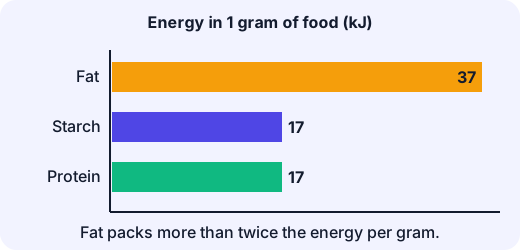
Nutrient What it does Rich sources Carbohydrate (starch and sugars) the body's quick fuel rice, roti, potato, bread, fruit Protein builds and repairs muscle, skin and blood dal, egg, paneer, fish, soya Fat stores energy, protects organs, carries some vitamins ghee, oil, butter, nuts Fats carry a lot of energy for their weight: roughly 37 kJ per gram, against about 17 kJ per gram for starch or protein. That is why a spoon of oil is so energy-dense, and also why you need only a little of it.
Testing foods
You cannot tell what is in a food by looking. A potato and a piece of paneer are both pale and soft. So we use chemical tests, each designed to give a clear colour change with one nutrient.
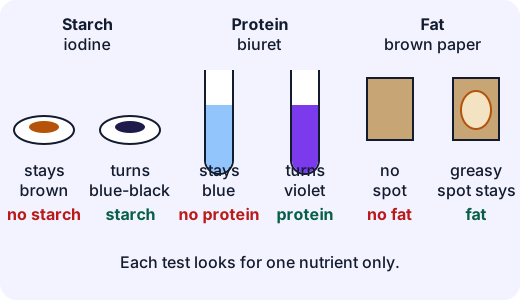
Test How Positive result Negative result Starch a few drops of dilute iodine solution on the food blue-black stays orange-brown Protein (biuret test) food mixed with water, then copper sulfate and sodium hydroxide solutions (the teacher adds these) violet or purple stays pale blue Fat rub the food on brown paper, then let the paper dry a translucent, greasy spot that stays no lasting spot Why wait for the paper to dry? A wet food leaves a translucent spot because water soaks into the paper. Water dries away. Fat does not. If the spot is still there when the paper is dry, the food contains fat.
Safety. Iodine stains skin and clothes. Sodium hydroxide can burn skin and eyes. These tests are done in a lab with a teacher, with goggles on, and nothing from a lab is ever tasted. Only the paper test is safe to do at home.
Example. A cook has an unlabelled white powder. Iodine turns it blue-black. The biuret test stays blue. The paper stays clean. Reading the three results together: starch is present, protein and fat are not detected. The powder could be cornflour or arrowroot, but not egg white or butter.
Notice what a test can and cannot say. Each test looks for one nutrient. A negative biuret test on a cucumber means "no protein found". It does not mean "no nutrients". A cucumber is mostly water, and has vitamins and fibre that these three tests never look for. Many foods give two positives: dal gives starch and protein, paneer gives protein and fat.
When something is missing
The body needs small amounts of vitamins and minerals to work. If the diet lacks one for a long time, a deficiency disease appears. Doctors knew these illnesses long before chemists knew why they happened. Sailors on long voyages bled from the gums (scurvy) until it was found that lemons and limes cured them. Those fruits supply vitamin C.
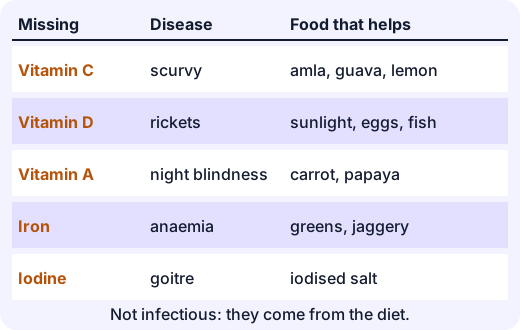
Missing Disease or sign Where to find it Vitamin C scurvy: bleeding gums, slow healing amla, guava, citrus fruits, tomato Vitamin D rickets: soft, bent bones in children sunlight on skin, eggs, fish, fortified milk Vitamin A night blindness: poor sight in dim light carrots, papaya, spinach, eggs Iron anaemia: tiredness, pale skin leafy greens, jaggery, lentils, meat Iodine goitre: swelling in the neck iodised salt, sea fish Protein (long shortage) poor growth, weak muscles dal, eggs, milk, soya Deficiency diseases are not infectious. You cannot catch scurvy from someone, any more than you can catch a flat tyre. They come from what is (or is not) in the diet, and they can usually be prevented or reversed by eating the missing nutrient.
Common mix-ups
- "Fat is bad and should be avoided." Fat is a needed nutrient. The problem is too much, not any at all. Your brain and nerves need it.
- "A food with a negative test has nothing in it." It only lacks the one nutrient that test detects.
- "Vitamin C comes only from oranges." Guava and amla have more per 100 grams than an orange. Many foods carry it.
- "Eat one 'perfect' food." No single food has everything. A balanced diet combines foods, so that what one lacks another supplies. Rice (starch) plus dal (protein) is a classic pair for this reason.
Try it: At home, rub a little butter on one piece of brown paper and a drop of water on another. Wait an hour. Which spot is still there? Do the same with a bit of potato and a groundnut.
In the lab for this unit, you will test seven foods in a safe simulation, work out what each contains, and then identify three mystery samples from their results alone.
Lab
The food testing bench
A safe, simulated lab. First test known foods with iodine, the biuret test and the brown-paper test until you have seen a positive result for each. Then identify three mystery samples from their test results alone.
Your goals
- See at least one positive result for starch, for protein and for fat.
- Test three mystery samples and name each food from its pattern of results.
The interactive lab opens once you register. Register to do this.
Quick check
Food components check
Eight questions about testing foods and what happens when a nutrient is missing.
1.A drop of iodine solution on a slice of potato turns blue-black. What does this show?
- The potato contains starch
- The potato contains protein
- The potato contains fat
- The potato contains no nutrients
Choose one
2.You rub a nut on brown paper. After the paper has dried for an hour, a translucent spot is still there. What does this show?
- The nut contains fat
- The nut contains water
- The nut contains starch
- The nut contains vitamins
Choose one
3.Match each missing nutrient to the problem it causes.
- Vitamin C
- Vitamin D
- Iron
- Iodine
Match each to: Rickets (soft, bent bones) · Anaemia (tired, pale) · Goitre (swollen neck) · Scurvy (bleeding gums)
4.Which of these are good sources of protein?
- Cooked lentils (dal)
- Egg
- Paneer
- Sugar
- Cooking oil
Choose all that apply
5.Food Q gives these results. Iodine: stays orange-brown. Biuret test: turns violet. Brown paper: no lasting spot. Which nutrient does Q contain (of the three tested)?
- Starch only
- Protein only
- Fat only
- Starch and protein
Choose one
6.Fat gives about 37 kJ per gram. About how much energy is in 20 g of fat, in kJ?
Answer with a number
7.A cucumber slice gives a negative result in all three tests. Which conclusion is correct?
- A cucumber has no nutrients at all
- No starch, protein or fat was found, but it can still contain water, fibre and vitamins
- The tests did not work
- A cucumber is mostly fat
Choose one
8.A child eats mostly rice and bread. Her gums bleed and cuts heal slowly. Which addition to her meals is most likely to help?
- A second helping of rice
- A guava or other fruit rich in vitamin C
- A spoon of oil
- Sugar in her tea
Choose one
Answering and checking are for registered learners. Register to do this.
Quick check
New puzzles with food
Use what you know about nutrients and tests in situations you have not seen before.
1.Three packed foods are tested. Sample 3: iodine turns blue-black, the biuret test turns violet, the brown paper stays clean. Which food is it most likely to be?
- Egg white
- Cooked dal
- Butter
- Cucumber
Choose one
2.A child eats almost only boiled rice and potato, and is growing slowly. Both foods are mainly starch. What is the best advice?
- Eat even more rice and potato
- Add protein foods such as dal, egg or milk, and fruit and vegetables
- Stop eating starch completely
- Eat nothing else, because starch has every nutrient
Choose one
3.A packet of 100 g snack contains 50 g starch, 10 g protein and 20 g fat. Starch and protein give about 17 kJ per gram, fat about 37 kJ per gram. About how much energy is in the packet, in kJ?
Answer with a number
4.A cook rubs a boiled potato on brown paper and sees a translucent spot at once. The spot is gone after the paper dries. What should she conclude?
- The potato contains a lot of fat
- The spot came from water, so the test does not show fat in the potato
- The potato contains starch
- The potato contains protein
Choose one
Answering and checking are for registered learners. Register to do this.
Your turn
Explain a plate of food
Write your answers in your own words.
- A friend says: "The biuret test on my boiled egg stayed blue, so an egg has no nutrients." Say what is wrong with this conclusion and what the result does show. (Hint: an egg is not made only of what one test looks for. Name what you would test next.)
- Plan one simple meal you could actually eat that includes a source of starch, a source of protein, and some fat. Name each food and say which test result you would expect for each food.
- Pick one deficiency disease from this unit. Explain what nutrient is missing, what the sign is, and how a change in the diet can fix it. Say why it is not infectious.
How it's judged
- Reading test results
- Meal plan and predictions
- Deficiency disease
Writing and submitting your answer is for registered learners. Register to do this.
Like what you see?
Register for free to answer the quick checks, do the activities and save your work. Your work is saved on your device and syncs to your account.