Unit 6
Magnetic fields
See the invisible region around a magnet by mapping it with a compass, then make a magnet of your own.
Read
The invisible reach of a magnet
Ananya is trekking in the Himalayan foothills. At a fork in the trail, mist hides every landmark. She takes out a small compass, holds it flat, and the needle swings, wobbles, and settles. Nobody pushed it. Nothing touches it. Yet something is turning that needle.
That "something" is a magnetic field, and the needle is a very small magnet that is free to turn. In this unit you will learn what a field is, how to map one, and how to make a magnet yourself.
What is a field?
You know from earlier years that a magnet can pull an iron nail without touching it, and that two magnets can push each other apart. The force acts across a gap. We say the magnet has a magnetic field:
A field is a region of space where a force acts. A magnetic field is the region around a magnet where another magnet, or a piece of iron, feels a magnetic force.
The field is not made of anything you can see. It is a way of saying "if a magnetic object were here, this is the push or pull it would feel". Gravity is also a field: a ball released anywhere near Earth feels a pull, even in mid-air.
A compass is a field detector
A compass needle is a tiny magnet. One end is its north-seeking pole (usually painted red); the other is its south-seeking pole. A compass needle lines itself up along the field at its position, with its red tip pointing the way the field points.
So to find a field, move a compass around. At each spot, mark which way the red tip points. Do it at enough places and a pattern appears.
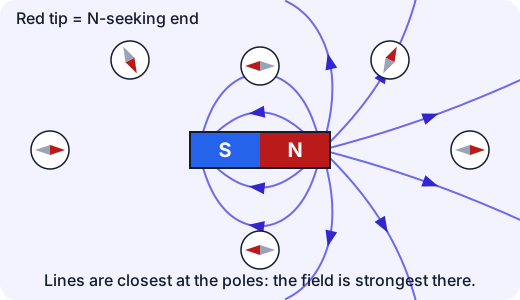
Three facts about the pattern:
- Direction. Outside the magnet, field lines leave the north pole and curve round to enter the south pole. A compass's red tip follows that direction.
- Strength. Where the lines are crowded (at the poles), the field is strong. Where they spread out (far away, or beside the middle of the magnet), it is weak.
- No crossings. At any point the field has only one direction, so two field lines can never cross.
The lines are a picture of the field, not real strings. You can see something like them if you sprinkle iron filings on a sheet of paper laid over a magnet and tap it: each filing becomes a tiny magnet and turns along the field, so the filings gather in curved lines crowded at the poles.
Example. In the figure, the compass just above the middle of the magnet has its red tip pointing left. Why? Above the middle, the field runs from the magnet's right end (north) towards its left end (south), so the red tip points left. The compass at the right-hand end points away from the magnet, because field lines leave the north pole there.
Try it: If you have a bar magnet and a small compass, set the magnet on a sheet of paper. Place the compass at one spot, mark the needle's two ends with pencil dots, then move the compass so its tail sits on the head dot and repeat. You trace one field line. Start somewhere else and trace another.
The Earth is a magnet too
Ananya's needle turns because the Earth itself has a magnetic field, as though a huge bar magnet lay inside it. The needle's red tip points towards the Earth's geographic north. A magnet's north pole is attracted to a south pole, so the magnetic pole in the Arctic is, in magnetic terms, a south pole. The fields of nearby magnets, steel tanks and iron beams are often much stronger than Earth's weak field, so a compass held near them gives false directions.
Making a magnet
Iron, steel, cobalt and nickel can be magnetised. Copper, aluminium, plastic and wood cannot. A magnet's strength comes from tiny regions inside the material, each acting like a tiny magnet. In an ordinary needle they point every which way and their effects cancel. Lining them up makes the whole needle a magnet.
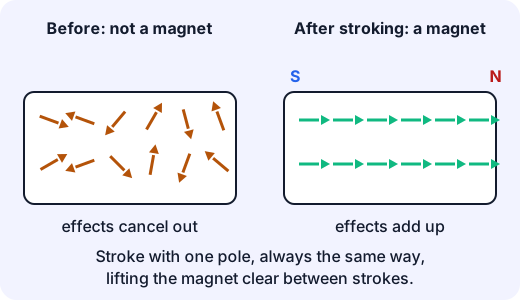
Method 1: stroking. Lay a steel needle on a table. Take a bar magnet and stroke it along the needle from one end to the other, using one pole only. Lift the magnet well clear and bring it back through the air, then stroke the same way again. Repeat 30 or more times. Always the same pole, the same direction. Test it: the needle should now pick up small pins and swing to line up north-south if you float it on a bit of cork in water.
Method 2: an electromagnet. Wrap insulated wire in many turns round an iron nail and connect the ends to a battery. Electric current makes a magnetic field, and the nail's iron strengthens it. More turns and more current make a stronger magnet. Disconnect the battery and it almost switches off. (Do this with an adult; the wire and battery get warm, so keep it short.)
A magnet can lose its strength if you heat it, hit it repeatedly or drop it hard, because the tiny magnets are shaken out of line.
Common mix-ups
- "A magnet's force is only at its ends." The field fills the space all around. It is strongest near the poles but never stops suddenly.
- "The red end of a compass points to the magnet's north pole." Unlike poles attract, so the red tip points to the magnet's south pole, which is the way the field runs.
- "Magnets attract all metals." Only a few: iron, steel, nickel and cobalt.
- "Field lines are real." They are our drawing of the field. Real filings only show them because each filing becomes a tiny magnet.
In the lab, you will place compasses around a magnet yourself, watch every needle turn when the magnet is flipped, and discover where the field is strong.
Lab
Map a magnet's field
Tap the board to leave compasses around a bar magnet. Place enough near the poles and far away, flip the magnet to see every needle turn, show the field lines, and answer two questions about what you found.
Your goals
- Place at least 10 compasses, with some close to a pole and some far away.
- Flip the magnet once and see how the needles change.
- Say where the field is strongest and which way field lines run outside the magnet.
The interactive lab opens once you register. Register to do this.
Quick check
Magnetic fields check
Eight questions about fields, compasses and making magnets.
1.Which statement best describes a magnetic field?
- The region around a magnet where a magnetic force acts
- The painted lines you see on a magnet
- The iron inside a magnet
- The force that exists only at the two ends of a magnet
Choose one
2.In the picture, which marked point has the strongest magnetic field?
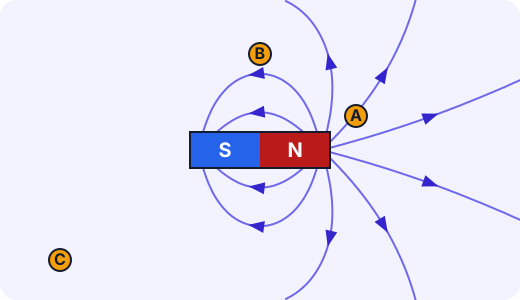
- A
- B
- C
- All three are the same
Choose one
3.Outside a bar magnet, in which direction do magnetic field lines run?
- From the north pole to the south pole
- From the south pole to the north pole
- Round and round the magnet, never ending
- Out of both poles
Choose one
4.A small compass is placed on the line of a bar magnet, just beyond its north pole. Which way does the red (north-seeking) tip of the needle point?
- Away from the magnet
- Towards the magnet
- Straight up out of the table
- Any direction
Choose one
5.Which of these can be turned into a magnet?
- An iron nail
- A steel needle
- A copper wire
- A plastic ruler
Choose all that apply
6.Put these steps for making a magnet by stroking in order.
- Stroke from one end to the other with one pole of a magnet, in one direction
- Repeat the strokes thirty times or more
- Lay the steel needle on a table
- Test by picking up small pins
- Lift the magnet clear of the needle and bring it back through the air
Put these in order
7.Why can two magnetic field lines never cross each other?
- At any point the field has only one direction
- Field lines repel each other like magnets
- They would make a spark
- Because they are too thin to meet
Choose one
8.Why does a compass needle settle pointing north?
- It lines up with the Earth's own magnetic field
- The Pole Star pulls it
- Gravity pulls the red tip downwards
- The Earth's spin pushes it
Choose one
Answering and checking are for registered learners. Register to do this.
Quick check
New puzzles with magnets
Use what you know about fields in situations you have not seen before.
1.A bar magnet lies on a table with its north pole pointing east. A compass is placed on the table directly north of the middle of the magnet. Ignore the Earth's field. Which way does the red tip point?
- West
- East
- North
- South
Choose one
2.A drawing shows 12 field lines leaving the north pole of a magnet. How many of them enter the south pole, if the drawing is done correctly?
Answer with a number
3.A student makes an electromagnet by winding wire round an iron nail and connecting a battery. Which change makes it stronger?
- Wind more turns of wire round the nail
- Replace the iron nail with a plastic rod
- Use fewer turns of wire
- Disconnect the battery
Choose one
4.Standing beside a large steel water tank, a hiker's compass points towards the tank instead of north. What is the best explanation?
- The steel tank is magnetised or disturbs the field, and its field is stronger than the Earth's there
- North has moved to the tank
- Compasses only work in the open
- The tank is hot and pulls the needle with heat
Choose one
Answering and checking are for registered learners. Register to do this.
Your turn
Explain a magnetic field
Write your answers in your own words. A labelled sketch (described in words if you are typing) is welcome.
- A younger cousin asks, "How does a magnet pull a nail without touching it?" Explain using the word field, and say how you could show the field is there.
- Describe how you would use a compass to map the field around a bar magnet. Say what you would do, what you would draw, and where the lines would be closest together and why.
- A friend says "the red end of a compass is pulled to the magnet's north pole". Explain whether this is right.
How it's judged
- Explaining the field idea
- Mapping method
- Correcting the misconception
Writing and submitting your answer is for registered learners. Register to do this.
Like what you see?
Register for free to answer the quick checks, do the activities and save your work. Your work is saved on your device and syncs to your account.