Unit 7
Materials and their properties
Test materials for hardness, solubility, transparency and conductivity, then choose the right one for each job.
Read
Why is the kettle handle plastic?
Look at an electric kettle. The body is steel, the lid hinge is metal, the handle is plastic, and the little window that shows the water level is clear plastic or glass. Nobody picked these at random. The steel stands the heat and does not leak, the plastic handle will not give you a shock or burn your hand, and the window lets you see through. Each part is made of the material whose properties suit its job.
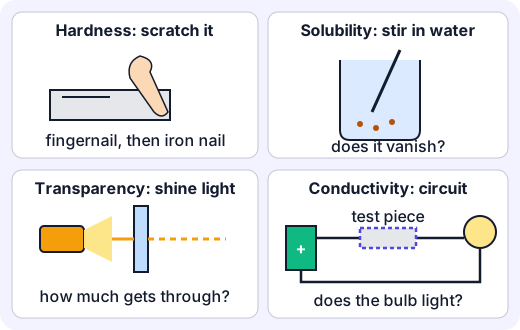
A property is something you can observe or measure about a material, and it does not depend on how much of the material you have. In this unit you will test four properties and then use the results to choose.
Four properties to test
1. Hardness
Hardness is how well a material resists being scratched. To test it, try to scratch the material with harder and harder things:
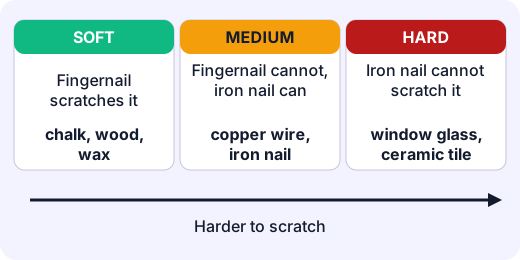
- Soft: a fingernail scratches it (chalk, wood, wax).
- Medium: a fingernail cannot, but an iron nail can (copper; the iron nail itself ranks here too).
- Hard: even an iron nail cannot scratch it (window glass).
Hard does not mean strong or unbreakable. Glass is hard but shatters when dropped. Hardness is only about scratching.
2. Solubility
A material is soluble if it dissolves in a liquid, usually water, and insoluble if it does not. Stir a spoonful of sugar into water: it seems to vanish, and the water tastes sweet. Stir a spoonful of sand: it sinks and stays as sand.
Misconception: "dissolving makes it disappear." The sugar is still there, spread out in tiny pieces too small to see. If you let the water evaporate, the sugar remains. Dissolving is not melting, either: nothing here changed to a liquid by heat.
3. Transparency
How much light passes through?
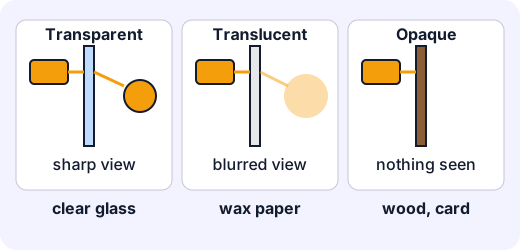
- Transparent: you can see clearly through it (window glass, clear water, a clear polythene sheet).
- Translucent: light gets through but the picture is blurred (wax paper, frosted glass, a thin cotton cloth).
- Opaque: no light gets through (wood, metal, card).
Transparent does not mean colourless. Green glass of a bottle is transparent.
4. Conductivity
A material is an electrical conductor if electric current flows through it easily, and an insulator if it hardly does. To test, put a piece of the material into a simple circuit between a cell and a bulb. If the bulb lights, the material conducts. Metals are good conductors. Plastic, wood, glass and rubber are insulators. (Metals are also good conductors of heat, which is why a steel spoon in hot tea becomes hot to touch.)
A surprise. The "lead" of a pencil is graphite, a form of carbon, not a metal. It is soft and it conducts electricity. Do not assume only metals conduct.
Writing results as a table
A table lets you compare many materials at once and look up a job's needs.
Material Hardness Conducts electricity Light In water Copper wire medium yes opaque insoluble Window glass hard no transparent insoluble Wood soft no opaque insoluble Sugar cube soft no opaque soluble Iron nail medium yes opaque insoluble Wax paper soft no translucent insoluble Properties decide uses
To choose a material, write the job's needs, then look for the material that has them all.
Example. A cable needs to carry electricity and also be tough enough to handle without crumbling, yet not so hard that it cannot be drawn into a thin wire. Needs: conductor, medium hardness. Check the table: copper and the iron nail both fit, and nothing else does. Glass, wood and wax paper do not conduct. Real household cables use copper, because it carries current better and rusts less than iron. Those are other properties, so a real choice may need more tests than this table.
Example. A lampshade should let light through gently but hide the bulb. Needs: translucent. Wax paper (or frosted glass) fits. Clear glass would show the bulb; wood would block the light completely.
Another way to see the same idea is to work backwards. Here is a pan: the body should conduct heat and not melt (metal), the handle should not conduct heat and electricity (plastic or wood), and the lid window might be transparent and hard (glass). Different parts, different needs, different materials.
Common mix-ups
- "Hard means strong." Hardness is resistance to scratching. A hard material can still be brittle.
- "Transparent means colourless" or "anything transparent is glass". Clear plastics are transparent too.
- "Only metals conduct." Graphite conducts as well.
- "Soluble means it melts." Dissolving mixes the substance into the liquid; melting is a change of state.
- "A material has one property." Every material has all four. You choose a material by checking several properties together.
In the lab you will test nine materials on a virtual bench, record the results, then pick materials for five jobs.
Lab
The materials testing bench
Test nine materials for hardness, conductivity, transparency and solubility. Then read five job cards and tick every material that has the properties the job needs.
Your goals
- Test all nine materials and fill in the results table.
- For each of five jobs, choose the materials whose properties fit.
The interactive lab opens once you register. Register to do this.
Quick check
Materials and properties check
Eight questions about testing and choosing materials.
1.Match each property to the test that finds it.
- Hardness
- Solubility
- Transparency
- Conductivity
Match each to: Stir it into water · Shine a torch through it · Put it in a cell-and-bulb circuit · Try to scratch it with a nail
2.Put these in order from softest to hardest. A fingernail scratches chalk. An iron nail scratches copper, but a fingernail does not. An iron nail does not scratch window glass.
- Copper
- Window glass
- Chalk
Put these in order
3.A spoon of sugar is stirred into water and seems to vanish. Which statement is correct?
- The sugar is still there, spread through the water in tiny pieces
- The sugar has been destroyed
- The sugar has melted into water
- The sugar has turned into air
Choose one
4.A glass tumbler is hard. Which statement about it is true?
- It resists scratching, but it can still break if dropped
- Because it is hard, it can never break
- It is soft because it breaks easily
- It is hard because it is insoluble
Choose one
5.Which of these are transparent?
- Window glass
- Clear water in a glass
- Wax paper
- Cardboard
Choose all that apply
6.A material is placed in a circuit with a cell and a bulb, and the bulb does not light. Which material is it most likely to be?
- A plastic comb
- A copper wire
- An iron nail
- Pencil lead (graphite)
Choose one
7.A cover for an electric switch must not let current flow to your hand, and it will be used outdoors where rain falls. Which material is best?
- A hard plastic
- Copper
- Pressed sugar
- Graphite
Choose one
8.A friend says "only metals conduct electricity". Which fact shows the friend is wrong?
- Pencil lead is not a metal, yet the bulb lights when it is in the circuit
- Glass does not conduct
- Iron conducts
- Wood is an insulator
Choose one
Answering and checking are for registered learners. Register to do this.
Quick check
New puzzles with materials
Choose and explain using properties in situations you have not seen before.
1.A material for a spectacle lens must be transparent and hard enough not to be scratched by ordinary use. The test results for four materials are: Glass: transparent, hard. Polythene film: transparent, soft. Wax paper: translucent, soft. Wood: opaque, soft. Which is the best choice?
- Glass
- Polythene film
- Wax paper
- Wood
Choose one
2.Salt and sand are mixed. Salt dissolves in water and sand does not. Which property difference could you use to start separating them?
- Solubility: add water to dissolve the salt
- Hardness: scratch each grain
- Conductivity: put the mixture in a circuit
- Transparency: look through each grain
Choose one
3.A teacher tests 12 materials with a cell and bulb circuit. The bulb lights for 5 of them. How many are insulators?
Answer with a number
4.The wiring inside an electric kettle must conduct, and the handle must be safe to hold if a fault lets current reach the outside. Which pair of materials is most sensible?
- Wiring: copper. Handle: plastic
- Wiring: plastic. Handle: copper
- Wiring: copper. Handle: copper
- Wiring: wood. Handle: sugar candy
Choose one
Answering and checking are for registered learners. Register to do this.
Your turn
Explain a choice of material
Write your answers in your own words.
- Choose any everyday object made of more than one material (a pen, a school bag, a torch, a cooking pan). Name three of its parts, the material of each, and which property of that material suits the part's job.
- A friend says "glass is hard, so it is the strongest material for a school window". Explain what is right and what is wrong with this.
- Describe a fair test you could carry out to compare the hardness of three materials. Say what you would do, what you would record, and how you would keep the test fair.
How it's judged
- Linking property to use
- Hardness versus strength
- Fair test of hardness
Writing and submitting your answer is for registered learners. Register to do this.
Like what you see?
Register for free to answer the quick checks, do the activities and save your work. Your work is saved on your device and syncs to your account.