Unit 8
Temperature and its measurement
Read a thermometer properly, and find out why a hot cup of tea and a warm bucket of water are very different things.
Read
How hot is hot?
Zoya's grandmother puts a hand on her forehead and says, "You feel warm." Zoya's mother brings a small thermometer. It reads 38.5 °C, and Zoya has a fever. Hands are a poor judge of hot and cold. Try this: hold one hand in a bowl of cold water and the other in warm water for a minute, then put both in lukewarm water. One hand says "warm", the other says "cool", for the same water. To describe how hot something is, we need an instrument.
Temperature and the thermometer
Temperature tells us how hot or cold something is. We measure it in degrees Celsius (°C). On this scale, water freezes at 0 °C and boils at 100 °C (at sea level).
A common thermometer is a glass tube with a bulb at the bottom that holds a liquid (coloured alcohol, or mercury in older ones). When the bulb gets hotter, the liquid expands and climbs up the narrow tube. When it cools, the liquid shrinks and falls. The height of the liquid on the printed scale is the temperature.
There are two thermometers you must learn to use.
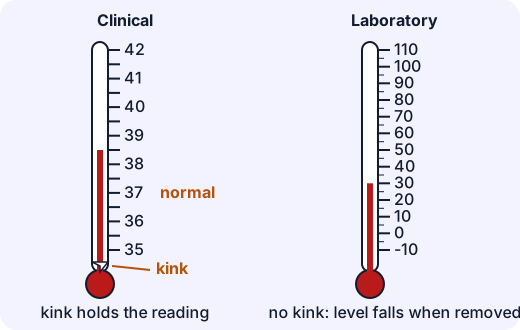
Clinical thermometer Laboratory thermometer Used for body temperature water, air, solutions Range 35 °C to 42 °C -10 °C to 110 °C Kink above bulb? Yes: the liquid stays up after you take it out No: the level falls as it cools Reset Shake it down below 35 °C before use not needed Normal body temperature is about 37 °C. A reading well above it, such as 38.5 °C, suggests a fever. If someone feels ill, a doctor or a trusted adult decides what to do; the thermometer only gives the number.
Using a clinical thermometer
- Wash it (in cool water and soap or antiseptic, never hot water) and shake it so the liquid is below 35 °C.
- Place the bulb under the tongue or in the armpit. Wait the time the instructions say.
- Take it out and read it at eye level.
- Wash it again and put it away.
Never use it to measure hot water: the range stops at 42 °C and it would break. Many homes now use digital thermometers, which work in a different way, but the idea (a sensor that gives a number) is the same. If a mercury thermometer breaks, do not touch the mercury: tell an adult at once.
Using a laboratory thermometer
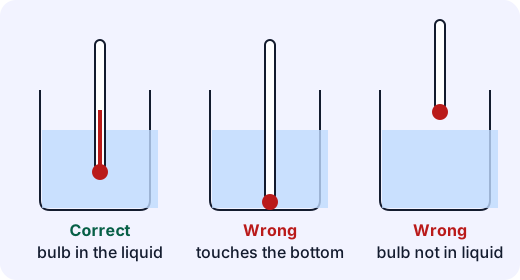
- Hold it upright, with the bulb fully in the liquid but not touching the sides or the bottom (the glass there may be hotter or colder than the liquid).
- Wait until the level stops moving.
- Read while the bulb is still in the liquid (the level falls as soon as it comes out).
- Put your eye level with the top of the liquid. Looking from above or below gives a wrong reading.
- Do not use it to stir.
Example (reading the scale). On a lab thermometer each small mark is 1 °C and the long marks are every 10 °C. The liquid stops at the third small mark above the 30 °C mark. The reading is 30 + 3 = 33 °C.
Heat is not temperature
People say "heat" and "temperature" as if they were the same. In science they are different.
- Temperature says how hot something is. It does not depend on how much of it there is.
- Heat is energy that moves from a hotter thing to a colder thing because of their temperature difference. We measure energy in joules (J).
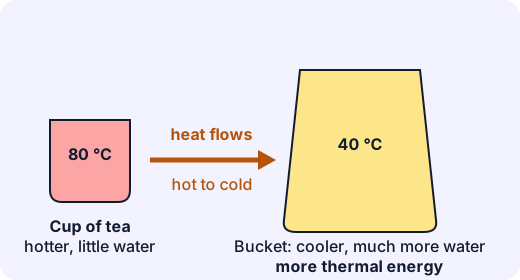
Compare a cup of tea at 80 °C with a bucket of water at 40 °C. The tea is hotter, so it has the higher temperature. But the bucket holds so much more water that it contains much more thermal energy. If you could use each to melt ice, the bucket would melt more ice, even though it is cooler.
Heat always flows from the hotter object to the colder one, until both are at the same temperature. When you hold an ice cube, you do not feel "cold flowing in". Heat is flowing out of your hand into the ice, which is why your hand feels cold.
The same heat gives different rises. A heater gives the same heat to a small pot and a big pot of water. In 2 minutes the small pot (100 g) might rise 10 °C. The big pot, with four times as much water (400 g), rises only a quarter as much: 2.5 °C. Same heat, different temperature change, because the energy is shared among more water.
Common mix-ups
- "Heat and temperature mean the same." Temperature is how hot; heat is the energy that moves.
- "The hotter thing always has more heat." Not if it is much smaller.
- "Cold flows in." Heat flows out of the warmer thing.
- "A thermometer can measure anything." Each is built for a range. A clinical thermometer is useless for boiling water.
- "Hands can measure temperature." They tell us about heat leaving or entering the skin, not temperature.
In the lab you will heat two beakers of different size with the same heater, read each thermometer scale yourself, and see how the temperatures differ.
Lab
Same heat, different temperature
Heat a small beaker and a large beaker with identical heaters. Read each thermometer scale and type the temperature in the table after every two minutes. Then say which beaker got more heat and which got hotter.
Your goals
- Read both thermometers correctly (within 1 degree) at 0, 2, 4 and 6 minutes.
- Say which beaker received more heat, which became hotter, and why.
The interactive lab opens once you register. Register to do this.
Quick check
Temperature and heat check
Eight questions about thermometers, temperature and heat.
1.What is normal human body temperature, in degrees Celsius, to the nearest whole degree?
Answer with a number
2.Why does a clinical thermometer have a kink just above the bulb?
- It stops the liquid falling back, so the reading stays after the thermometer is taken out
- It makes the liquid rise faster
- It makes the glass stronger
- It lets the scale go up to 100 °C
Choose one
3.Put these steps for using a laboratory thermometer in order.
- Wait until the level stops moving
- Hold it upright with the bulb in the liquid, not touching the sides or bottom
- Read the scale while the bulb is still in the liquid
- Put your eye level with the top of the liquid
Put these in order
4.On a laboratory thermometer each small mark is 1 °C and the numbered marks are 10 °C apart. The top of the liquid is at the 4th small mark above the 20 °C mark. What is the temperature, in °C?
Answer with a number
5.Which statement about heat is correct?
- Heat is energy that moves from a hotter object to a colder one
- Heat is the same as temperature
- Heat is a substance that cold objects soak up
- Heat is how big an object is
Choose one
6.Which can give out more heat as it cools down to room temperature (20 °C): 1 litre of water at 60 °C or 10 litres of water at 40 °C?
- 10 litres at 40 °C
- 1 litre at 60 °C, because it is hotter
- They give out the same
Choose one
7.You hold an ice cube and your hand feels cold. What is happening?
- Heat is flowing from your hand into the ice
- Cold is flowing from the ice into your hand
- No energy moves
- Heat is flowing from the ice into your hand
Choose one
8.Why must a clinical thermometer never be used to measure boiling water?
- Its scale stops at 42 °C and the glass could break
- Water would make the scale blurry
- It cannot be shaken afterwards
- There is no reason
Choose one
Answering and checking are for registered learners. Register to do this.
Quick check
New puzzles with heat
Use the ideas of temperature and heat in situations you have not seen before.
1.A heater warms 200 g of water by 8 °C in 3 minutes. Using the same heater for the same time, by how many degrees would 800 g of water be warmed? (Ignore heat lost to the air.)
Answer with a number
2.A student lifts a laboratory thermometer out of hot water and then reads it. The reading is lower than the water's temperature. Why?
- A laboratory thermometer has no kink, so the level falls as soon as it is out of the hot water
- The thermometer is broken
- Heat cannot be measured outside water
- The scale changes in air
Choose one
3.A cup of hot tea is left on a table in a cool room. In which direction does heat flow?
- From the tea to the cup and the cooler air
- From the air into the tea
- Nowhere; tea only loses temperature
- Cold flows from the air into the tea
Choose one
4.Two metal blocks, both at 30 °C, are placed in contact. What happens?
- There is no net flow of heat, because their temperatures are equal
- Heat flows from the bigger block to the smaller
- Heat flows from the smaller block to the bigger
- Both get hotter
Choose one
Answering and checking are for registered learners. Register to do this.
Your turn
Explain heat and temperature
Write your answers in your own words.
- A friend says "heat and temperature are the same thing, just two words". Explain the difference, and give one example where the two ideas lead to different answers.
- You are asked to measure the temperature of warm water in a beaker with a laboratory thermometer. Describe how you would do it so the reading is accurate, and say why each rule matters.
- Explain why a clinical thermometer has a kink and why this makes it different from a laboratory thermometer.
How it's judged
- Heat versus temperature
- Correct use of the thermometer
- Clinical and laboratory thermometers
Writing and submitting your answer is for registered learners. Register to do this.
Like what you see?
Register for free to answer the quick checks, do the activities and save your work. Your work is saved on your device and syncs to your account.