Unit 10
Separating substances
Learn five ways to pull a mixture apart (filtering, settling, decanting, evaporating and chromatography) and how to pick the right one.
Read
Pulling a mixture apart
Someone has tipped a spoon of salt, a spoon of sand and a spoon of iron filings into one dry bowl and stirred. Can you get the salt, the sand and the iron back as three separate piles? It sounds impossible, but it takes four ordinary steps, and you can reason your way to each one. The trick is always the same: find something in which the parts differ, and use it.
Mixtures and why they can be separated
In a mixture the parts are only mixed, not joined into a new substance. Each part keeps its own properties. Sand is still gritty and salt is still salty, whether they are mixed or not. Because nothing new is made, we can separate the parts again using only physical methods, with no chemistry needed.
Some parts of a mixture are dissolved: salt in water makes a solution, and the salt breaks into particles too small to see. Other parts are simply suspended or sit among the others, like sand in water or stones in rice.
Which method works depends on how the parts differ: in size, in weight, in magnetism, or in how well they dissolve.
Method 1: Decanting (and settling)
If you leave muddy water in a jar, the heavier bits slowly sink and form a layer at the bottom. This is sedimentation, and the layer is called the sediment. When the water above is clear, you can carefully pour it into another container, leaving the sediment behind. Pouring off the liquid this way is decanting.
Cooks decant when they pour the clear oil off the dregs, and villagers do it when they let a pot of river water stand overnight. To make very fine mud settle faster, water works in India have traditionally used a lump of alum (phitkari): it makes tiny particles clump together so they sink.
Works when: the solid is heavy enough to sink and does not stay floating. Does not work for: dissolved things, which never settle.
Method 2: Filtration
A filter is a sheet with holes that let the liquid through but trap the solid bits. Filter paper, a coffee filter, a piece of cloth and a kitchen strainer all work this way. The liquid that passes through is the filtrate; the solid left behind is the residue.
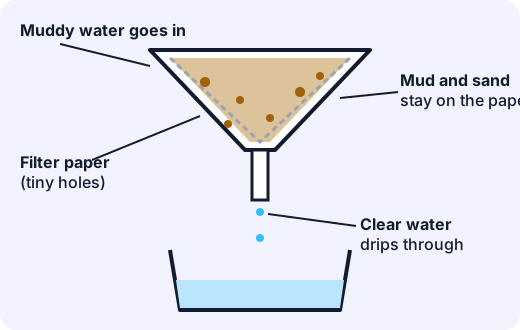
Making paneer is a good example. Hot milk is curdled with lemon juice; the lumps of curd are held back by a muslin cloth while the watery whey drains through.
Misconception. "A filter can take salt out of salt water." No. Dissolved salt is made of particles far smaller than the holes in any paper, so salty water goes straight through and the filtrate is still salty. Filtration separates undissolved solids from a liquid.
Method 3: Evaporation
To get a dissolved solid back, remove the liquid. Heat the solution (or leave it in the sun) and the water evaporates into the air; the solid stays behind. This is how sea salt is made in the shallow pans of the Gujarat and Tamil Nadu coast.
The water is not destroyed; it is now vapour in the air. If you wanted the water too, you would catch the vapour and cool it so it condenses. That method is called distillation, and you will meet it later.
Works when: the dissolved solid does not itself turn to vapour or burn when heated. Safety: an adult should do the heating, and you should stop before the last drops of liquid are gone, because the hot salt can spit.
Method 4: Chromatography
Black ink looks like one colour, but it is often a mixture of several dyes. Chromatography separates dissolved substances like these.
Put a small dot of ink on a strip of filter paper, stand the strip with its tip in a little water (the dot must stay above the water), and wait. Water creeps up the paper and carries the dyes with it. But the dyes do not travel at the same speed: a dye that dissolves well in water and clings little to the paper travels far, while one that sticks to the paper travels only a short way. After some minutes the dot has spread into a column of separate colours.
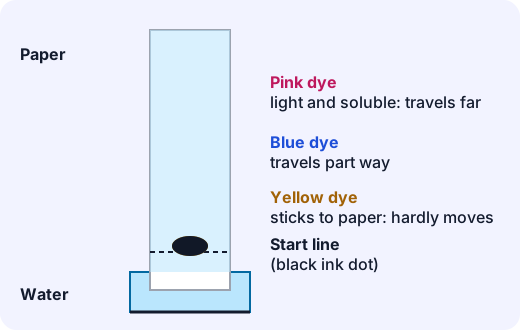
Chromatography is used to check food colours for banned dyes, to test whether a water sample holds a pollutant, and by detectives to match an ink on a note to a pen. The same idea separates the pigments in a spinach leaf.
Two more for dry mixtures
- Sieving. Pieces of different sizes. The chalni that sifts lumps out of flour, or the sieve that holds back stones while sand passes.
- Magnetic separation. Iron and steel are attracted to a magnet; sand and plastic are not. Scrapyards lift steel out of rubbish this way.
Farmers also use winnowing: tossing grain and husk in the air so the breeze blows the lighter husk away. It works because the parts differ in weight.
Choosing the method
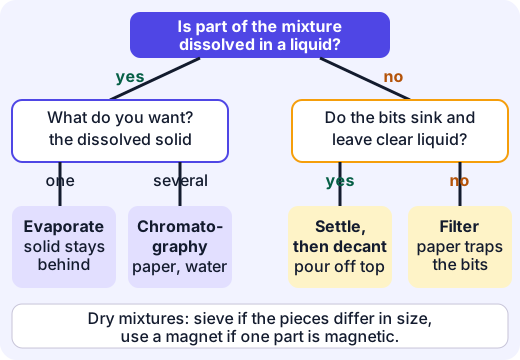
Ask in this order: Is some of it dissolved? Do the undissolved bits sink? How big and how magnetic are the pieces?
Example. The bowl from the start has dry sand, iron filings and salt.
- Magnet. Move a magnet through the dry mixture: the iron filings stick to it. The iron is out, and it is the one that differs by magnetism.
- Add water and stir. The salt dissolves; the sand does not.
- Filter. Pour through filter paper. Sand is trapped on the paper (residue). Salt water passes through (filtrate).
- Evaporate the filtrate. The water leaves as vapour and the salt crystals are left in the dish.
Three piles, four steps. The order matters: if you had added water first, the iron filings would have to be picked out of wet sand.
Try it: The lab for this unit gives you seven mixtures and a set of tools. Plan the steps in order, and see what each tool does to the mixture. If a step does nothing, read why: the answer is nearly always about how the parts differ.
When there is more than one way
Muddy water can be separated by settling and decanting or by filtering; filtering is faster and gets the water clearer. Two methods may both be correct. But some choices are plainly wrong: a sieve will never separate salt from water, and evaporation will never separate sand from stones. Always give a reason that names the difference between the parts: size, weight, magnetism or solubility.
Lab
The separation bench
Seven mixtures, eight tools. For each mixture, choose the tools in the right order to get every part into its own pile. A wrong choice is refused with the reason, so you learn what each method needs.
Your goals
- Separate all seven mixtures into their parts.
- For each, be able to say what property of the parts the method uses (size, weight, magnetism, solubility).
The interactive lab opens once you register. Register to do this.
Quick check
Separating substances check
Eight questions on choosing and using the right separation method.
1.You pour salt water through filter paper into a clean beaker. What do you find in the beaker?
- Pure water; the paper kept the salt back.
- Salt water; the dissolved salt passed through with the water.
- Nothing; the paper soaks it all up.
Choose one
2.What is the best way to get the salt itself out of a salt solution?
- Filtering
- Sieving
- Letting the water evaporate
- Using a magnet
Choose one
3.Match each mixture to the method that suits it.
- Lumps in wheat flour
- Steel pins spilled into sand
- Tea leaves in brewed tea
- The different dyes in a green felt-tip pen
Match each to: Magnet · Chromatography · Sieve · Filter
4.Put the steps for getting both sand and salt out of a dry mixture of the two in the right order.
- Filter the mixture; the sand stays on the paper
- Add water and stir so the salt dissolves
- Heat the filtrate until the water has evaporated and salt is left
Put these in order
5.Which of these mixtures can be separated by filtering? Choose all that apply.
- Sand stirred into water
- Salt dissolved in water
- Tea leaves in hot water
- Ink dyes dissolved in water
Choose all that apply
6.A 250 g dry mixture of sand and salt is separated. The sand left on the filter paper, once dried, weighs 60 g. Assuming nothing was lost, how many grams of salt are in the evaporating dish?
Answer with a number
7.What is the solid left behind on the filter paper called?
Answer with a word or phrase
8.A student sets up chromatography with the ink dot lower than the water level in the beaker. The dot just disappears and no colours appear on the paper. Why?
- The dot dissolved into the water in the beaker, so nothing was left to climb the paper.
- Black ink is always one dye.
- Paper cannot soak up water.
Choose one
Answering and checking are for registered learners. Register to do this.
Quick check
Separating substances - new puzzles
Four problems that need the idea "the parts differ" in new settings.
1.A gold panner swirls river sand and water in a wide dish and tips the water out gently. A few specks of gold are left in the dish. Which difference between gold and sand does this use?
- Gold is magnetic and sand is not.
- Gold is much heavier for its size, so it sinks and stays while lighter sand is washed away.
- Gold dissolves in water and sand does not.
Choose one
2.Sawdust is mixed into dry sand. Wood floats on water and sand sinks. Which plan separates them?
- Use a magnet.
- Stir the mixture into water, then scoop or pour off the floating sawdust and keep the sand that sank.
- Evaporate the mixture over a flame.
Choose one
3.Seawater holds roughly 35 g of dissolved salt in every litre. A salt farmer lets 40 litres of seawater evaporate completely. About how many grams of salt are left?
Answer with a number
4.A chromatogram of the ink on a note shows three coloured spots at exactly the same heights as the three spots from pen A. What can you reasonably conclude?
- The note's ink contains the same dyes as pen A, so pen A could have been used.
- Pen A certainly wrote it, and no other pen could match.
- Chromatography cannot compare inks.
Choose one
Answering and checking are for registered learners. Register to do this.
Your turn
Explain your choices
Answer in your own words. In each part, name the difference between the parts that your method uses.
- A friend says "You can get the sugar back out of sugar water by pouring it through filter paper." Say whether that works, and explain why or why not.
- A bowl holds dry iron filings, dry chalk powder and table salt (chalk does not dissolve in water). Describe a set of steps that gives you all three, in order, and say why the order matters.
- Choose a real separation from home, farm or kitchen (for example making paneer, winnowing grain, or making salt) and explain which method is used and what difference between the parts makes it work.
How it's judged
- Dissolved versus undissolved
- Planning a multi-step separation
- Real-world example
Writing and submitting your answer is for registered learners. Register to do this.
Like what you see?
Register for free to answer the quick checks, do the activities and save your work. Your work is saved on your device and syncs to your account.