Unit 9
Water's changes of state
Find out why wet clothes dry, why a cold glass "sweats" and why melting ice stays at 0 °C, and test what makes water evaporate faster.
Read
Where did the puddle go?
After a monsoon shower there is a puddle on the school playground. By afternoon it is gone. Nobody mopped it up and it did not soak into the concrete. Meanwhile, a glass of cold nimbu pani on the table is covered in drops on the outside. Where did the puddle go, and where did those drops come from? Both stories are about water changing from one state to another, and both come down to one idea: a change of state needs energy to go in or come out.
Three states, one substance
Water exists as a solid (ice), a liquid (water) and a gas (water vapour). It is the same substance every time. What changes is how the tiny particles of water are arranged and how freely they move.
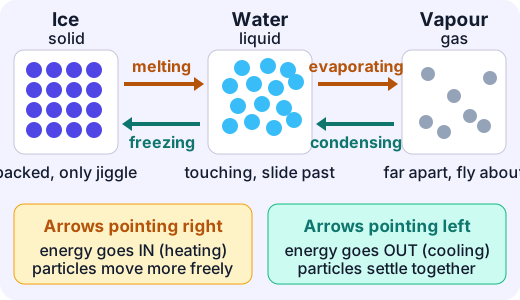
- In ice the particles are packed in a fixed pattern. They jiggle on the spot but cannot move around.
- In liquid water the particles still touch, but they slide past each other. That is why water pours.
- In water vapour the particles are far apart and fly about in all directions. Vapour is invisible. It fills whatever space it is in.
The four changes are named for what happens:
Change From → to Energy Melting solid → liquid goes in Freezing liquid → solid comes out Evaporation (and boiling) liquid → gas goes in Condensation gas → liquid comes out Heating gives the particles more energy, so they move faster and break free of their neighbours. Cooling takes energy away, so they slow down and settle together.
Melting and boiling: the flat parts of the graph
Put crushed ice at in a beaker and heat it steadily, reading the thermometer every minute. This is what you would find.
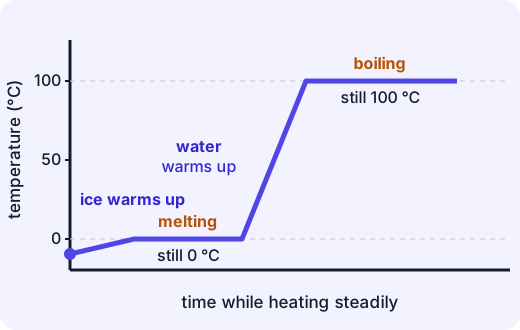
The thermometer does not rise all the time. While the ice is melting it stays at , even though the burner is still on. All the energy is being used to pull the particles out of their fixed places, not to make them move faster. Only when every bit of ice has melted does the temperature climb again. It then rises to about (at sea level) and stops again while the water boils into vapour. Boiling takes a lot of energy: turning water at into vapour at needs more than five times the energy that heated it from to .
Misconception. "If you keep heating something, its temperature keeps rising." Not during a change of state. Heat and temperature are different things: heat is energy moving, temperature measures how hot something is. During melting and boiling, energy goes in but the temperature stays flat.
Example. A cold drink has ice in it. You take a sip on a hot day and the drink is still cold even after twenty minutes, though the room is warm. The ice is absorbing energy from the drink to melt, and while any ice remains the mixture stays near . Once the ice is gone the drink warms up quickly.
Evaporation: the puddle disappears
Water does not have to boil to become vapour. At the surface of a puddle some particles are moving fast enough to escape into the air. That is evaporation. It happens at any temperature, only at the surface, and slowly. Boiling happens only at the boiling point, all through the liquid, and fast (you see bubbles of vapour forming inside).
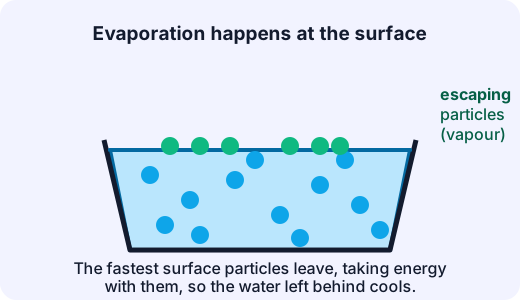
The particles that escape are the fastest ones, the ones with the most energy. They take that energy with them, so the water that is left becomes a little cooler. This is why sweat cools you down: it evaporates from your skin, taking energy from your body. It is also why a wet cloth feels cold on your forehead.
Four things change how fast water evaporates.
Factor Faster evaporation Why Temperature warmer particles have more energy to escape Surface area a wide, shallow dish more particles are at the surface Moving air wind or a fan it carries escaped vapour away, so fewer return Humidity dry air air that already holds a lot of vapour can take little more Salt farmers on the coast of Gujarat use all four. They let seawater into wide, shallow pans so there is a huge surface, and they leave it in the hot sun and wind of a dry season. The water evaporates and the salt stays behind.
Try it: Put the same amount of water in a saucer and in a narrow cup, side by side in the shade. Mark the water level, and look again after a day. Which went down more? Change only one thing at a time, or you will not know which change caused the effect. That is a fair test, and the lab in this unit lets you run them on a virtual tray of water.
Condensation: the drops outside the glass
Air always holds some invisible water vapour. When that air touches something cold, the vapour particles lose energy, slow down and clump together as tiny drops of liquid. That is condensation. The drops on the nimbu pani glass did not leak through the glass. They came out of the air. You can check: if the drink is in a closed bottle you will find the water inside the bottle has not gone down.
Condensation also warms what it lands on, because the vapour releases the energy it took to evaporate. A burn from steam is worse than a burn from hot water at the same temperature for exactly this reason: the vapour condenses on your skin and gives out all that extra energy.
More everyday examples:
- Mist on a bathroom mirror after a hot shower: warm, damp air meets the cool glass.
- Drops on the inside of a pan lid: vapour from the boiling water touches the cooler lid.
- Dew on grass at dawn: the ground cools overnight and the air next to it cannot keep all its vapour.
- Clouds: air rises and cools, and vapour condenses on dust specks into droplets so tiny they float.
Misconception. "The white cloud from a kettle spout is steam." Real steam, the vapour, is invisible. The white cloud you can see is made of tiny liquid droplets that formed when the vapour met cooler air. You are looking at condensation.
Putting it together
Next time you see a change of state, ask two questions. Which way is it going, and is energy going in or coming out? Drying clothes: liquid to gas, energy in (from sun and air). Dew: gas to liquid, energy out. Ice lollipop dripping: solid to liquid, energy in from the warm air. A pond freezing in the Himalayan winter: liquid to solid, energy out into the cold air.
If you can answer those two questions, you can explain any change of state, from the puddle in the playground to the clouds that made it.
Lab
Evaporation fair tests
A tray of water dries in a virtual room. Run the starting settings, then change one thing at a time (temperature, dish, air movement, humidity) and compare each run with the first. Then write what your tests show.
Your goals
- Run the starting settings and then four fair tests, each changing only one factor.
- Use your table to say whether warmth, a wide surface, moving air and humid air make evaporation faster or slower.
The interactive lab opens once you register. Register to do this.
Quick check
Changes of state check
Eight questions on melting, evaporation, condensation and the energy that goes with them.
1.A beaker of crushed ice at 0 °C is heated steadily. While the ice is melting, what does the thermometer in it show?
- It rises steadily, because the burner is still on.
- It stays at 0 °C until all the ice has melted.
- It falls below 0 °C.
Choose one
2.Which of these make a puddle evaporate faster? Choose all that apply.
- A warm day
- The same water spread in a wide, shallow layer
- A breeze blowing across it
- Very humid air
Choose all that apply
3.Drops form on the outside of a cold glass of water on a warm day. Where did that water come from?
- It leaked through tiny holes in the glass.
- It was water vapour in the air that condensed on the cold glass.
- The cold turned the glass itself into water.
Choose one
4.Match each everyday event to the change of state it shows.
- Wet clothes drying on a line
- Mist on a bathroom mirror
- Water in an ice tray turning hard
- A kulfi dripping in the sun
Match each to: Freezing · Melting · Condensation · Evaporation
5.Ice at -10 °C is heated steadily until the water boils. Put the stages in the order they happen.
- The water boils, staying at 100 °C
- The ice warms up to 0 °C
- The ice melts, staying at 0 °C
- The water warms up to 100 °C
Put these in order
6.On a hot day you sweat, and a breeze makes you feel cooler. Why does the sweat cool you?
- Sweat is colder than your skin to begin with.
- Evaporating sweat takes energy from your skin.
- Sweat condenses and gives out cold.
Choose one
7.What is the name of the change when water vapour becomes liquid water?
Answer with a word or phrase
8.At sea level, a pan of water has been boiling hard for ten minutes on a strong flame. What does a thermometer in the boiling water read, in °C?
Answer with a number
Answering and checking are for registered learners. Register to do this.
Quick check
Changes of state - new puzzles
Four situations you have not seen before. Use what you know about energy and changes of state.
1.Water in an unglazed clay pot (matka) stays cooler than the air around it. A little water seeps through the clay and evaporates from the outside. Why does that keep the water inside cool?
- Evaporation takes energy from the pot and the water inside.
- Clay is a natural freezer.
- The evaporating water gives energy to the pot.
Choose one
2.Three days, same cold glass of water each time. On which day would the outside of the glass collect the most drops?
- A hot, very dry day
- A hot, very humid day
- A cool, dry day
Choose one
3.A wet towel dries in 90 minutes in still air. In front of a fan the water evaporates three times as fast, and nothing else changes. How many minutes does it take to dry?
Answer with a number
4.A salt farm lets seawater into large, shallow pans. Which design choices help get the salt out sooner? Choose all that apply.
- Shallow, wide pans, to expose more surface
- Working in the dry season with a steady wind
- Putting a lid over each pan
- Making the pans deep and narrow
Choose all that apply
Answering and checking are for registered learners. Register to do this.
Your turn
Explain the changes
Answer in your own words. Use the ideas of particles and of energy going in or out.
- A friend says "A pan of water on a stove must get hotter and hotter until it is all gone." Describe what the temperature does as ice at -10 °C is heated all the way to boiling, and say why there are flat parts.
- After a hot shower, the mirror is covered in mist. Explain where the water on the mirror came from, which change of state it shows, and why it does not form on a warm dry day.
- Plan a fair test to find out whether a wide dish dries faster than a narrow one. Say what you change, what you keep the same, and what you measure.
How it's judged
- Temperature and change of state
- Explaining condensation
- Fair test design
Writing and submitting your answer is for registered learners. Register to do this.
Like what you see?
Register for free to answer the quick checks, do the activities and save your work. Your work is saved on your device and syncs to your account.