Unit 3
Pushes and pulls
Find out what makes things start, stop and change direction, and why a tug-of-war can end in a tie.
Read
Why things start, stop and turn
It is sports day at Kavya's school and the last event is tug-of-war. Her class is on the left end of the rope. The other class is on the right. A red flag is tied in the middle.
"Pull!" calls the teacher. Everyone leans back, hands tight on the rope. The flag wobbles... and stays exactly where it is. Both teams are pulling hard, and nothing moves.
How can that be? Why does the flag move sometimes and not other times? To answer, we need the idea of a force.
What is a force?
A force is a push or a pull. You use forces all day long: you push a door, pull a drawer, kick a ball, squeeze a lemon, stretch a rubber band.
A force can do four things to something that is moving, or not moving:
A force can... Example start something moving kicking a ball that is lying still stop something moving a goalkeeper catching the ball speed it up or slow it down pedalling harder, or squeezing the brakes change its direction hitting a cricket ball back the way it came Notice that all four are about a change in motion. That gives us the big idea of this unit:
A change in motion needs a force.
A force can also change a shape (squashing clay), but here we focus on motion.
Balanced and unbalanced forces
Usually more than one force acts on a thing at once. What matters is whether the forces add up to a difference.
- Balanced forces are equal in size and pull in opposite directions. They cancel out, so there is no change in motion. A thing that is still stays still. A thing that is moving keeps moving the same way.
- Unbalanced forces are not equal. The bigger force wins, and the thing changes its motion in the direction of the bigger force.
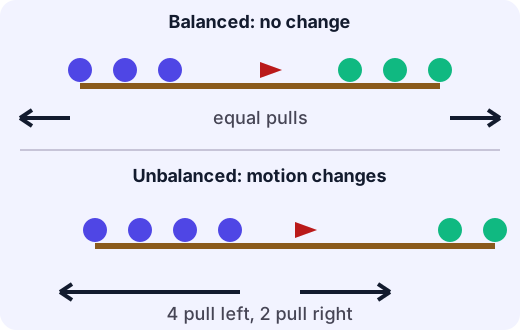
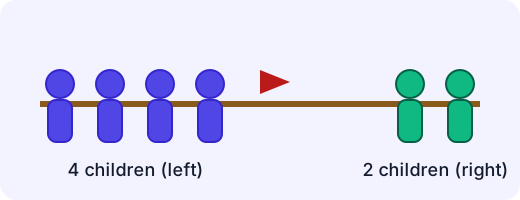
Example. Kavya's team has 4 strong pullers; the other team has 4 pullers of the same strength. The pulls are balanced, so the flag stays put. Now two of the other team let go. Kavya's team now pulls with 4 and the other team with 2. The forces are unbalanced by the pull of 2 children, so the rope and flag move toward Kavya's side.
Try it: Find a friend and a rope or towel. First pull equally, then one person pulls harder. Which way does the middle go each time?
"But nothing is moving, so there are no forces!"
That is a very common mistake. A book lying on a table is not moving, but forces are acting on it. Gravity pulls the book down. The table pushes it up. These forces are balanced, so the book stays still. Take the table away and the forces are suddenly unbalanced, and the book falls.
So "still" does not mean "no forces". It means the forces are balanced.
"Doesn't something need a push to keep it moving?"
Another common idea is that a rolling ball keeps moving only because something keeps pushing it. It is the other way round. A ball rolling on the floor slows down and stops because a force acts against it: friction, the rubbing between the ball and the floor (and a little from the air). That is an unbalanced force that slows the ball. On very smooth ice, there is less friction, so a sliding puck keeps going much farther.
Patterns of motion help us predict
Motion often follows a pattern. Hang a heavy nut on a string, hold the string up, pull the nut to one side and let go. This is a pendulum.
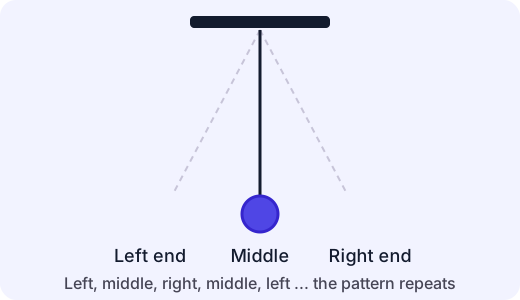
It swings from left to right and back again, over and over. Each swing takes about the same time. Gravity pulls it back toward the middle each time. If it takes 2 seconds to go from the left end to the right end and back to the left, then after 4 seconds it is at the left again, and after 6 seconds it is at the left again. Once we know the pattern, we can predict where it will be.
This is useful. The same idea lets you time when to push a swing: a little push at the right moment each time keeps it going. (Without any pushes, the swing gradually gets smaller, because friction and air resistance take a little energy away each time.)
Worked example: a toy car on a floor
Tomás gives a toy car one push along a smooth floor. It rolls, then slows, then stops.
- The push is a force. It started the car moving.
- After he lets go, nothing pushes the car forward. Friction pulls backwards on the wheels.
- Friction is the only unbalanced force, so the car slows down and stops.
- Prediction: on a rough carpet there is more friction, so the car will stop sooner.
Remember
- A force is a push or a pull.
- A force can start, stop, speed up, slow down or change the direction of motion.
- Balanced forces: no change in motion. Unbalanced forces: motion changes in the direction of the bigger force.
- A change in motion needs a force. Still does not mean "no forces".
- Patterns of motion, like a pendulum, let us predict what comes next.
Lab
The tug-of-war crate
Two teams pull a crate along a floor. Set how many people pull on each side and see what the crate does. First try the challenges, then predict three new set-ups before you press Go.
Your goals
- Keep the crate still while both teams pull hard.
- Make the crate move right, then make it move left.
- Predict what the crate will do in three set-ups, then check.
The interactive lab opens once you register. Register to do this.
Activity
Force detectives
Hunt for pushes and pulls at home, then use a swinging weight to predict a pattern of motion. About 30 minutes.
You'll need
- Paper and a pencil
- A piece of string about 1 metre long
- A small weight, for example a nut, a key or a small bag of coins
- A watch or phone with a timer
- A toy car and a smooth floor, and a mat or towel
Steps
- Walk around your home for 5 minutes. Find 10 pushes and pulls (opening a tap, pulling a drawer, kicking a ball, pressing a doorbell). Make a table with two columns, Push and Pull.
- For three of them, write what the force changed: it started, stopped, sped up, slowed down or changed the direction of something.
- Make a pendulum. Tie the weight to one end of the string and hold the other end steady (tape it to a table edge so the weight hangs free). Make sure nobody is close to the swing path.
- Pull the weight a hand-width to one side and let go. Do not push it. Time 10 full swings (left to right and back counts as one) and divide by 10 to get the time for one swing.
- Predict first: where will the weight be after 3 swings plus half a swing? Write your prediction, then watch to check.
- Predict again: if you let go from a bigger angle, will one swing take much longer? Write your prediction, then test with two or three releases. Try it with a shorter string too.
- Toy car test: give the car the same push on a smooth floor and then on a mat or towel. Predict which goes farther. Mark where it stops and measure.
Safety
- Use a light weight on the string and keep faces and other people out of its path.
- Tie string only to things that cannot fall on you (a table edge or a stand), never around a neck or a finger.
- Clear the floor so nobody trips over the car.
Keeping a log of the activity is for registered learners. Register to do this.
Quick check
Pushes and pulls check
Seven questions about forces and motion.
1.What is a force?
- A push or a pull
- Anything that moves fast
- Anything that is heavy
Choose one
2.Which of these involve a force? Pick all that do.
- Kicking a football
- Pulling a toy wagon
- The colour of the football
- Pushing open a door
Choose all that apply
3.Look at the tug-of-war. Which way will the flag move?
- To the left
- To the right
- It stays still
Choose one
4.In the same tug-of-war (4 children pull left, 2 pull right, all equally strong), by how many children's worth of pull is the left team stronger?
Answer with a number
5.A book is lying still on a table. Which statement is true?
- No forces act on it, because it is not moving
- Forces act on it, but they are balanced (gravity pulls down, the table pushes up)
- The forces are unbalanced, but the book is too heavy to move
Choose one
6.Match each situation to what the force does to the ball.
- A player kicks a ball lying on the grass
- A goalkeeper catches a flying ball
- A batter hits a ball back the way it came
Match each to: Changes its direction · Stops it · Starts it moving
7.A pendulum takes 2 seconds to swing from the left end to the right end and back to the left end. It is released from the left end. Where is it after 6 seconds?
- At the left end
- At the right end
- In the middle
Choose one
Answering and checking are for registered learners. Register to do this.
Quick check
New puzzles
Forces in some new situations. Think about balanced and unbalanced forces.
1.Aisha pushes a box along the floor at a steady speed, with no speeding up or slowing down. What does this tell you about the forces on the box (her push forwards and friction backwards)?
- They are balanced - her push equals the friction
- Her push is bigger than the friction
- The friction is bigger than her push
Choose one
2.Two teams of 7 children play tug-of-war and it is a tie. Then 2 children on the second team let go. How many more children pull on the first team's side than on the second team's?
Answer with a number
3.Rohan gives a swing one push and then sits still. The swing keeps going but each swing is a little smaller until it stops. Why?
- Friction and air push against the swing's motion, which gradually takes the swinging away
- There are no forces on the swing, so it just stops
- The swing gets tired
Choose one
4.A ball rolls to the right across the playground. A gust of wind blows steadily from the right. What happens to the ball's speed?
- It slows down
- It speeds up
- It stays exactly the same
Choose one
Answering and checking are for registered learners. Register to do this.
Your turn
Does a moving thing need a push?
Your friend says: "A ball only keeps rolling if something keeps pushing it. Once nothing is pushing, it stops because it has no force on it."
Write a reply of 6 to 10 sentences. Include:
- What the friend gets right or half-right about the ball, and what is missing.
- A balanced or unbalanced forces explanation of why a ball rolling on a floor slows down and stops.
- A prediction about what would happen if the ball rolled on a much smoother surface, such as ice, and why.
How it's judged
- Balanced and unbalanced forces
- Correcting the idea
- Prediction
Writing and submitting your answer is for registered learners. Register to do this.
Like what you see?
Register for free to answer the quick checks, do the activities and save your work. Your work is saved on your device and syncs to your account.