Unit 5
Comparing life cycles
Follow a butterfly, a frog, a hen and a mustard plant from the start of life to the next generation, and find the pattern they all share.
Read
Same pattern, different paths
When the monsoon rains come, Zainab's grandfather takes her to the edge of the village pond. The water is full of tiny black dots with wriggling tails.
"Are those fish?" she asks.
"Wait and see," he says. They come back every week. The dots grow fat. First two back legs appear, then two front legs. The tails get shorter. One evening, a small frog is sitting on a leaf where the tadpoles used to be.
Zainab has just watched a life cycle: the stages that a living thing goes through from the start of its life to the time it makes new living things like itself. You already know the life cycles of a few living things. Now let us compare them, and find out what they have in common.
Four life cycles
Here are four very different living things.
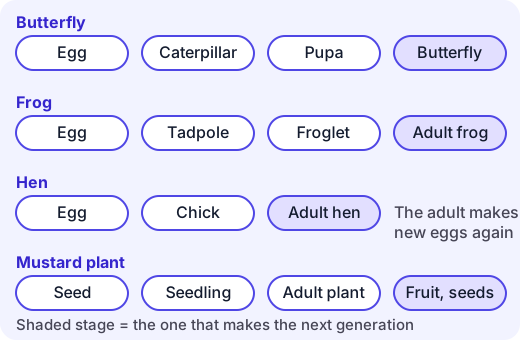
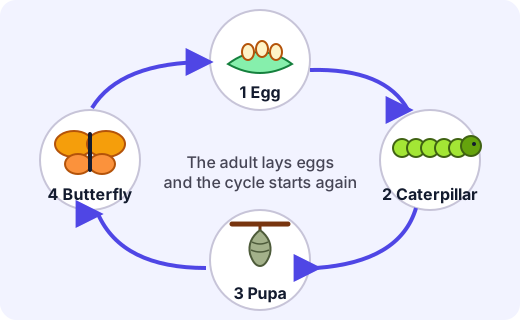
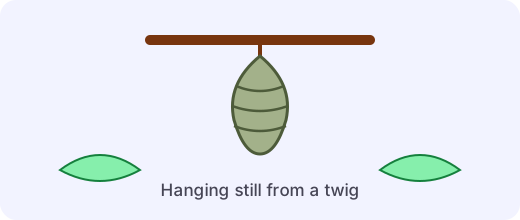
The butterfly has four stages. The female lays tiny eggs on a leaf. A caterpillar (the larva) hatches and eats leaves all day, growing and shedding its skin. Then it becomes a pupa, hanging still in a hard case called a chrysalis (moths often make a silk cocoon instead). The pupa does not move or eat, but inside, its body is rebuilt. A winged adult butterfly comes out. It mates and lays eggs, and the cycle starts again.
The frog also has four stages. Eggs are laid in water. A tadpole hatches. It has a tail and gills, and lives like a fish. As it grows it gets back legs, then front legs, and its tail shrinks. This young frog with legs and a small tail is a froglet. The adult frog breathes air with lungs and can live on land and in water.
The hen has three stages. A hen lays an egg. If the egg is kept warm for about three weeks, a chick hatches. A chick already looks like a small hen, and it only has to grow bigger and swap its fluffy down for feathers. The adult hen lays eggs of its own.
The mustard plant is a living thing too, and it has a life cycle. A seed sprouts when it gets water and warmth. The seedling grows leaves and a stem. The adult plant makes yellow flowers. After the flowers are pollinated, they become pods with new seeds inside. The mustard plant dies after a few months, but the seeds start the next generation.
What is the same?
The paths look very different, but each one has the same four jobs:
- Begin. Life starts as an egg, a seed, or a baby.
- Grow. The young one gets bigger and changes.
- Reproduce. The adult makes new living things like itself.
- Die. Every living thing's life ends. The new generation carries on.
So there is the big idea of this unit:
Every life cycle includes birth, growth, reproduction and death.
The words may differ ("hatch", "sprout", "be born") but the pattern is the same. Because the new young ones start again, we draw a life cycle as a circle.
What is different?
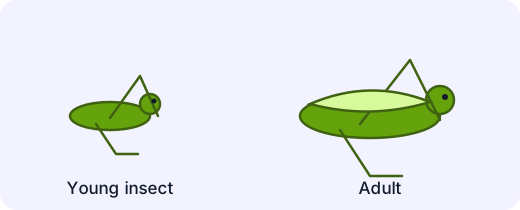
Question Butterfly Frog Hen Mustard plant How many stages? 4 4 3 4 Does the young one look like the adult? No, a caterpillar is very different No, a tadpole is very different Yes, a chick looks like a small hen No, a seed and a seedling are very different from the adult Where does it start? Egg on a leaf Egg in water Egg, kept warm Seed in soil Other living things have other patterns. A grasshopper has only three stages: egg, nymph and adult. A nymph looks like a small adult without wings, and it grows by shedding its skin, with no pupa stage. Cows, dogs and people start differently again: the baby grows inside its mother and is born alive, and the mother feeds it milk. Lengths differ hugely too. An adult mayfly may live only a day. A housefly lives about a month. A dog lives about ten to fifteen years, and a banyan tree can live for hundreds of years.
Worked example: comparing a frog and a hen
- Find the stages. Frog: egg, tadpole, froglet, adult. Hen: egg, chick, adult.
- Find what is shared. Both start as eggs, grow, become adults that make eggs, and die.
- Find what is different. The frog has one more stage, and its young (the tadpole) looks and lives very differently from the adult. The hen's chick is like a small adult.
- Write a conclusion. The two life cycles follow the same pattern (birth, growth, reproduction, death) but not the same path.
Mistakes to avoid
- "A caterpillar and a butterfly are different animals." They are the same animal at two stages of one life.
- "Only animals have life cycles." Plants have them as well. A seed is the beginning, and a plant that makes seeds closes the circle.
- "All animals hatch from eggs." Birds, insects, frogs and fish do. Mammals (cows, dogs, humans) give birth to live young.
- "The pupa is just sleeping." The inside of a pupa changes completely; the caterpillar's body is rebuilt into a butterfly.
Try it: Choose a creature or plant near you: a mosquito (egg, wriggler, pupa, adult), a mango tree, a chicken, or your pet. Find out its stages and put them in a circle. Which of the four jobs happens at which stage?
Remember
- A life cycle is the series of stages in a living thing's life, from its beginning to making the next generation.
- Different living things have different numbers of stages, and young ones may look like or very unlike their parents.
- All life cycles share the same pattern: birth, growth, reproduction and death.
- We draw a life cycle as a circle, because the new generation starts again.
Lab
The life cycle sorter
Put the stage cards of four life cycles in order, find the stage where each one reproduces, then work out what all four share.
Your goals
- Put the stages of the butterfly, frog, hen and mustard plant in the right order.
- Choose the stage of each that makes the next generation.
- Pick the things that every life cycle shares.
The interactive lab opens once you register. Register to do this.
Activity
Grow one, compare two
Watch a seed's life cycle begin, then research one animal's life cycle and compare the two. About 20 minutes a day for five days, plus 30 minutes to compare.
You'll need
- About 10 whole moong (green gram), chana or mustard seeds
- A small bowl and a clean cloth or kitchen paper, plus water
- Paper, pencil and coloured pencils
- A book, a video or a grown-up to help you find the life cycle of one animal (a butterfly, frog, hen, mosquito, cockroach, or any other)
Steps
- Day 1: soak the seeds in water for about 8 hours. Drain them and spread them on the damp cloth in the bowl. Keep the cloth damp and the bowl in a warm place out of the sun.
- Draw a seed and write the date. Each day, rinse the seeds gently with clean water and draw what you see: seed, split seed, tiny root, shoot, first leaves. Measure the longest shoot with a ruler.
- On day 5, put the best seedling in a pot of soil or a cup of damp soil and keep watering it. Predict what stage will come next, and how long it might take.
- Choose one animal. Find out its stages in order, and draw them in a circle with arrows. Write what each stage is called and one thing that happens in it.
- Make a comparison table with two columns: the plant and the animal. Add rows for: stages in order, how many stages, does the young one look like the adult, how long each stage takes (if you can find out).
- Under the table, write two sentences that start with 'They are the same because...' and 'They are different because...'. Mark on both circles where growing, reproducing and dying happen.
Safety
- Wash your hands after handling seeds, soil or animals.
- Do not eat sprouts unless a grown-up says they are safe. Sprouts grown at home can carry germs and are safer cooked.
- If you look for caterpillars, tadpoles or insects outdoors, take a grown-up and keep away from pond edges. Do not touch hairy caterpillars, which can irritate skin. Look, draw and leave them where you found them.
Keeping a log of the activity is for registered learners. Register to do this.
Quick check
Life cycles check
Eight questions about the life cycles of different living things.
1.Put the stages of a butterfly's life cycle in order, from the start.
- Egg
- Pupa
- Caterpillar
- Adult butterfly
Put these in order
2.Which stage of the butterfly's life cycle is this?
- Egg
- Caterpillar
- Pupa
- Adult butterfly
Choose one
3.Which of these are part of every life cycle? Pick all that apply.
- Life begins
- The young one grows
- The adult makes new living things like itself
- Life ends
- A pupa stage
- Wings
Choose all that apply
4.Which young animal already looks like a small version of its parents when it hatches?
- A caterpillar
- A tadpole
- A chick
- A mosquito wriggler
Choose one
5.A mosquito goes through egg, wriggler (larva), pupa and adult. How many stages is that?
Answer with a number
6.Dev says, "Plants do not have life cycles, because only animals are born." Which reply is best?
- Plants start as seeds, grow, make flowers and new seeds, and die, so they have a life cycle too
- Dev is right, because plants are not alive
- Only trees have life cycles, not small plants
Choose one
7.Match each living thing to its young stage.
- Butterfly
- Frog
- Hen
- Mustard plant
Match each to: Caterpillar · Chick · Tadpole · Seedling
8.Which statement correctly compares the frog's and the hen's life cycles?
- Both follow the same pattern of birth, growth, reproduction and death, but the frog's young looks very different from the adult and the hen's chick does not
- They have nothing in common, because one lives in water
- They have exactly the same stages
Choose one
Answering and checking are for registered learners. Register to do this.
Quick check
New puzzles
Use what you know about life cycles on some living things you have not met yet.
1.A silk farmer collects cocoons made by silk moth caterpillars (silkworms). A silk moth has the same four stages as a butterfly. Which stage is resting inside the cocoon?
- The egg
- The caterpillar eating mulberry leaves
- The pupa
- The adult moth, laying eggs
Choose one
2.Rani finds a tiny insect with no wings that looks like a small copy of an adult grasshopper. It has not been through a pupa stage. Which stage is it?
- An egg
- A nymph
- A pupa
- An adult
Choose one
3.A butterfly has four stages and a grasshopper has three. How many more stages does a butterfly have?
Answer with a number
4.A farmer sows rice seeds. The seeds sprout, the plants grow, flower and make grains. What are the new grains in the life cycle of rice?
- New seeds, the beginning of the next generation
- The end of rice, with nothing after it
- Seedlings
Choose one
5.Imran draws a butterfly's life as a straight line from egg to adult, and stops there. What is missing from his drawing?
- The adult lays eggs, so the line should join back to the start to make a cycle
- Nothing, a life cycle is a straight line
- The butterfly should be coloured in
Choose one
Answering and checking are for registered learners. Register to do this.
Your turn
Same pattern, different path
A younger child asks you two questions:
- "A frog starts as a tadpole and a hen starts as a chick. Are their lives the same or different?"
- "A plant is not an animal. Does it have a life cycle?"
Write 6 to 10 sentences to answer. Include:
- The stages of a frog's life cycle and a hen's, in order.
- One way they are different and one way they are the same.
- The life cycle of a plant you know (for example a bean, mango, rice or mustard), and which stage of it matches "reproduction".
- A sentence saying what all life cycles share.
How it's judged
- Stages in order
- Comparing
- What all life cycles share
Writing and submitting your answer is for registered learners. Register to do this.
Like what you see?
Register for free to answer the quick checks, do the activities and save your work. Your work is saved on your device and syncs to your account.