Unit 4
Magnets
Find out what magnets pull, why two magnets sometimes push each other away, and how far a magnet's pull reaches.
Read
The force you cannot see
Arjun is building a toy train for the science fair. He has two wooden carriages. On the back of one he sticks a small magnet, and on the front of the next carriage he sticks another. He pushes the carriages toward each other and, a finger-width apart, something odd happens: the second carriage jumps forward and clicks onto the first. Nobody touched it.
Then Arjun turns one magnet around. This time, when the carriages get close, the second one slides away, as if it did not want to be joined.
What is pulling and pushing the carriages across the gap? Last time you learned that a force is a push or a pull. A magnet gives us a force that works without touching.
What is a magnet?
A magnet is an object that pulls on some materials, and that can push or pull on other magnets. The pull of a magnet is called magnetic force. It is a real force: it can start things moving, stop them or change their direction, just like a kick or a tug. The surprise is that it works across a gap, through air, and even through paper, wood or water.
When a magnet pulls a thing toward itself, we say the magnet attracts it. When it pushes a thing away, we say it repels it.
Which materials do magnets attract?
Many people think a magnet sticks to every metal. It does not. A magnet attracts only a few materials:
- iron (a nail, a hammer head)
- steel (made mostly of iron: paper clips, pins, screws, many tins)
- nickel and cobalt (rarer metals)
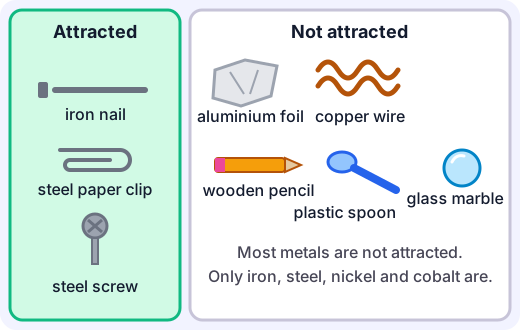
A magnet does not attract aluminium foil, copper wire, gold, silver, wood, plastic, glass, paper or rubber. Most metals are not magnetic. A few kinds of steel, such as some stainless steel spoons, are not attracted either, because of what else is mixed in. The only way to know is to test.
Try it: Take a magnet and test ten things around you. Before each test, write yes or no as your prediction. How many predictions were right? What did all the "yes" things have in common?
Poles: where the pull is strongest
A bar magnet is not equally strong everywhere. The pull is strongest at its two ends, which are called poles. One is the north pole (N) and the other is the south pole (S). If you hang a bar magnet from a string so that it can turn freely, its N end swings round to point roughly north. That is how compasses work: a compass needle is a tiny magnet, and the Earth itself acts like a very large one.
Two magnets can attract or repel, depending on which poles face each other:
- Unlike poles attract: N meets S and they pull together.
- Like poles repel: N meets N, or S meets S, and they push apart.
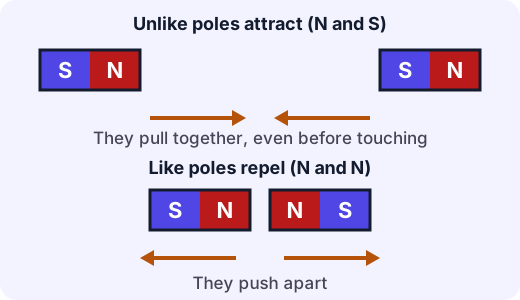
This is what happened to Arjun's train. When he turned a magnet around, he changed which poles faced each other, so the carriages went from attracting to repelling. A magnet always has both poles. If you cut a bar magnet in half, each piece is a smaller magnet with its own N and S.
Distance changes the pull
Hold a magnet far from a paper clip and nothing happens. Bring it closer, and at some distance the clip suddenly jumps toward it. The magnetic force gets weaker as the distance grows. Near the magnet the pull is strong; a bit farther it is weak; far enough away it is too weak to notice.
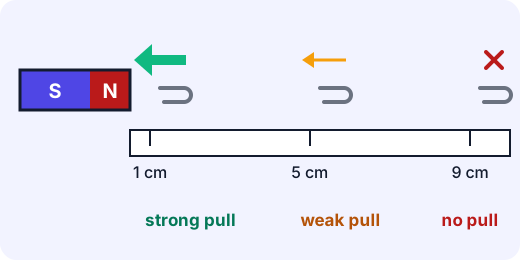
Example. Meera tests a fridge magnet by seeing how many paper clips it can pull sideways across a table from different distances.
Distance from magnet Clips that moved 1 cm 6 3 cm 3 5 cm 1 7 cm 0 Her results show the pattern: the farther the magnet, the weaker the pull. To keep her test fair she used the same magnet, the same kind of clips and the same table. She changed one thing only: the distance. If she had swapped to a stronger magnet halfway, she would not know whether the distance or the magnet caused the change.
Seeing the force pass through things
Put a paper clip on a sheet of card. Hold a magnet underneath and move it: the clip slides around on top, as if by magic. The magnetic force passes through thin card, paper, cloth and even a glass of water. Thick layers of material, and big gaps, weaken it, because both make the distance to the clip larger.
Remember
- A magnet is a force-maker: it attracts and repels without touching.
- Magnets attract iron, steel, nickel and cobalt. Most other materials are not attracted, so we test.
- The pull is strongest at the poles. Unlike poles attract, like poles repel.
- The farther away the magnet, the weaker the pull.
- To compare magnets or materials fairly, change one thing at a time.
Lab
The magnet bench
Three stations on one bench. Test eight materials, flip a magnet to see poles attract and repel, then find how far a weak magnet and a strong magnet can pull a paper clip. Predict first, then test.
Your goals
- Predict, then test, all eight materials and see which ones a magnet attracts.
- Find an arrangement where two magnets attract and one where they repel, then predict three more flips.
- Find the farthest distance at which the weak magnet and the strong magnet can still pull the clip.
The interactive lab opens once you register. Register to do this.
Activity
Magnet detectives
Test which things a magnet attracts, find out how poles behave, and measure how the pull changes with distance. About 40 minutes.
You'll need
- One or two magnets (a bar magnet, a toy magnet or a flat fridge magnet)
- Ten household objects to test (for example a nail, a paper clip, a coin, aluminium foil, a spoon, a key, a pencil, a plastic cap, a rubber band, a steel safety pin)
- About 10 identical paper clips
- A ruler and a sheet of card
- Paper and a pencil for tables
Steps
- Make a table with three columns: Object, My prediction (yes or no), Result. Write your predictions for all ten objects before you test any.
- Test each object by holding the magnet close to it. Write the result. Sort the objects into two piles: attracted and not attracted. Count how many predictions you got right.
- Look at the attracted pile. Write one sentence about what those objects have in common (hint: think about what they are made of).
- Poles: if you have two magnets, bring the ends together slowly and feel the push or pull. Mark the ends that attracted each other with the same coloured dot, then check what happens with the other ends. Write a rule about like and unlike poles.
- Distance test: lay the ruler on the table and put one paper clip at the 0 cm end, touching the ruler. Slowly slide the magnet toward the clip along the ruler and note the distance at which the clip first moves. Do this three times and write the three distances.
- Predict: will the pull still work through a sheet of card? Put a paper clip on the card, move the magnet underneath, and check. Try a thicker layer of two sheets and compare.
- Write what you changed and what you kept the same in the distance test. How did you make it a fair test?
Safety
- Small magnets can be dangerous if swallowed. Keep them away from young children and never put them in your mouth. Tell an adult at once if one is swallowed.
- Very strong magnets (the shiny, coin-like ones sold as toys or craft magnets) can pinch skin hard when they snap together. Use only the weak magnets for this activity unless an adult is helping.
- Keep magnets away from phones, tablets, bank cards, watches and anyone with a pacemaker or other medical device.
- Do not test sockets or anything plugged in. Use only objects that are not connected to electricity.
Keeping a log of the activity is for registered learners. Register to do this.
Quick check
Magnets check
Eight questions about what magnets do and how to test them.
1.Which of these would a magnet pick up? Pick all that apply.
- A steel paper clip
- A ball of aluminium foil
- An iron nail
- A wooden pencil
- A piece of copper wire
Choose all that apply
2.Chandni says, "A magnet sticks to every metal." Which test would show she is wrong?
- Hold a magnet near aluminium foil and see that it is not pulled
- Hold a magnet near an iron nail and see that it sticks
- Weigh the magnet on a kitchen scale
Choose one
3.Look at the two magnets. What will happen if you slide them closer together?
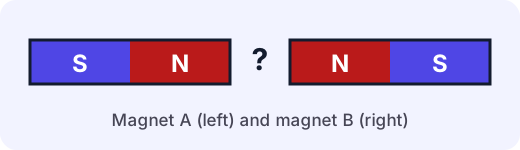
- They will attract and snap together
- They will repel and push apart
- Nothing will happen
Choose one
4.A magnet 2 cm away pulls a paper clip across a table without touching it. What does this show?
- A force must always touch something to work
- Magnetic force can act without touching
- The paper clip is lighter than air
Choose one
5.A magnet moved 4 clips from 1 cm away, 2 clips from 3 cm away and 0 clips from 5 cm away. How many fewer clips did it move from 3 cm than from 1 cm?
Answer with a number
6.Put these in order, from the strongest magnetic pull on a paper clip to the weakest.
- Clip 9 cm from the magnet
- Clip 1 cm from the magnet
- Clip 4 cm from the magnet
Put these in order
7.Ria lays a steel pin on a sheet of card and moves a magnet under the card. The pin slides along on top. Why?
- Magnetic force passes through the thin card and pulls the pin
- The card is magnetic
- The pin is alive and follows the magnet
Choose one
8.What are the two ends of a magnet, where the pull is strongest, called?
Answer with a word or phrase
Answering and checking are for registered learners. Register to do this.
Quick check
New puzzles
Magnets turn up in new places. Use what you know about attracting, repelling, poles and distance.
1.Maya threads two ring magnets onto a pencil standing upright. The top ring floats above the bottom ring and does not touch it. Why?
- The faces of the two rings that meet are like poles, so they repel
- The faces that meet are unlike poles, so they attract
- Rings of magnets stay up only because the pencil holds them
Choose one
2.A recycling plant uses a big magnet over a conveyor belt that carries mixed rubbish. The magnet lifts out the steel food tins. Which of these stay on the belt? Pick all that apply.
- Aluminium drink cans
- Steel food tins
- Glass bottles
- Plastic bottles
Choose all that apply
3.A compass needle is a small magnet. Its marked end is its N pole. Rohan brings the N pole of a bar magnet close to the marked end of the needle. What does the needle do?
- It turns toward the bar magnet
- It turns away from the bar magnet
- It does not move at all
Choose one
4.Zoya wants to find out whether distance changes how strongly a magnet pulls. Which plan is a fair test?
- Use the same magnet and the same clips every time, and change only the distance
- Use a different magnet at each distance, to see which is best
- Use more clips each time the magnet is moved farther away
Choose one
Answering and checking are for registered learners. Register to do this.
Your turn
Explain it to a friend
Your friend Kabir has a magnet and a pile of things: a steel screw, a piece of aluminium foil, a wooden ruler and a piece of copper wire. He says: "Magnets pull on all metals, and they can only work when they touch something."
Write 6 to 10 sentences to help him. Include:
- Which of his things the magnet will pull and which it will not, and what the pulled things are made of. Why is "all metals" wrong?
- How you know that magnets can work without touching. Describe a simple test he could do.
- What happens when he holds two magnets near each other, and what decides whether they pull together or push apart.
- How the distance between the magnet and a paper clip changes the pull, and how he could test that fairly.
How it's judged
- Materials
- Force without touching and poles
- Distance and a fair test
Writing and submitting your answer is for registered learners. Register to do this.
Like what you see?
Register for free to answer the quick checks, do the activities and save your work. Your work is saved on your device and syncs to your account.