Unit 6
Cultural roots
Meet the great questioners of the ancient world, from the Upanishads, the Buddha and Mahavira to Socrates and Confucius, and see which of their ideas still shape daily life.
Read
Old ideas, living ideas
Look at India's national motto, Satyameva Jayate, "truth alone triumphs". It is written beneath the lion emblem on banknotes and passports. It comes from a text called the Mundaka Upanishad, composed more than 2,500 years ago. The wheel in the middle of the national flag, the chakra, was borrowed from a pillar of Ashoka, who promoted a way of living he called dhamma, shaped by Buddhist ideas of compassion and non-violence. Every day, without noticing, we use ideas that people argued about thousands of years ago.
This unit is about those ideas, and about the people who asked the big questions. It is not about which tradition is "right". It is about understanding what each tradition asked, what it answered and how its ideas still reach us.
An age of questions
Between about 800 and 200 BCE, in several parts of the world at nearly the same time, thinkers started asking questions in a new way: How should we live? What is real? What do we owe other people? The philosopher Karl Jaspers called this period the "Axial Age". Few of these thinkers knew each other, yet their questions overlap strikingly.
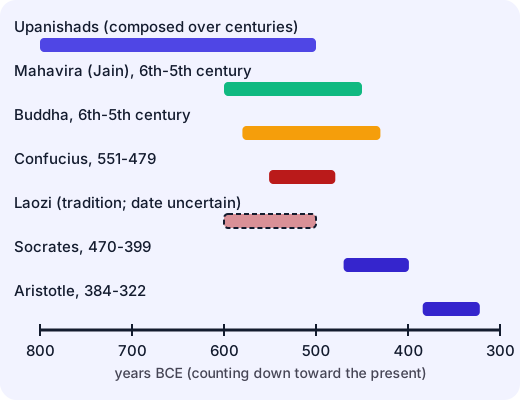
Dates for early thinkers are approximate. We have much better evidence for Socrates and Confucius, who appear in many texts soon after their lives. For the Buddha and Mahavira, scholars give "the 6th to 5th century BCE", and for Laozi even the existence of a single person is debated.
Vedic and Upanishadic ideas
The Vedas are among the oldest texts in the world, with the Rigveda's hymns composed perhaps 3,000 or more years ago. There are four: the Rigveda, Samaveda, Yajurveda and Atharvaveda. For centuries they were not written. They were memorised, with elaborate patterns of recitation that checked every word, and passed from teacher to student. UNESCO recognised Vedic chanting as a masterpiece of oral heritage in 2008.
The Vedas include hymns to natural forces, prayers and rituals. One famous hymn (the Nasadiya Sukta) asks how the world began, and ends in honest doubt: who really knows, and perhaps even the highest overseer may not know?
The Upanishads, composed over several centuries from around 800 BCE, turn from ritual to inquiry. Teachers and students talk about the self (atman) and the ultimate reality (Brahman). A famous line, tat tvam asi ("you are that"), points to the idea that the self and the deepest reality are connected. Two other key ideas are dharma (duty, right conduct, the order that holds things together) and karma (actions have consequences).
The Buddha
Siddhartha Gautama, born into the Shakya clan at Lumbini (in today's Nepal), left his home in search of an answer to suffering. According to tradition he reached enlightenment at Bodh Gaya and gave his first teaching at Sarnath. He taught:
- Life involves suffering, and suffering comes from craving and attachment.
- It can end, by following the Eightfold Path: right understanding, thought, speech, action, livelihood, effort, mindfulness and concentration.
- The Middle Way: avoid both a life of luxury and harsh self-denial.
- Impermanence: everything changes.
- Compassion for all living beings.
His followers formed a community, the sangha. Buddhism spread across Asia, helped by King Ashoka and by monks and traders, to Sri Lanka, Central Asia, China, Japan and South-east Asia.
Mahavira and the Jain tradition
Jains honour 24 great teachers called Tirthankaras. The last, Mahavira, lived in the region of Bihar around the same time as the Buddha. Jain teaching centres on five great vows: ahimsa (non-violence in thought, word and deed, extended even to tiny creatures), satya (truth), asteya (not taking what is not given), brahmacharya (self-restraint) and aparigraha (not grasping at possessions).
Two further Jain ideas are special. Anekantavada says reality is many-sided, so no single point of view captures the whole truth, a good habit of mind for any debate. And Jains stress taking care to cause as little harm as possible, which is why many Jains are strict vegetarians.
Many teachers of this time, including the Buddha and Mahavira, questioned some of the rituals around them, such as animal sacrifice, and the claim that a person's worth depends on birth.
Beyond India: Greece and China
Greece. The word philosophy means "love of wisdom". In Athens, Socrates (470–399 BCE) walked the marketplace asking people to explain what they meant by words like "justice", and showed that they often did not know. He wrote nothing; his student Plato recorded his conversations. Plato's student Aristotle (384–322 BCE) studied logic, living things and politics, and taught the young Alexander. Greek thought stressed reason, argument and observation of nature. Alexander's army reached north-west India in 326 BCE, so Indian and Greek ideas did meet, though the extent of the exchange is debated.
China. Confucius (551–479 BCE) believed society is held together by good relationships: parents and children, rulers and subjects, teachers and students, friends. Each should show respect and care (ren, humaneness), and learning and example matter more than force. He taught: "What you do not wish for yourself, do not do to others." Another tradition, Daoism, linked to the book Dao De Jing (traditionally by Laozi), urged people to live in harmony with the Dao, "the Way" of nature, and not to force things.
Comparing
Try it: Choose one question and ask it of each tradition: How should I treat other people? Notice that "do not do to others…" appears in Confucius, "non-violence" in Jainism, "compassion" in Buddhism and "seeing the same self in all" in the Upanishads. The routes are different but the concern is shared.
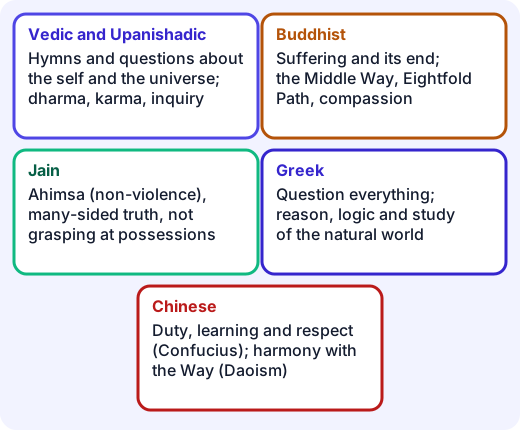
Question Indian traditions Greek Chinese How to find truth? Inquiry, meditation, many-sided views Argument, logic, observation Learning, reflection, harmony How to treat others? Ahimsa, compassion, dharma Justice and virtue in the city Respect, duty, humaneness What is the aim? Freedom from suffering; right living The good life through reason A good society and a balanced life Misconceptions to avoid
- "These ideas are only religion." They include ethics, logic, politics and attitudes to nature as well as worship.
- "All the traditions say the same thing." They overlap, but they disagree on many points, for example on the existence of a permanent self (the Upanishads affirm it; the Buddha taught that nothing is fixed).
- "Old ideas are dead." Gandhi drew on ahimsa. Schools use Socratic questioning. East Asian ideals of respect for learning draw on Confucius. Ashoka's pillars sit on our flag.
Old ideas are tools. We can ask what each was for, test it against our own experience and decide what to keep.
Lab
Whose idea is it?
Twelve ideas and sayings are waiting to be matched with the tradition they come from: Vedic and Upanishadic, Buddhist, Jain, Greek or Chinese. Then compare what the traditions share.
Your goals
- Match twelve ideas to the right tradition.
- Say what the traditions share and where they differ.
The interactive lab opens once you register. Register to do this.
Quick check
Cultural roots check
Eight questions on early traditions of thought and what they teach.
1.Which Jain idea is the commitment to non-violence in thought, word and deed?
- Ahimsa
- Anekantavada
- Karma
- Sangha
Choose one
2.The Eightfold Path and the Middle Way belong to which tradition?
- Buddhist
- Greek
- Daoist
- Vedic
Choose one
3.Match each thinker to the place or tradition he is linked with.
- Socrates
- Confucius
- Mahavira
- Siddhartha Gautama
Match each to: Chinese ideas of duty and respect · The Jain tradition · The Buddhist tradition · Greek philosophy in Athens
4.How were the Vedas passed on for centuries?
- Printed in books
- Memorised and recited from teacher to student
- Painted on cave walls
- Written on coins
Choose one
5.What are the Upanishads mostly about?
- Rules for building cities
- Inquiry into the self and ultimate reality
- Lists of kings
- Rules for trade
Choose one
6.India's national motto 'Satyameva Jayate' comes from the Mundaka ___ . Fill the blank with one word.
Answer with a word or phrase
7.Choose all the traditions that, in the reading, teach compassion or care for others in some form.
- Buddhist (compassion)
- Jain (ahimsa)
- Confucian (humaneness and respect)
- None of them
Choose all that apply
8.A class debates whether a new rule is fair. The teacher asks each student to define "fair" and then asks, "Is that always true?" Which of these does the method most resemble?
- Socrates's questioning in the Athens marketplace
- Vedic memorisation
- The Jain vow of non-possession
- The Daoist idea of not forcing things
Choose one
Answering and checking are for registered learners. Register to do this.
Quick check
New puzzles about cultural roots
Four new situations. Use what you know about early traditions of thought.
1.In the 20th century, Mahatma Gandhi led campaigns using peaceful non-cooperation. Which early Indian idea did this most directly draw on?
- Ahimsa (non-violence)
- Memorising the Vedas
- The Greek idea of logic
- Confucian exams
Choose one
2.A shopkeeper finds he gave a customer too much change. He thinks: 'I would be unhappy if someone short-changed me, so I should not do it to others.' Which tradition's saying is closest to his thinking?
- Confucius: what you do not wish for yourself, do not do to others
- Aristotle's classification of animals
- The Vedic hymn on creation
- The Daoist idea of not forcing things
Choose one
3.Two friends argue over whether a village's river is 'the best' in the district. One says 'it's the cleanest', the other says 'it's the longest'. Which Jain idea says each view shows part of the truth?
- Anekantavada, the many-sidedness of truth
- Aparigraha, non-possession
- Dharma as duty only
- Karma as consequences
Choose one
4.Which of these are true when we compare early Indian, Greek and Chinese traditions of thought?
- They asked overlapping questions about how to live well
- They gave identical answers
- Some of their ideas still shape daily life, such as non-violence and questioning
- They are only about worship and not about ethics or logic
Choose all that apply
Answering and checking are for registered learners. Register to do this.
Your turn
Explain an old idea at work today
Write 150 to 250 words in your own words.
- Choose two of the traditions in the reading (Vedic and Upanishadic, Buddhist, Jain, Greek, Chinese). For each, give one core idea and explain it so a younger child could follow it.
- Pick one idea and describe a modern situation (at school, at home, in the news) where people use it, whether or not they know where it comes from.
- Name one way the two traditions you chose are similar and one way they differ.
How it's judged
- Describing core ideas
- Connecting to today
- Comparing
Writing and submitting your answer is for registered learners. Register to do this.
Like what you see?
Register for free to answer the quick checks, do the activities and save your work. Your work is saved on your device and syncs to your account.