Unit 5
The beginnings of civilisation
Walk the planned streets of the Harappan cities, follow their traders and a script nobody can read yet, and compare them with Mesopotamia.
Read
Cities, systems and shared culture
Imagine you are an archaeologist in the 1920s, digging at a mound in Sindh that locals call Mohenjo-daro, often explained as "mound of the dead". Under the dust you find a street running dead straight. Then another, crossing it at a right angle. Beside the street is a brick-lined channel with a cover over it, carrying away wastewater from the houses. The bricks are baked and all the same shape. Who built a town like this, more than 4,500 years ago, and how did they agree on a plan?
This was the Harappan civilisation, also called the Indus or Indus–Saraswati civilisation. It was one of the world's first great urban cultures, and it was lost from memory until archaeologists found it.
What makes a civilisation?
Historians use the word civilisation for a society that has grown big and complex. They look for a set of connected features:
- Cities: large settlements where thousands of people live, many of them not farmers.
- Systems: planning, rules, standard measures, ways of organising food, water and trade.
- Specialised work: potters, bead-makers, builders, traders and others who make a living from a skill.
- Writing or record-keeping: some way of marking information.
- Shared culture: styles of art, symbols and customs found over a wide area.
Be careful with the word. "Civilisation" here does not mean "better" or "more cultured". A forest-dwelling community with deep knowledge of plants and a rich oral tradition has a culture too. The word names a particular kind of society, one with cities and systems, not a score.
The Harappan cities
The Harappan civilisation flowered between about 2600 and 1900 BCE (its "mature" phase), though people lived in early farming villages for centuries before that. Over a thousand sites are known across today's Pakistan and north-western India, and some in Afghanistan, an area of perhaps a million square kilometres, larger than either Egypt or Mesopotamia in that age. The best-known cities are Harappa and Mohenjo-daro (both in Pakistan), and Dholavira, Lothal, Kalibangan and Rakhigarhi (in India).
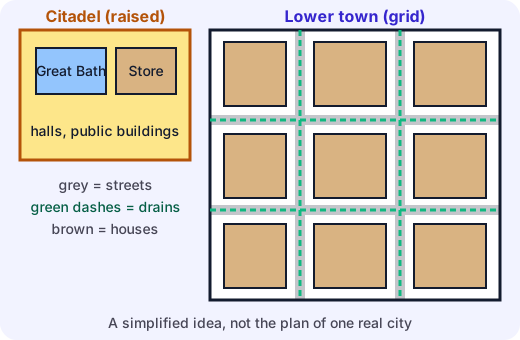
Planning. Streets ran roughly north–south and east–west and met at right angles. Many cities had two parts: a raised citadel with large public buildings and a lower town with houses. At Mohenjo-daro the citadel holds the Great Bath, a brick-lined pool roughly 12 metres long, waterproofed with bitumen. Its exact purpose is a guess; ritual bathing is the usual suggestion.
Water and drains. Many houses had a bathing area and a drain that joined covered street drains, with inspection holes for cleaning. Dholavira, in the dry Kutch region of Gujarat, had a chain of large water reservoirs cut into stone, a clever answer to little rain. UNESCO listed it as a World Heritage Site in 2021.
Standard bricks. Bricks were baked and made in the ratio 1 : 2 : 4 (thickness : width : length) all over the region.
Worked example. A Harappan brick is 7 cm thick. Find its width and length.
- Width is twice the thickness: cm.
- Length is four times the thickness: cm.
- So the brick is cm, and a brick from a city hundreds of kilometres away would be the same shape. This is a clue that builders shared a common standard.
Trade
Harappan people grew wheat, barley, peas, sesame and cotton, and kept cattle, sheep and goats. They also made things for trade: beads of shell and a red stone called carnelian, copper and bronze tools, pottery and cotton cloth. They imported what the plains lacked.
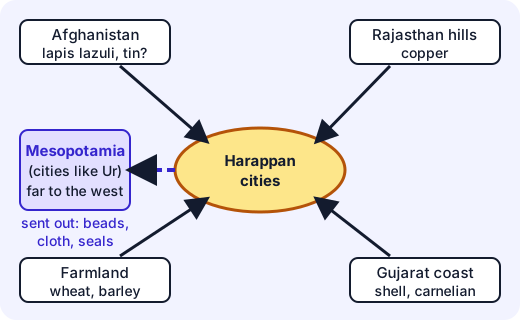
- Lapis lazuli, a deep blue stone, came from the mountains of Afghanistan; the Harappans even set up a trading outpost at Shortugai near the mines.
- Copper came from Rajasthan and probably from Oman.
- Shell and carnelian came from the coast and from Gujarat.
Mesopotamian records speak of a land called Meluhha, which most scholars identify with the Harappan region, and Harappan seals and beads have been found in Mesopotamian cities such as Ur. So goods, and probably people, travelled by land and by sea.
The Harappans also used weights in a neat series, 1, 2, 4, 8, 16, 32, 64 (each double the last) at the small end. Stone cubes of these weights turn up at many sites, which suggests common standards for fair trade.
A script nobody can read
Thousands of small seals, usually carved from soft stone called steatite, have been found. Each shows an animal such as a bull, an elephant or a rhinoceros, and a line of signs. There are around 400 different signs, and inscriptions are very short, about five signs on average. Scholars agree this is a writing system, but it has not been deciphered, because no long text or bilingual inscription (like the Rosetta Stone) has been found. Many proposed readings exist; none has convinced the experts.
Misconception: "We can't read the script, so we know nothing about them." We learn a great deal from archaeology: cities, drains, bricks, beads, weights, seeds, bones. Without writing, we learn little about their names, stories or beliefs, but plenty about how they lived.
Why did it fade?
By about 1900 BCE the big cities were being left. Rivers shifted or dried (the Ghaggar–Hakra is often discussed), the monsoon weakened, and trade networks changed. Most scholars think this was a gradual change of climate and trade, not a sudden invasion or disaster. People moved toward the Ganga plains and elsewhere. Historians still debate the exact causes.
Compare: Mesopotamia
Mesopotamia means "between the rivers", the plains of the Tigris and Euphrates in today's Iraq. Cities such as Uruk and Ur had grown there by about 3500 to 3000 BCE, earlier than Harappa.
Harappan Mesopotamian (Sumer) Rivers Indus and others Tigris and Euphrates Writing Short seal inscriptions; not deciphered Cuneiform wedge-shaped signs on clay tablets; deciphered; long texts City layout Grid streets, covered drains, standard bricks Winding streets, walls, a tall stepped temple called a ziggurat Rulers No palace or royal tomb clearly identified Kings and priests, known by name from tablets Shared with the other Planned cities, farming, craft, trade Same, and each traded with the other The comparison shows a general idea: civilisations share some features (cities, systems, writing or record-keeping, trade) but build them differently. Mesopotamia tells us loudly in words who its kings were; the Harappans mostly speak through bricks, drains and seals.
Putting it together
Next time you see a street map with straight roads and a drain along the side, remember the first idea behind it: people deciding to live together in large numbers needed rules, shared measures and ways of exchanging goods. Cities, systems and shared culture are not three separate things; each makes the others possible.
Lab
The clue board
Eight pieces of Harappan evidence are on the board. For each, pick the most reasonable conclusion, then decide which statements fit the Harappans, Mesopotamia, or both.
Your goals
- Draw reasonable conclusions from eight pieces of Harappan evidence.
- Compare the Harappan civilisation with Mesopotamia.
The interactive lab opens once you register. Register to do this.
Quick check
Early civilisations check
Eight questions on the Harappan civilisation and how it compares with Mesopotamia.
1.Which of these are features historians look for in a civilisation?
- Cities with many people who are not farmers
- Systems such as planning, standard measures and trade
- Having more powerful weapons than neighbours
- Shared styles and symbols over a wide area
Choose all that apply
2.About when was the mature phase of the Harappan civilisation?
- About 600 BCE to 300 BCE
- About 2600 BCE to 1900 BCE
- About 1500 CE to 1800 CE
- About 8000 BCE to 7000 BCE
Choose one
3.A Harappan brick is 5 cm thick. Bricks were made in the ratio 1 : 2 : 4 (thickness : width : length). How long is the brick, in cm?
Answer with a number
4.What does the straight, gridded street plan of Mohenjo-daro best suggest?
- That the city was planned and organised, which needed shared rules
- That the city was built in a single week
- That there was no trade
- That the city was a fort only
Choose one
5.Match each material to where it came from.
- Lapis lazuli
- Copper
- Shell
Match each to: The Gujarat coast · Rajasthan hills · Mountains of Afghanistan
6.Why is the Harappan script still unread?
- It has no signs at all
- The inscriptions are very short and no long or bilingual text has been found
- All the seals were destroyed
- It is the same as cuneiform, which nobody can read
Choose one
7.What is the name of the wedge-shaped writing of Mesopotamia, pressed into clay tablets?
Answer with a word or phrase
8.Which statement about why Harappan cities were left is best supported?
- A sudden invasion destroyed every city in one year
- Gradual change in climate, rivers and trade is the leading explanation, still debated
- The cities were never really left
- A single flood ended everything at once
Choose one
Answering and checking are for registered learners. Register to do this.
Quick check
New puzzles about early civilisations
Four new situations. Use the features of civilisation you learned.
1.An archaeologist digs up a large, ancient settlement. Which findings would best support calling it a civilisation, rather than a big village?
- Streets planned in a grid with drains
- Workshops making beads and metal goods, and stores of grain
- A few farmers' huts of similar size
- Seals and weights like those from far-away towns
Choose all that apply
2.A set of Harappan weights goes 1, 2, 4, 8, 16, 32, and so on, doubling each time. A trader puts an 8 weight, a 4 weight and two 2 weights in one pan. Which single weight from the set balances that pan?
Answer with a number
3.An archaeologist finds a large brick room with a drain next to a house. A newspaper says it was 'definitely a royal bathroom'. What would a careful historian say?
- It is a fact; the newspaper says so
- We can say what is found, but a 'royal' purpose is a guess unless other evidence supports it
- Nothing can ever be said about old buildings
- It must be a bathroom since all drains are for bathing
Choose one
4.A museum label says: 'This civilisation grew along a great river, built cities, used a script of signs on clay and traded with its neighbours.' Which part of this could also be said about the Harappans?
- All of it, including the clay tablets of cuneiform
- River, cities and trade; their script was on seals, not long clay tablets, and unread
- Nothing at all
- Only the trade
Choose one
Answering and checking are for registered learners. Register to do this.
Your turn
Explain what makes a civilisation
Write 150 to 250 words in your own words.
- Pick three pieces of evidence from the Harappan sites (for example drains, bricks, weights, seals, lapis beads). For each, say what it suggests about how the Harappans lived or organised themselves.
- Name one way the Harappan civilisation was similar to Mesopotamia and one way it was different.
- A friend says: "We can't read their script, so we can't know anything about them." Explain why this is only partly true.
How it's judged
- Reading evidence
- Comparison
- Limits of the evidence
Writing and submitting your answer is for registered learners. Register to do this.
Like what you see?
Register for free to answer the quick checks, do the activities and save your work. Your work is saved on your device and syncs to your account.