Unit 7
Unity in diversity
Follow a festival, a meal and a family of languages across India to see how very different regions share common threads.
Read
Many threads, one cloth
On a January morning, a family in a Tamil village lets a pot of rice and milk boil over and shouts "Pongal-o-Pongal!". Two thousand kilometres away in Punjab, neighbours gather round a bonfire and toss in popcorn and peanuts for Lohri. In Assam, people feast at dawn beside a hut of straw that will be burnt for Magh Bihu. In Gujarat, the sky fills with kites for Uttarayan. Different languages, different food, different songs. Yet look closer: all four mark the harvest, the turning of the sun, and sharing food with neighbours.
Is India one thing or many? The honest answer is both, and that is what we mean by unity in diversity.
Diversity: real and wide
India has many regions, each with its own history, climate, food, clothing and language. The Constitution lists 22 scheduled languages, and hundreds of other languages and dialects are spoken. The people follow many religions and ways of life: Hindu, Muslim, Christian, Sikh, Buddhist, Jain, Parsi and tribal traditions, and others. Diversity is not a problem to be removed. It is a fact, and in many ways a strength: different regions have developed different foods, crafts, music and ways of solving problems.
Unity: not sameness
A society can hold together without everyone being the same. Think of a woven cloth: the threads are of different colours, but the pattern comes from how they cross. Unity means shared threads:
- Shared practices. Festivals, foods, pilgrimage, ways of greeting.
- Shared history. Rivers, trade routes, empires, and the freedom movement that brought together people from every region.
- Shared rules and symbols. One Constitution, one flag, one national anthem, elections, the railways, the Indian cricket team.
Misconception: "Unity means everyone must be the same." If unity needed sameness, every difference would be a threat. In India's case unity means people respect differences and stay connected. A cricket fan in Chennai and one in Kolkata cheer the same team but don't need to speak the same language.
Thread 1: festivals
Many festivals fall at the same time of year because they follow the same farming rhythm. In mid-January, when the sun begins its northward journey (Makar Sankranti), people in different regions celebrate the harvest.
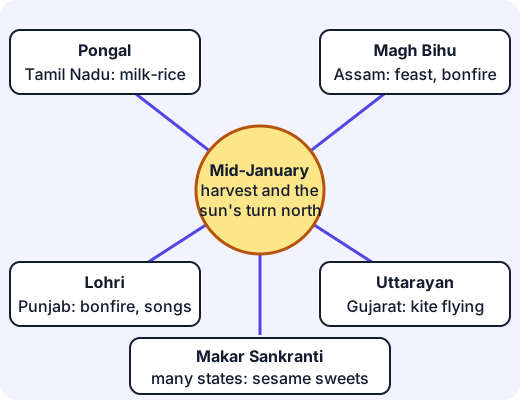
Festival Region What people do Pongal Tamil Nadu Boil fresh rice and milk until it overflows; thank the sun and cattle Magh Bihu Assam Feasts, bonfires, sweets made from rice Lohri Punjab Bonfire, songs, sesame and peanuts Uttarayan Gujarat Kite-flying, sesame and jaggery sweets Makar Sankranti Many states Sesame-and-jaggery sweets, river baths Other examples: Diwali is celebrated in many forms by Hindus, Jains and Sikhs. Eid, Christmas, Buddha Purnima and Gurpurab belong to particular communities, yet neighbours of other faiths often join the sweets, the greetings and the celebrations. The names and stories differ, but the shared pattern (lights, feasting, sharing with neighbours) repeats.
Thread 2: food
India's cooking varies hugely, but certain patterns run through it. Almost everywhere, a meal is built around a staple grain (rice in the east and south, wheat in the north and west, millets in many dry regions) with lentils (dal), vegetables and spices. The names change: sambar in Tamil Nadu, dal tadka in the north, dalma in Odisha, varan in Maharashtra. A wheat-based flatbread appears as roti, paratha, puri, luchi or thepla, and a rice-and-lentil dish as khichdi or pongal. Chillies came to India only after about 1500 CE (from the Americas), yet they now seem to belong everywhere; food keeps travelling and mixing.
Try it: Ask an elder at home which dish at your table has a "cousin" in another region. For example, does your family make a rice-and-lentil dish? What is it called, and how does it differ from khichdi or pongal?
Thread 3: languages
Indian languages belong to a few big language families: groups of languages that share a common ancestor and so share many words, sounds and grammar.
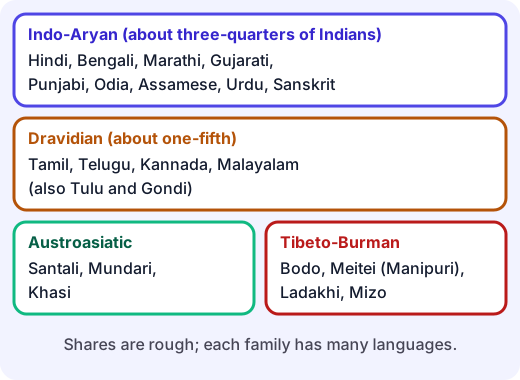
- Indo-Aryan, spoken by about three-quarters of Indians: Hindi, Bengali, Marathi, Gujarati, Punjabi, Odia, Assamese, Urdu and others. Sanskrit is its ancient classical member.
- Dravidian, spoken by about one-fifth: Tamil, Telugu, Kannada, Malayalam.
- Austroasiatic: Santali, Mundari, Khasi.
- Tibeto-Burman: Bodo, Meitei (Manipuri), Mizo, Ladakhi.
A family is not a fence. Languages in different families have lived side by side for thousands of years and borrowed from each other: Tamil, Telugu, Kannada and Malayalam have taken many words from Sanskrit; Hindi and many others have words from Persian and Arabic and from English (such as station and school), and English now has words from India, such as jungle, shampoo and pyjamas. Words, like people, travel.
Worked example. Are Tamil and Telugu in the same family? Are Hindi and Tamil?
- Tamil and Telugu are both Dravidian, so yes: same family.
- Hindi is Indo-Aryan, Tamil is Dravidian: different families, even though both contain many Sanskrit-derived words.
- So being in the same family is a different thing from sharing words. Families come from common ancestry, while borrowing comes from contact.
Thread 4: stories and journeys
The epics the Ramayana and the Mahabharata are told and retold across the country and beyond, in hundreds of versions: Valmiki's Sanskrit, Kamban's Tamil Ramavataram, Tulsidas's Ramcharitmanas in Awadhi, Krittivasa's Bengali version, and in puppet theatre and dance from Kerala to Indonesia. Each retelling is a local version of a shared story. Likewise, pilgrimages bring people across the whole country: to rivers such as the Ganga and the Kaveri, to Bodh Gaya, Ajmer Sharif, Amritsar, Velankanni and Shravanabelagola. A pilgrim from Kerala at a shrine in the Himalayas is a living thread between regions.
How to talk about it well
When you explain unity in diversity, give both sides and a specific example. For instance: "Pongal, Lohri, Magh Bihu and Uttarayan have different names, foods and songs (diversity), but all mark the harvest and the sun's northward turn and are celebrated by sharing food (shared thread)." Avoid claiming that every part of India is the same, or that differences always cause division. And be careful of stereotypes: "all Tamils eat only idli" or "all Punjabis eat only butter chicken" are not true. Within one state, food, dialect and custom vary from district to district.
A diverse society is held together less by everyone being alike than by people choosing to share, to travel and to learn each other's words.
Lab
The thread finder
Match harvest festivals to their regions, sort languages into their families, and decide what the shared threads are. Each answer gives you a reason.
Your goals
- Match five festivals to the regions that celebrate them.
- Sort eight languages into four families.
- Explain the difference between unity and sameness.
The interactive lab opens once you register. Register to do this.
Quick check
Unity in diversity check
Eight questions on shared practices, regions and language families.
1.Match each festival to its region.
- Pongal
- Magh Bihu
- Lohri
- Uttarayan
Match each to: Tamil Nadu · Punjab · Assam · Gujarat
2.What shared thread connects Pongal, Magh Bihu, Lohri and Uttarayan?
- They mark the harvest and the sun's turn north, and involve sharing food
- They are all celebrated in one state
- They all use the same language for prayers
- They are all about kites
Choose one
3.Which pair of languages are in the same family?
- Tamil and Kannada
- Hindi and Tamil
- Bengali and Telugu
- Santali and Gujarati
Choose one
4.Match each language to its family.
- Marathi
- Malayalam
- Khasi
- Mizo
Match each to: Tibeto-Burman · Indo-Aryan · Dravidian · Austroasiatic
5.How many languages are listed in the Eighth Schedule of the Constitution of India (the scheduled languages)?
Answer with a number
6.Which sentence best describes unity in diversity?
- Everyone shares the same language and customs
- Differences are respected while people share threads such as festivals, rules and history
- Diversity is a weakness and should end
- Regions have nothing in common
Choose one
7.Why do Tamil and Hindi share some Sanskrit-derived words though they are in different families?
- Languages borrow words from each other through contact
- They are really the same language
- Families cannot differ in vocabulary
- Words never move between languages
Choose one
8.Choose all the examples of shared practices across regions.
- Harvest festivals in January under different names
- A staple grain with lentils (dal) in most meals
- The Ramayana retold in many languages
- A single language spoken by everyone
Choose all that apply
Answering and checking are for registered learners. Register to do this.
Quick check
New puzzles about unity in diversity
Four new situations. Use the ideas of shared threads and language families.
1.A new student from Odisha joins your class in Kerala. She says, 'We eat rice and dal and celebrate harvest too.' Which is the best response?
- 'Then our two states must be exactly the same.'
- 'We have shared threads, and our own names, dishes and songs. Let's compare!'
- 'You must be wrong; Odisha is too different.'
- 'That means we speak the same language.'
Choose one
2.Odia (spoken in Odisha) is closely related to Bengali and Assamese. Which family is Odia in?
- Indo-Aryan
- Dravidian
- Austroasiatic
- Tibeto-Burman
Choose one
3.Switzerland has four national languages and many local cultures, yet people feel they belong to one country. What does this suggest about unity?
- It can rest on shared rules and shared life without one language or culture
- It requires a single language
- It is impossible in diverse countries
- It depends on having no neighbours
Choose one
4.A village has a Hindu temple, a mosque and a church on the same street. At the spring fair, all three communities set up stalls and help each other. Which are shared threads here?
- Everyone joins a common fair and helps neighbours
- All three communities pray in the same way
- Living on the same street and sharing the market
- Everyone is forced to follow one religion
Choose all that apply
Answering and checking are for registered learners. Register to do this.
Your turn
Explain unity in diversity with examples
Write 150 to 250 words in your own words.
- Explain what "unity in diversity" means. Say what unity is not.
- Give two examples of shared practices across different regions of India (for example a festival, a kind of food, a language family or a story). For each, name at least two regions and say what is the same and what differs.
- A classmate says that all people in one state are the same. Explain, with one example, why this is not true.
How it's judged
- Meaning of unity in diversity
- Examples of shared practices
- Avoiding stereotypes
Writing and submitting your answer is for registered learners. Register to do this.
Like what you see?
Register for free to answer the quick checks, do the activities and save your work. Your work is saved on your device and syncs to your account.