Unit 4
Timelines and sources of history
Learn how historians turn broken pots, carved pillars and travellers' diaries into a story, and how they work out how old things are.
Read
History is built from evidence
In 1837 a British scholar named James Prinsep sat in Kolkata, staring at copies of inscriptions from pillars and rocks across India. Nobody could read the script. Yet the same mysterious letters, called Brahmi, appeared again and again, always beside the title Devanampiya Piyadassi, "beloved of the gods, who looks on all with kindness". Prinsep and others worked out the letters one by one. When they finished, a king who had been almost forgotten spoke again after 2,000 years: Ashoka, who wrote of his regret after the war in Kalinga and of his wish that people live by dhamma.
Nobody was alive to tell Prinsep this. The story came out of evidence. That is the central idea of this unit: history is not a list of things somebody remembers; it is a case built from evidence, and a good historian can say how she knows.
Two big families of sources
A source is anything that gives information about the past. Historians sort sources into two families.
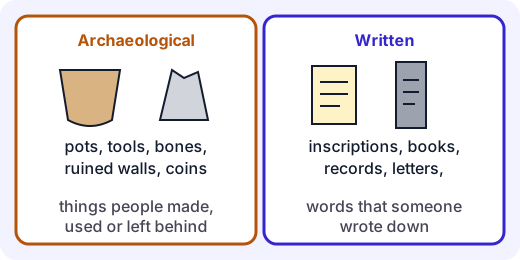
Archaeological sources are the things people made, used or left behind: pottery, tools, jewellery, bones, burnt grain, ruined walls, coins, whole buried cities. They are found by archaeologists, who dig carefully and record exactly where every object lay. Archaeology is the only way to learn about the long ages before writing, and it also shows what ordinary people did, such as what they ate or how they built a house, which rulers rarely bothered to write down.
Written sources are words someone put down:
- Inscriptions: writing cut into stone, metal or other hard surfaces, such as Ashoka's edicts or a copper-plate record of a king giving land to a temple.
- Manuscripts and books: the Vedas, epics, the Jain and Buddhist texts, plays, poems, law books. Before printing, these were copied by hand, so no two copies are exactly alike.
- Chronicles and accounts: Rajatarangini (a history of Kashmir's kings written by Kalhana in the 12th century CE), and the writings of travellers who came from elsewhere: Megasthenes (a Greek envoy, around 300 BCE), Faxian and Xuanzang (Chinese monks, 5th and 7th centuries CE), and Al-Biruni (a scholar from Central Asia, early 11th century CE).
There is a third kind worth naming: oral sources, such as songs, stories and sayings handed down by speaking. They are valuable but need extra care, since the words can change as they are passed on.
Try it: Pick one object in your bag, such as a notebook, a lunch box or a coin. Is it an archaeological source or a written one? (Some things are both: a coin is an object, and the words on it are writing.) What would a historian 2,000 years from now learn from it?
Reading a source carefully
Finding a source is only the start. A historian asks questions of it.
- Who made it, and why? A king's inscription is written to make the king look good. A traveller describes what surprised him, which may not be what mattered to local people.
- What does it actually show? A seal with a bull on it shows people carved bulls. It does not, by itself, prove why.
- What does it leave out? Most people, for most of history, could not write and left no record in words. Their lives show up in the soil, not in books.
- Do other sources agree? A claim backed by a text and by a dig is much stronger than a claim made by one source alone.
A common misconception: "If it's written down, it's true." A written source records what one person believed, wanted or was told. It is evidence, not a verdict. A king who says he won every battle is giving us his side. The historian's job is to test the claim against other sources.
Putting things in order: dating
Evidence is useful only if we know when it is from. Historians use two kinds of dating.
Relative dating: which came first?
When people build, rebuild and abandon a place, their remains pile up in layers, like pages in a stack. Digging down through the layers (called strata, one layer is a stratum) is like reading backwards through time.
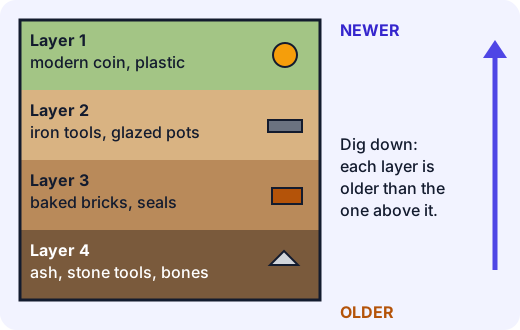
The rule is simple: in an undisturbed trench, a deeper layer is older than the layer above it. Things in the same layer are roughly the same age. This tells us the order of events, but not the number of years.
Absolute dating: how many years ago?
To get actual dates, historians use several methods.
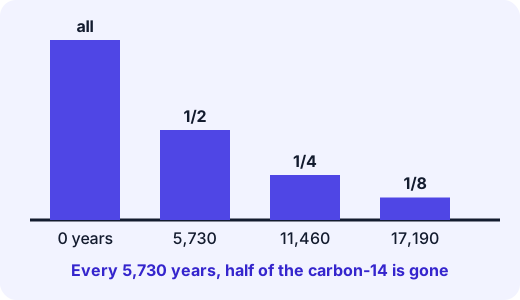
- Radiocarbon dating. Every living thing takes in a tiny amount of a radioactive form of carbon called carbon-14 from the air or its food. When it dies, the intake stops and the carbon-14 slowly decays. Half of it is gone after 5,730 years (its half-life), half of what is left goes in the next 5,730 years, and so on. Measuring how much remains in a bone, a seed or a piece of charcoal tells us how long ago it died.
- Tree rings. Many trees add one ring each year, thick in good years and thin in dry ones. Matching ring patterns from living and old wood gives exact calendar years. This is called dendrochronology.
- Dates inside the sources. Many inscriptions name a ruler or give a year in an era such as the Vikram Samvat (which starts in 57 BCE) or the Shaka era (which starts in 78 CE). Coins show rulers whose reigns are known from other sources.
Worked example. A charcoal sample from a hearth has one quarter of its original carbon-14. How old is it?
- One half-life leaves . Two half-lives leave .
- So two half-lives have passed: years.
- The charcoal comes from a fire lit about 11,500 years ago.
Notice what each method needs. Radiocarbon dating works only on things that were once alive (wood, bone, grain, shell, cloth). A stone tool never took in carbon-14, so it cannot be dated this way; instead you date the charcoal or bone found in the same sealed layer. And because so little carbon-14 is left after about 50,000 years, the method cannot date dinosaurs, which died millions of years ago.
Another misconception: "Carbon dating tells us the age of anything old." It dates only once-living material, and only back to roughly 50,000 years. Other methods, based on other radioactive elements or on heat-treated clay, handle older things.
Dates are often written BCE ("Before Common Era") and CE ("Common Era"). Counting BCE years goes backwards: 500 BCE is earlier than 200 BCE. You may also see BP, "before present", where "present" is fixed at 1950 so that the dates do not shift every year.
Why this matters
The same facts can be read in different ways, and new evidence can change the story. For a long time Ashoka was unknown in India; one decoded script brought him back. The next time you read "historians believe…", ask: which sources? How were they dated? Who might be missing? That habit of asking is the real skill of a historian, and it is useful far beyond history, whenever you have to decide what to believe.
Lab
The evidence desk
Sit at a historian's desk. Sort sources into archaeological and written, read the carbon-14 clock, work out which layer is oldest and decide how to treat a king's claim. Each answer gives you feedback; you can try again.
Your goals
- Sort eight sources into archaeological and written.
- Use the carbon-14 half-life to date three samples.
- Read a trench's layers and weigh conflicting sources.
The interactive lab opens once you register. Register to do this.
Quick check
Sources of history check
Eight questions on kinds of sources, reading them, and dating.
1.Which of these is an archaeological source?
- Megasthenes's book Indica
- A pot fragment dug up from a house floor
- Kalhana's Rajatarangini
- Al-Biruni's account of India
Choose one
2.Choose all the written sources.
- A copper-plate record of a land grant
- Xuanzang's travel account
- A string of clay beads
- An edict carved on a pillar by Ashoka
Choose all that apply
3.A trench is dug into a mound and has not been disturbed. It has four layers. Which layer is the oldest?
- Layer 1, at the top
- Layer 2
- Layer 3
- Layer 4, at the bottom
Choose one
4.Carbon-14 has a half-life of 5,730 years. A piece of wood has one quarter of its original carbon-14 left. How many years ago did the tree die?
Answer with a number
5.Why can radiocarbon dating not be used directly on a stone tool?
- Stone was never alive, so it never took in carbon-14
- Stone contains too much carbon-14
- Radiocarbon dating works only on written objects
- Stone tools are always too recent
Choose one
6.Match each source to the thing it is best placed to tell us.
- Charred wheat grains in a hearth
- A traveller's diary
- A coin showing a ruler
- Post-holes in the ground
Match each to: What the people grew and ate · Who ruled, and how far money travelled · The shape and size of a lost house · What a visitor noticed, from outside
7.Put these in order, earliest first.
- Al-Biruni writes about India (about 1030 CE)
- Harappan cities at their height (about 2600 BCE)
- Ashoka's reign (about 268 to 232 BCE)
- Xuanzang's journey to India (630s CE)
Put these in order
8.A king's inscription says he won a great victory over a city. No other source mentions it, and the ruins of the city show no sign of burning or attack. What is the best way to treat the inscription?
- As proof, since it is carved in stone
- As one source: a claim by someone who wanted to look good, to be tested against other evidence
- As worthless, since kings always lie
- As true because it is old
Choose one
Answering and checking are for registered learners. Register to do this.
Quick check
New puzzles about sources
Five new situations. Use what you know about sources and dating.
1.In a sealed layer, archaeologists find a cooking pot and, right beside it, charcoal that radiocarbon dating puts at about 2,000 years old. What can they say about the pot?
- It was probably made and used around the same time as the charcoal
- Nothing at all, because pots cannot be dated
- It is exactly 2,000 years old to the day
- It is much older than the charcoal
Choose one
2.A seed has one eighth of its original carbon-14. With a half-life of 5,730 years, how many years ago did the plant die?
Answer with a number
3.Historians 2,000 years from now study your town today. Which of these would be written sources?
- Minutes of a panchayat or ward meeting
- Plastic bottles in a landfill
- A newspaper's printed edition
- A layer of ash from a fire
Choose all that apply
4.Give the name of the dating method that matches the ring patterns of old and living trees to find exact calendar years (either the scientific name or a plain description).
Answer with a word or phrase
5.Two travellers describe the same market town. One says it was poor and quiet; the other says it was rich and crowded. What should a historian do first?
- Find out when and why each wrote, and look for diggings, coins or other evidence
- Pick the one who writes better
- Average the two descriptions
- Decide the town cannot be studied
Choose one
Answering and checking are for registered learners. Register to do this.
Your turn
Explain how we know the past
Write 150 to 250 words in your own words.
- Choose one object from your home or school (for example a coin, a school bell, a water pot). Say whether it would be an archaeological or a written source for a future historian, and name two things it could tell them and one thing it could not.
- Explain how historians could work out how old a burnt wooden beam found in a ruin is. Name the method and say what it measures.
- A classmate says: "If something is written in an old book it must be true." Explain what is wrong with this, using one example of a source and its maker's purpose.
How it's judged
- Kinds of sources
- Explaining dating
- Weighing a written source
Writing and submitting your answer is for registered learners. Register to do this.
Like what you see?
Register for free to answer the quick checks, do the activities and save your work. Your work is saved on your device and syncs to your account.