Unit 8
Family and community
See how families and communities look after their members, what unwritten rules hold them together, and how they settle quarrels.
Read
People who hold each other up
On a Sunday morning in a housing colony in Pune, a water pipe bursts under the road. Within an hour, the whole lane knows. Mr. Iyer from the corner flat brings a bucket brigade together; the Khan family, whose tank is full, offers to share; a retired teacher phones the municipal office; and Zoya, aged 12, writes "Water at the community hall from 11 o'clock" on a sheet and sticks it on every gate.
Nobody was ordered to do any of this. Yet it happened, quickly and without much fuss. Why? This unit looks at the two groups that make such mornings possible: families and communities.
Family: the first group
A family is a group of people connected by birth, marriage, adoption or a long-term commitment to care for one another. Families come in many shapes:
Kind of family Who lives together Nuclear Parents (or one parent) and their children Joint or extended Several generations, such as grandparents, parents, uncles, aunts and cousins, sharing a home and a kitchen Single-parent One parent bringing up children Blended Parents, step-parents and children from earlier families Chosen or foster Adults and children who live as a family without being related by birth No shape is "the right one". What matters is what a family does for its members: it feeds and shelters, cares for the young, the old and the ill, passes on language, stories and skills, and gives each person a place where they belong.
Community: the wider circle
A community is a group of people who share a place or something important in common and who depend on each other: a village, a neighbourhood, a school, a trade, a faith, a football club, even an online group of people who love the same hobby. Most of us belong to several communities at once.
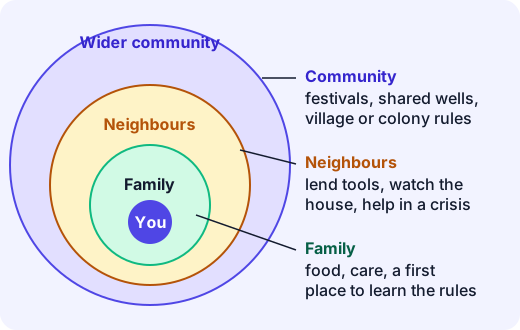
Communities do things that one family cannot do alone. They share costs and risks (a village well, a lane's night watch, a savings circle). They celebrate together (Pongal, Eid, Christmas, Baisakhi, Onam). They look after those who are in trouble. Across the world, people have names for this idea: shramdaan (giving your labour for a common good) in India, ubuntu ("a person is a person through other people") in southern Africa, and neighbourhood associations in many cities.
Cooperation is not charity only. When the Iyers help the Khans today, they know someone will help them tomorrow. Groups survive when people give and receive.
Norms: the rules nobody printed
How do twenty strangers in one lane know what to do? Through norms: shared expectations about how people should behave. Some norms are written down (colony bye-laws, school rules, laws of the country). Most are unwritten:
- Take off your shoes before entering a home or a temple.
- Don't play loud music late at night.
- Greet elders; offer water to a visitor.
- Return the borrowed ladder, and clean it first.
Norms work because people want to be thought well of, and because breaking them has a cost: a frown, a word from a neighbour, being left out. Norms are also not fixed. In many parts of India, people were once expected to keep apart by caste. Reformers challenged this for generations, and the Constitution abolished untouchability in 1950; practising it is a punishable offence today. Norms that harm some members, or that deny them equal rights, can and do change, through people speaking up and through new laws.
Worked example. Is "a guest is served first, even if the family goes hungry" a norm? Is it always good? It is a norm of hospitality: unwritten, widely shared, and it builds trust. But if a family is truly short of food, children going hungry for the sake of the norm would not be good. Good communities treat norms as ways to care for people, and adjust them when they stop doing that.
When people disagree
Disputes are normal wherever people live close together: over a boundary wall, a loud generator, a shared water tap, a cricket ball through a window. The real question is how a community settles them without anyone being hurt. There is a ladder of methods, and it is best to start at the bottom.
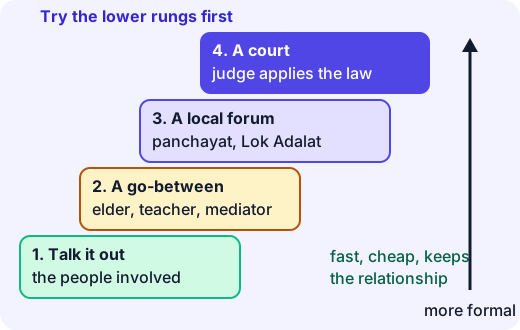
- Talk it out. The people concerned listen to each other, say what they need and look for a fair arrangement. Most disputes end here.
- A go-between. If talk breaks down, a trusted third person (an elder, a teacher, a trained mediator) helps both sides speak and listen. The go-between does not decide; the parties agree on the solution themselves.
- A local forum. A gram panchayat or a Lok Adalat ("people's court", a free, informal forum set up under Indian law where parties try to reach a settlement) can hear a matter. A settlement reached in a Lok Adalat is binding and cannot be appealed.
- A court. For serious matters, or when the law is unclear, a judge decides by applying the law. It takes longer and costs more, and one side usually loses.
Why prefer the lower rungs? They are quicker and cheaper, and they let neighbours go on living side by side. But the ladder has a limit: some matters, such as violence, abuse or a denial of someone's rights, must never be "settled" quietly by pressure. Those belong with the police and the courts, whatever the elders say.
Worked example. Two families share a lane. One keeps a buffalo whose dung gathers near the other's door. Step 1: the neighbours talk; the buffalo's owner didn't realise. Agreement: the dung is cleared daily and used for a biogas pit. If the owner refused, step 2 would be an elder both respect. A settlement was possible at step 1, so nothing more was needed.
Common misconceptions
- "Communities are all alike." They differ in size, language, wealth and customs, and a single person belongs to many.
- "If a rule is old, it must be right." Age is not the test. The test is whether the rule is fair and helps people.
- "Disputes mean the community is failing." Disagreements are normal. A healthy community has fair ways to settle them.
- "Family is only the people who live under one roof." Many families are spread over cities and countries and still support one another.
Think about it
Next time something small goes wrong in your lane, class or family, notice which rung of the ladder people use first, and who does the helping.
Lab
The dispute desk
You run a community help desk. Six cases arrive. For each one, choose the right rung of the dispute ladder to start on, then the best opening sentence.
Your goals
- Choose a fitting starting rung for all six cases, including one that must not be settled quietly.
- Pick an opening sentence that listens and keeps the way open to a fair answer.
The interactive lab opens once you register. Register to do this.
Quick check
Family and community check
Eight questions about how families and communities look after people and settle quarrels.
1.Which best describes a joint (extended) family?
- Two parents and their children living by themselves
- Several generations, such as grandparents, parents and cousins, sharing a home and kitchen
- Any group of people who work in the same office
Choose one
2.Which of these are examples of norms (shared expectations about behaviour)?
- Offering water to a visitor who arrives at your home
- Taking off your shoes before entering a temple or a home
- Water freezes at 0 °C
- Rain falls from clouds
Choose all that apply
3.Match each word to what it means.
- Norm
- Mediator
- Lok Adalat
- Court
Match each to: A shared expectation of how people behave · A judge applies the law and decides · A free, informal forum where a settlement is binding · A go-between who helps both sides agree but does not decide for them
4.Put the ways of settling a dispute in the usual order to try them, starting with the first step.
- A local forum such as a panchayat or Lok Adalat
- A court decides
- The people involved talk it out
- A trusted go-between helps both sides
Put these in order
5.Villagers give a Sunday of their labour to repair the path to the school. What idea does this show best?
- Cooperation: people give effort for a common good
- A dispute being settled in court
- A rule that only the rich must work
Choose one
6.Someone says, "This custom is very old, so it must be right." What is the best reply?
- Yes, old customs are always fair
- Age is not the test; ask whether the custom is fair and helps people
- Old customs should always be broken
Choose one
7.What is the one-word name for the shared, often unwritten, expectations that tell people how to behave in a group?
Answer with a word or phrase
8.Which problem should NOT be settled quietly by elders alone?
- Two children quarrel over a swing
- A neighbour keeps a noisy generator on at night
- A man is threatened with violence by a neighbour
Choose one
Answering and checking are for registered learners. Register to do this.
Quick check
New puzzles
Use what you know about families, communities and disputes in situations the reading did not show.
1.In a fishing village, one family's boat is wrecked in a storm. The whole village contributes money and labour to build a new one. What does this best show?
- Communities share risks that one family could not bear alone
- A dispute being settled in a Lok Adalat
- A nuclear family caring for itself
Choose one
2.In one town, girls were once expected to leave school after class 5. Now most families send their daughters to college. What does this show about norms?
- Norms never change
- Norms can change when people speak up, see new possibilities or when laws change
- Norms are laws written by the government
Choose one
3.Which are signs of a good go-between (mediator) in a quarrel?
- Both sides trust them
- They listen to both sides before speaking
- They secretly side with the richer family
- They announce who is guilty and force everyone to obey
Choose all that apply
4.Classes 6A and 6B both think the playground is theirs on Friday afternoon. The two class monitors have not yet spoken to each other. What is the best first step?
- Go to court
- The two monitors talk and work out a fair timetable
- Hold the playground by force until the other class leaves
Choose one
Answering and checking are for registered learners. Register to do this.
Your turn
How your own community works
Choose a community you belong to (your lane or village, your class, a sports team, a festival group). Write your answers in your own words.
- Describe two ways this community supports its members. Say who gives the help and who receives it.
- Name one unwritten norm and one written rule in the community. Say what each one does for the group.
- Describe a disagreement that happened (or could happen) there. Say which rung of the ladder (talk, go-between, local forum, court) fits best and why. Name one kind of matter that should never be settled quietly.
How it's judged
- Community support
- Norms and rules
- Settling disputes
Writing and submitting your answer is for registered learners. Register to do this.
Like what you see?
Register for free to answer the quick checks, do the activities and save your work. Your work is saved on your device and syncs to your account.