Unit 9
Grassroots democracy
Find out who runs your village or town, how they are chosen, and how ordinary people can shape local decisions.
Read
Democracy starts down the lane
The village of Rampur has a broken handpump. Children carry water from a stream 2 km away, and the school has been closed twice this month. Who should fix it? The state government in the capital, 300 km away, has never heard of Rampur's pump. The Prime Minister certainly has not. But the people of Rampur know exactly what is wrong, and a decision about it can be made in the village, by the people who need the pump.
That is the idea of local self-government: decisions about local matters are made locally, by people the locals choose. It is democracy at its smallest and closest scale, and so it is often called grassroots democracy.
Local government in India
India has three levels of government: the Union (central) government, the state governments and local governments. In 1992, two amendments to the Constitution, the 73rd for villages and the 74th for towns and cities, gave local bodies a firm place in the system. Before that, a state could, and often did, leave its local bodies unelected for years. Now every state must hold regular elections for them.
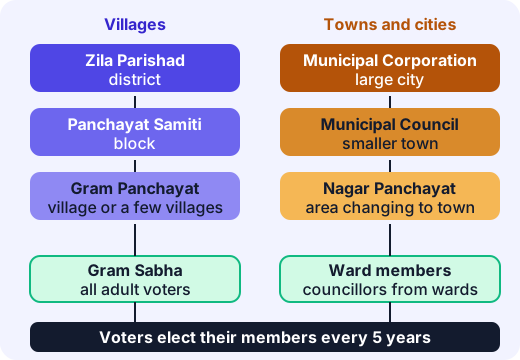
In the countryside there are three tiers, together called the Panchayati Raj (rule by panchayats):
- the Gram Panchayat for a village or a small group of villages;
- the Panchayat Samiti at the level of a block (a group of villages);
- the Zila Parishad for the district.
In towns and cities the bodies are municipalities: a Nagar Panchayat for an area changing from rural to urban, a Municipal Council for a smaller town, and a Municipal Corporation for a large city.
Who is on a gram panchayat?
The village is divided into wards, and the voters of each ward elect one ward member (often called a panch). A head of the panchayat, called a sarpanch or pradhan, leads it. In most states the sarpanch is elected by the voters; in some, the members choose one. Elections are held every five years, run by a State Election Commission, which is independent of the government of the day. Seats are reserved: at least one-third of the seats (and many states have half) are for women, and seats are also reserved for Scheduled Castes and Scheduled Tribes in proportion to their numbers. This helps people who were often left out of decisions to take part.
A city council works in the same way. Each ward elects a councillor, and the councillors form the council. In most places the mayor or chairperson is chosen by the councillors; in some states, by the voters directly.
What do they do?
Local governments run the services you see every day.
Rural (gram panchayat) Urban (municipality) Drinking-water sources, village roads Water supply, roads, street lights Sanitation, drains, village cleanliness Garbage collection, sewage, public toilets Village schools and anganwadis (they help run them) Parks, markets, birth and death records Choosing and checking works under schemes like MGNREGA Public health, fire services, building permits Money comes from local taxes and fees (a house tax, a market fee), and from grants by the state and Union governments.
The Gram Sabha: the village meeting
Every adult who is on the voters' list of a village is a member of its Gram Sabha. It is where the people, not only their representatives, meet. The Gram Sabha usually meets at least twice a year (states set the exact rules, including the minimum number of people needed, called the quorum). It can:
- discuss and approve the panchayat's plans and its budget;
- choose who gets benefits under public schemes;
- look at the accounts and question members about how money was spent (a social audit).
Why it matters: representatives can forget. The Gram Sabha lets every resident ask, "What did you do with our money?"
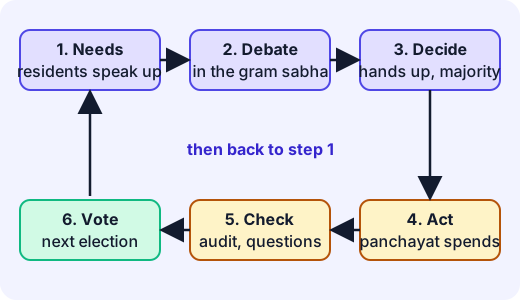
Worked example. The Rampur Gram Sabha has Rs 3,00,000 for the year. Needs raised: handpump repair Rs 60,000; anganwadi roof Rs 1,20,000; streetlights Rs 80,000; drain cleaning Rs 50,000; a playground Rs 1,00,000. The total of all five is Rs 4,10,000, more than the money available. The Gram Sabha must choose. After discussion, a farmer proposes: the handpump (Rs 60,000), the anganwadi roof (Rs 1,20,000) and streetlights (Rs 80,000). That is Rs 2,60,000, leaving Rs 40,000, which will be used to clear the worst stretch of drain now and the rest next year. The playground waits. The chair calls for a show of hands, and a majority of those present vote yes. Notice how democracy works here: nobody gets everything, and people give up some of what they wanted for a plan most can accept.
Democracy around the world
Local democracy exists in many forms. In New England, USA, many towns hold an annual town meeting where residents vote on the budget. In England, a village may have a parish council. In two cantons of Switzerland, Glarus and Appenzell Innerrhoden, citizens still vote on laws by raising their hands in an open-air assembly called a Landsgemeinde. In big cities elsewhere in the world, city councils and elected mayors play the same role as municipal councils in India.
Common misconceptions
- "A panchayat means five old men." The word does mean "council of five", and informal caste or community councils still exist. But the elected gram panchayat is a body created by the Constitution, with women and members of all communities. Informal caste councils have no legal power to punish people.
- "The sarpanch decides everything." The sarpanch leads, but decisions are taken by the panchayat and the Gram Sabha, and the sarpanch must follow the law and the budget.
- "Local government is only about roads." It also deals with health, schools, water and the rights of the poorest.
- "My voice does not count in a big country." Local bodies are where one voice counts most.
Attend a meeting
A good habit for a citizen is to attend a real meeting if you can, with a parent or teacher: a Gram Sabha, a ward meeting, or a residents' association meeting. If you cannot, simulate one with your class: the offline activity in this unit shows how.
Lab
The Rampur gram sabha
You chair the gram sabha of a village with more needs than money. Pick projects within the budget and call a show of hands: a plan needs more than half of the 100 votes.
Your goals
- Say who can attend and vote at a gram sabha.
- Build a plan within the budget that wins a majority, and notice who is left out.
The interactive lab opens once you register. Register to do this.
Activity
Hold a class gram sabha
Run a mock ward or gram sabha meeting in class or with family and friends, or attend a real local meeting with an adult. About 30 minutes.
You'll need
- Paper and pencils
- A "budget" of 10 paper tokens, each worth Rs 10,000 (pretend money)
- A list of 5 real needs in your lane, school or village, each with a cost in tokens
Steps
- Choose a chair, a note-taker and a timekeeper. Everyone else is a resident.
- The chair reads each need. Residents say who it helps and who it may leave out.
- Anyone may propose a plan using at most 10 tokens. Another person seconds it.
- Vote by show of hands on each plan, starting with the first proposed. A plan passes if more than half of those present vote yes.
- The note-taker writes the decision, the vote counts and the reasons people gave.
- Together, check for one thing that went well, and whether anyone was left out. Decide how to look after them next time.
Safety
- If you attend a real meeting, go with a parent, teacher or trusted adult and follow the meeting's rules.
Keeping a log of the activity is for registered learners. Register to do this.
Quick check
Grassroots democracy check
Eight questions on how local governments are chosen and how they work.
1.Put the rural tiers of Panchayati Raj in order from the smallest area to the largest.
- Panchayat Samiti (block)
- Zila Parishad (district)
- Gram Panchayat (village)
Put these in order
2.After how many years must panchayat elections normally be held again?
Answer with a number
3.Who is a member of the Gram Sabha?
- Every adult on the village voters' list
- Only the sarpanch
- Only the elected ward members
Choose one
4.Match each place to its local body.
- A village
- A smaller town
- A large city
Match each to: Municipal Council · Municipal Corporation · Gram Panchayat
5.Which of these is a normal job of a municipality in a city?
- Garbage collection and sewage
- Street lights and city roads
- Fighting wars with other countries
- Printing the country's currency
Choose all that apply
6.What does the Constitution require for women in panchayat seats?
- At least one-third of seats are reserved for women
- No seats are reserved
- Only the sarpanch can be a woman
Choose one
7.Why does the Gram Sabha look at the accounts and ask members how money was spent?
- To let residents check that their representatives used public money properly
- To print the village newspaper
- To replace the state government
Choose one
8.A friend says, "The gram panchayat is just five elders who decide everything." What is the best correction?
- The elected gram panchayat has ward members chosen by voters, works under the law and answers to the Gram Sabha
- Your friend is right in every way
- A gram panchayat is a private club
Choose one
Answering and checking are for registered learners. Register to do this.
Quick check
New puzzles
Use what you know about local democracy in new situations.
1.A gram sabha meeting has 120 adults present. A motion gets 58 yes votes, 49 no votes, and 13 people abstain (do not vote). How many more yes votes than no votes does the motion have?
Answer with a number
2.In a ward meeting with 90 voters present, a plan needs MORE than half to pass. How many yes votes does it need at the least?
- 45
- 46
- 50
Choose one
3.In a Swiss canton that holds a Landsgemeinde, citizens gather in the open air and vote on laws by raising their hands. Which idea from this unit does it most resemble?
- A gram sabha, where residents themselves decide
- A court case
- A royal order
Choose one
4.A lane in a city has a leaking public tap and no street light. Who is the right body to approach first?
- The ward councillor and the municipality
- The Reserve Bank
- The country's Parliament
Choose one
5.A panchayat funds three projects. The farmers' group wins, but the village's few Adivasi households (with no road to their hamlet) get nothing. What should a fair panchayat do next?
- Ignore them because they lost the vote
- Plan to include their road need next, and let the Gram Sabha hear them
- Cancel the election
Choose one
Answering and checking are for registered learners. Register to do this.
Your turn
Explain your local government
Think about the village, town or city you live in (or one you know well). Write your answers in your own words.
- Name the local body that serves your place and say how its members are chosen. How often are elections held?
- Describe two services it provides and one it could do better. Say what you would raise in a Gram Sabha or ward meeting.
- A neighbour says, "Why bother with local meetings? My vote hardly matters." Write a short reply.
- If you took part in the class gram sabha (or a real meeting), describe one decision and how it was made.
How it's judged
- How local bodies are chosen
- Services and improvement
- Making a case for taking part
- Meeting reflection
Writing and submitting your answer is for registered learners. Register to do this.
Like what you see?
Register for free to answer the quick checks, do the activities and save your work. Your work is saved on your device and syncs to your account.