Unit 2
Landforms and life
See how mountains, plateaus and plains open some doors for farming, settlement and culture and close others, and why people in the same landscape still choose differently.
Read
The land sets the options
Travel by train from Siliguri to Darjeeling and you can watch the landscape change your day. At the foot of the hills the land is flat and crowded with rice fields and bus stands. A few hours later you are on a slope so steep that tea bushes grow on narrow steps cut into the hillside, and the houses perch on ledges. The people in both places want the same things: food, shelter, work. The ground under them offers very different ways to get them.
Geographers call the shape of the land a landform. The three big ones in this unit are mountains, plateaus and plains. The central idea is this: landforms set the options; people choose among them. The land makes some choices easy, some hard and a few impossible. It never makes the choice for you.
Three landforms
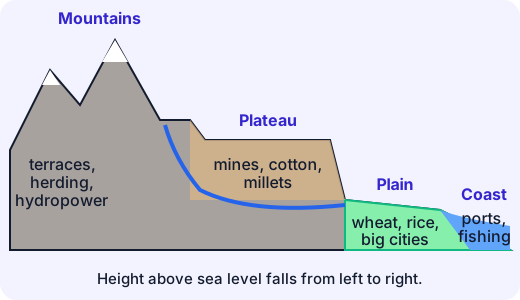
Mountains are high, steep landforms that rise sharply above their surroundings, with narrow valleys, thin rocky soil and a cooler climate as you climb (it falls about C for every 1,000 m). The Himalayas, the youngest big range, were pushed up over tens of millions of years as the Indian plate pressed into Asia; Everest rises 8,849 m. The Aravallis are among the oldest mountains in the world, worn down to low ridges.
Plateaus are raised areas with a fairly flat top and steep sides, sometimes called tablelands. The Tibetan Plateau averages about 4,500 m up; the Deccan Plateau of peninsular India is far lower, around 600 m on average, and is made partly of ancient lava.
Plains are broad, low and nearly level lands, often built by rivers laying down mud (silt) as they overflow. The Indo-Gangetic Plain is one of the most densely populated regions on Earth.
Mountain Plateau Plain Height high high but flat-topped low Slope steep flat on top, steep edges gentle or none Soil thin, stony varies: lava soil, thin rocky deep, silty Example Himalaya, Western Ghats Deccan, Chota Nagpur Ganga plain, Punjab Misconception. "A plateau and a plain are the same, because both are flat." A plain is low; a plateau is raised with steep sides. This changes the weather, the rivers (which tumble over a plateau's edges as waterfalls, such as Jog Falls) and the way people use it.
How the land shapes life
Farming
On a plain, flat land and deep river-laid soil make farming easy: large fields, canals for irrigation, two or three crops a year. Wheat and rice dominate the Indo-Gangetic Plain. The flat land also means floods, so a plain's farmers live with the river's mood.
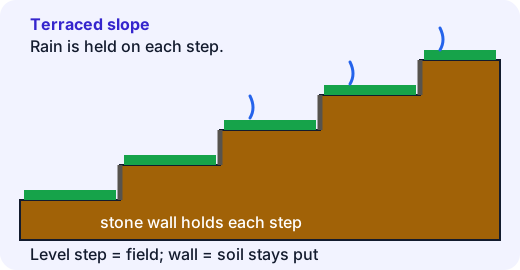
On a mountain slope farmers cannot simply plough. They carve terraces, flat steps held up by stone walls, so rain does not wash the soil downhill. Terraces grow rice in the Philippines' Cordillera, potatoes in the Andes, and tea in Darjeeling. Cool, misty slopes give Darjeeling tea its famous flavour. (Assam grows its tea on warm, humid plains, another reminder that more than one choice usually works.)
On the Deccan plateau the black soil formed from lava holds water well, so cotton and millets do well even where rain is uncertain. High, dry grasslands on plateaus and mountains suit herding: yaks in Ladakh and Tibet, sheep and goats among the Gaddi of Himachal Pradesh, and the Bakarwal of Jammu and Kashmir, who move their flocks up to mountain pastures in summer and down in winter.
Settlement
A settlement is a place where people live. On a plain, space and level ground encourage clustered (nucleated) villages and big cities around river crossings and ports. In steep mountains, flat ground is rare and precious, so houses are often scattered along terraces and ridges, and villages are small.
Resources and industry
Plateaus often hold minerals because old rock is exposed at the surface. The Chota Nagpur plateau has coal, iron ore, bauxite and mica, and so it hosts mines and steel towns. Mountains offer something else: fast water. The Bhakra dam across the Sutlej makes electricity and stores water for farms far downstream on the plains of Punjab and Haryana.
Culture and contact
Steep mountains and deep valleys keep villages apart for centuries. In Papua New Guinea, one of the most rugged countries, people speak more than 800 languages. Passes such as the Khyber or Nathu La, where the land lets people through, became routes for traders, armies and ideas. Plains, by contrast, make travel and contact easy, so languages and customs spread and mix over wide areas.
People choose among the options
If the land decided everything, all mountain villages would be poor and all plain villages rich. They are not.
- Switzerland is largely mountains. Its people chose tourism, dairy, precision watch-making, and hydropower, and it is among the wealthier countries.
- The Netherlands is so flat that about a quarter of it lies below sea level. The Dutch chose to build dykes and pump out the water, creating new farmland ("polders") from the sea.
- Bengaluru sits on the Deccan plateau at about 900 m. Its mild climate and its people's choices made it a centre of the software industry, not just of cotton or millets.
A landform sets a menu. A society picks from it with the tools, knowledge and money it has, and its choices can change as technology changes. A road tunnel or a cable car can turn an isolated valley into a tourist town.
Misconception. "Geography decides destiny." The land narrows the options, but it does not choose for people. The same plateau has been a farmland, a mining region and a high-tech city.
Worked example
Question. A village sits high on a Himalayan slope at 2,200 m. Suggest two ways of making a living that the landform supports, and one that it makes hard. Give reasons.
Answer.
- Terrace farming of potatoes or apples: cool climate and wet slopes suit them, and terraces control soil loss.
- Tourism and trekking: dramatic scenery draws visitors, and the villagers know the trails.
- Hard: large-scale wheat farming with machines, because the land is steep and fields would have to be tiny.
Summary
- Mountains are high and steep; plateaus are raised and flat-topped; plains are low and flat.
- Plains favour big-scale farming, dense settlement and easy contact; mountains favour terracing, herding, hydropower and tourism, and tend to keep communities apart; plateaus often hold minerals and unique soils.
- Landforms set the options. People, with their tools and ideas, choose among them.
Lab
Site chooser
Seven activities need a home: a dam, tea gardens, mines, a port and more. Put each on the landform that suits it, read why, and fix any poor fits.
Your goals
- Place all seven activities on a landform where they work, with no poor fits.
- Notice which activities have more than one possible site, and why.
The interactive lab opens once you register. Register to do this.
Quick check
Landforms and life check
Eight questions on how mountains, plateaus and plains shape life.
1.Match each landform to its description.
- Mountain
- Plateau
- Plain
Match each to: Raised land with a fairly flat top and steep sides · Broad, low, nearly level land, often built by river silt · High and steep, rising sharply above its surroundings
2.What is the main purpose of terraces on a hillside farm?
- To make level steps that hold soil and water instead of letting the rain wash them downhill.
- To make the slope steeper so crops get more sun.
- To keep animals out of the fields.
Choose one
3.What is the key difference between a plateau and a plain?
- A plateau is raised above its surroundings; a plain is low.
- A plateau is steep all over; a plain is flat all over.
- There is no difference; the two words mean the same.
Choose one
4.Which are real advantages of a river plain for farming and settlement? Choose all that apply.
- Deep, fertile silt left by the river
- Level land that is easy to irrigate and to build roads on
- Easy travel, so people, languages and trade mix
- Steep valleys that keep communities separate
Choose all that apply
5.Why do the Chota Nagpur plateau and similar regions have many mines?
- Old, hard rocks that hold minerals are near the surface there.
- Plateaus are always barren, so nobody can farm them.
- Rivers on plateaus carry coal from the plains.
Choose one
6.About a quarter of the Netherlands lies below sea level, yet it has farms and cities. What does this show?
- The land sets options, but people with tools and effort can change what is possible.
- Landforms have no effect on how people live.
- Low land always becomes rich farmland by itself.
Choose one
7.A town on the plain is at 30 °C. A village 2,000 m higher in the mountains is at roughly what temperature in °C? (Air cools by about 6 °C for each 1,000 m of height.)
Answer with a number
8.Put these in order from the lowest height above sea level to the highest.
- Tibetan Plateau, about 4,500 m on average
- Summit of Mount Everest, 8,849 m
- Deccan Plateau, about 600 m on average
- Ganga delta plain near Kolkata, about 10 m
Put these in order
Answering and checking are for registered learners. Register to do this.
Quick check
Landform puzzles
Apply the idea that landforms set options and people choose, to places the reading did not describe.
1.A mountainous country has no coal or oil but many fast, steep rivers. Which energy choice does its landform make easiest?
- Hydroelectric power from dams on the rivers
- Large coal mines on the plains
- Growing sugar cane for fuel on flat fields
Choose one
2.Two neighbouring valleys have the same slopes and climate. One village grows apples; the other builds guesthouses for trekkers. What does this show?
- People choose among the options a landform allows.
- One of the villages has misread the land.
- Landform decides what every village must do.
Choose one
3.A road tunnel is opened through a mountain barrier that used to cut a valley off in winter. Which changes are likely? Choose all that apply.
- Farmers can sell fresh produce in the town beyond the mountain all year.
- More visitors can arrive, so tourism may grow.
- The mountain stops affecting the valley's climate at all.
Choose all that apply
4.A satellite photo shows small houses scattered along narrow terraced ridges, with no large clustered villages. Which landform is it most likely?
- Mountains
- A river plain
- A coastal delta
Choose one
Answering and checking are for registered learners. Register to do this.
Your turn
Landform, options and choices
Choose a region you know or can research: for example the Western Ghats, the Thar desert fringe, the Punjab plain, Ladakh, the Chota Nagpur plateau, Switzerland or the Andes. Write about 200 words.
- Name the main landform and describe two features of it (height, slope, soil, rivers).
- Explain how the landform shapes one of: farming, where people settle, or culture and contact.
- Give one example of people choosing among options, or changing the options with technology. Say why this shows that the land does not decide everything.
How it's judged
- Describing the landform
- Linking land to life
- Options and choices
Writing and submitting your answer is for registered learners. Register to do this.
Like what you see?
Register for free to answer the quick checks, do the activities and save your work. Your work is saved on your device and syncs to your account.