Unit 7
Building from pieces
Build towers, bridges and walls from small pieces, take them apart, and build something new with the very same pieces.
Read
Thousands of small pieces
Ishaan watched the workers build a new house on his street. All day they carried small red bricks, spread a grey paste on top of each one, and set the next brick in place. Brick after brick after brick.
"One brick is tiny," Ishaan said. "How can that be a whole house?"
"It is not one brick," said the mason. "It is thousands of them. A big thing can be made of many small pieces."
Pieces and structures
A piece is one small part. A structure is the bigger thing that you make when you put pieces together.
Pieces Structure bricks a wall or a house beads a necklace toy blocks a tower or a bridge tiles a floor jigsaw pieces a picture 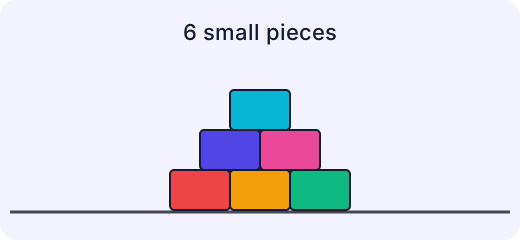
Not everything is built from pieces. A statue carved from one big rock is not made of pieces. But a surprising number of things are: houses, bridges, and even cloth, which is made of thousands of threads.
The same pieces can make new things
Here is the best part. You can take a structure apart and build something different with the very same pieces.
Example. Mira has 20 toy blocks. She builds a house with all 20. Then she takes it apart and builds a boat. The boat also uses 20 blocks. The house is gone, but the pieces are still there. Nothing was lost.
This is why builders love pieces. If one tile in a floor cracks, they take out that one tile and put in a new one. They do not rebuild the whole floor.
Try it: Use the Block builder in the next activity. You will build a tower, then a bridge, then take everything apart and build a staircase from the same pieces.
How pieces hold together
Pieces do not just sit near each other. They are joined. There are a few ways:
- Stacking: weight presses the pieces together, as in a pile of blocks.
- Locking: some pieces have bumps and holes that click together.
- Sticking: mortar, glue or tape holds them.
- Tying: string or rope holds them, like a bundle of sticks.
Making a structure strong
Builders use two simple tricks.
1. Overlap the pieces. In a strong brick wall, each brick sits across the join between two bricks below it. In a weak wall the joins line up in a straight line, and the wall can split along that line.
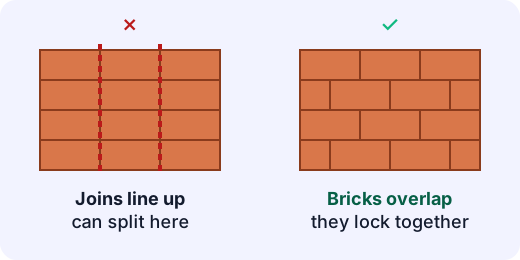
2. Make the bottom wide. A tower that is one block wide wobbles and falls. A tower that is wide at the bottom and narrow at the top stays up, because its weight sits low and spread out.
A common mistake is to think a structure is only as good as its biggest piece. Really, it is how the pieces are joined and arranged that matters.
For the grown-up helping
Let your child build with anything that stacks: blocks, steel cups, matchboxes, small boxes. Ask "What are the pieces? What did you build?" Then ask them to knock it down gently and build something new with the same pieces. The key idea is that the pieces stay the same while the structure changes. Towers that fall are normal and are the best teacher: ask "What could we change so it stays up?"
Lab
Block builder
Build a tower and a bridge from a pile of blocks. Then take everything apart and use the same blocks to build a staircase.
Your goals
- Build a tower that is 5 blocks tall.
- Build a bridge with an extra long block resting on two stacks and a gap underneath.
- Take it all apart, then build a staircase of stacks 1, 2, 3 and 4 blocks tall from the same pieces.
The interactive lab opens once you register. Register to do this.
Activity
Build, take apart, build again
Your child builds a structure from small household pieces, takes it apart, and builds something new from the same pieces. About 20 minutes.
You'll need
- 15 to 25 small pieces that stack (toy blocks, matchboxes, small boxes, steel cups or folded cards)
- A flat table or floor
- Paper and a pencil
Steps
- Count out the pieces together. Say "These are our pieces. How many do we have?" Write the number.
- Ask your child to build a tower using at least ten pieces. If it falls, ask "Why do you think it fell?"
- Try a second tower with a wider bottom. Ask "Which tower stayed up better? Why?"
- Now ask your child to take the tower apart and build a bridge or a wall with the same pieces. Count again. The number should be the same.
- Try one wall where the pieces overlap like bricks, and one where the joins line up. Gently push each wall with one finger. Which one stays together?
- Draw one of the structures and write its name.
Safety
- Build on a table or the floor, never on stairs or near a doorway.
- Use light things only. Do not stack glass, heavy books or sharp-edged tins.
- Keep very small pieces away from babies and toddlers.
- Pick up fallen pieces right away so nobody trips.
Keeping a log of the activity is for registered learners. Register to do this.
Quick check
Pieces and structures check
Seven questions about building with small pieces.
1.How many blocks are used to build this structure?
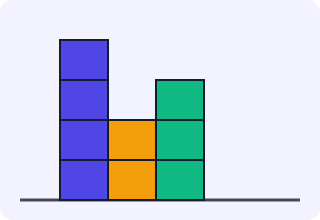
Answer with a number
2.Which of these are made by putting many small pieces together? Pick all that apply.
- A house built of bricks
- A necklace of beads
- A single glass marble
- A jigsaw puzzle picture
- A statue carved from one big stone
Choose all that apply
3.Builders put each brick across the join between two bricks below it. Why?
- It uses fewer bricks
- The bricks lock together, so the wall does not split along a straight line
- It makes the wall a different colour
Choose one
4.Mira builds a house from 20 blocks. She takes it apart and builds a boat using all the blocks. How many blocks are in the boat?
Answer with a number
5.Match each structure to the small pieces it is made from.
- A brick wall
- A necklace
- A tiled floor
Match each to: Beads · Tiles · Bricks
6.Put these in a sensible order for changing a toy-block house into a bridge.
- Build the bridge from the same blocks
- Gently press the bridge to test it
- Lay out the loose blocks
- Take the house apart
Put these in order
7.You take apart a block house and build a car. What stays the same?
- The pieces
- The shape of the structure
- What the structure can do
Choose one
Answering and checking are for registered learners. Register to do this.
Quick check
New puzzles
Use what you know about pieces and structures in new places.
1.A mason builds a wall that is 5 rows high. Each row has 6 bricks. How many bricks are in the wall?
Answer with a number
2.Which toy can you take apart and build into many different things?
- A doll moulded in one piece of plastic
- A box of wooden blocks
- A rubber ball
Choose one
3.Kavya's tall, thin tower of blocks keeps falling over. Which change will help most?
- Make the bottom wider, with more blocks on the ground
- Add more blocks to the top
- Paint the blocks a brighter colour
Choose one
4.A floor is made of hundreds of tiles. One tile cracks. What is the best thing to do?
- Take out just that tile and put in a new one
- Break the whole floor and start again
- Nothing can be done, because the floor is one piece
Choose one
Answering and checking are for registered learners. Register to do this.
Activity
Tell it back
Your child explains, in their own words, how a big thing can be made from small pieces and how the same pieces can make something new. About five minutes.
Steps
- Look at a wall, a floor or a toy made of pieces. Ask "What is this made of? What are the small pieces?"
- Ask "If we take it apart, can we make something different with the same pieces? What could we make?"
- Ask "What can we do to make a structure stronger?" Let your child answer in their own words, then write down what they said.
Keeping a log of the activity is for registered learners. Register to do this.
Like what you see?
Register for free to answer the quick checks, do the activities and save your work. Your work is saved on your device and syncs to your account.