Unit 8
Land and water on Earth
Find mountains, rivers, lakes and oceans on a globe and a map, and discover why Earth is called the blue planet.
Read
The blue planet
When astronauts first travelled far enough to see the whole Earth, they saw a round ball, swirled with white clouds. And most of it was blue.
"Earth should be called Ocean," some people joke. They are not far wrong.
Two kinds of surface
If you could peel Earth's surface like an orange and spread it out, you would see two things: land and water.
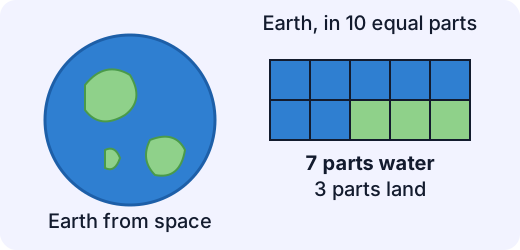
Imagine splitting the whole surface of Earth into 10 equal parts. About 7 parts are water and only about 3 parts are land. So Earth's surface is mostly water.
Almost all of that water is in the oceans. Ocean water is salty, so we cannot drink it.
Kinds of land
- A mountain is very high land that rises above everything near it. Mount Everest, in the Himalayas, is the highest mountain above sea level. A row of mountains is called a mountain range.
- An island is land with water all around it.
Kinds of water
- A river is water that flows along the land, from high places to low places. The Ganga starts high in the Himalayas and flows down towards the sea.
- A lake is a large patch of water with land all around it. It does not flow away like a river. Dal Lake in Kashmir is one.
- An ocean is a huge area of salty water. There are five: the Pacific, Atlantic, Indian, Southern and Arctic Oceans. The Pacific is the biggest.
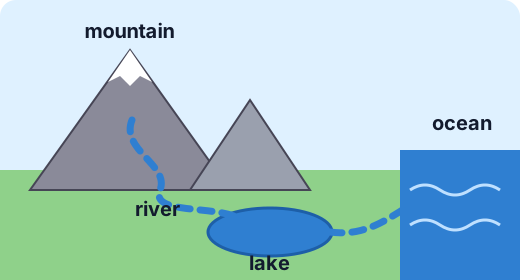
Look at the picture and follow the water. Rain and melting snow run down a mountain and make a stream. Streams join to make a river. The river may pass through a lake, and in the end it usually reaches the ocean.
Globes and maps
How do we know where all this is? We use a globe or a map.
- A globe is a ball-shaped model of Earth. It shows the real shape, but you cannot carry it in your pocket.
- A map is a flat picture. It is easy to carry and shows a lot at once.
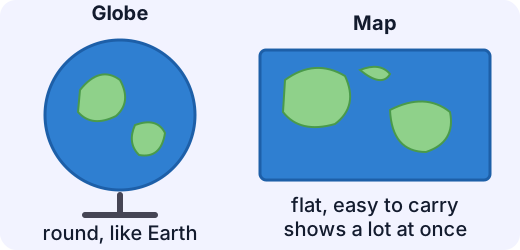
On most maps, blue means water, and land is shown in green, yellow or brown. To find a place, look for its blue or green shape, then read its name.
Example. On a map of India you see a blue shape on the left side, a blue shape on the right side, and a blue shape at the bottom. The big blue areas are seas and oceans that touch India.
A common mistake is to think the land is bigger than the water because the continents look big on a map. But add up all the oceans and you find there is more than twice as much water as land.
Try it: Spin a globe with your eyes closed and stop it with a finger. Look at where your finger landed. Do it ten times. How often was it on water?
For the grown-up helping
If you have a globe or atlas, use it. Say the names often (mountain, river, lake, ocean) and ask your child to point to them in books, photos and real life. A world map can make land look bigger than it is, so the globe tap game (see the hands-on activity) is a good check. It is fine if your child mixes up lake and ocean at first. Ask "Which one is salty? Which one has land all around it?"
Lab
Land and water explorer
Find a mountain, river, lake, ocean and island in a picture. Sort real places by kind, then guess how much of Earth is covered by water.
Your goals
- Find a mountain, a river, a lake, an ocean and an island in the picture.
- Sort eight real places into mountain, river, lake and ocean.
- Say how many parts out of 10 of Earth's surface are water.
The interactive lab opens once you register. Register to do this.
Activity
Globe and map hunt
Your child finds land and water on a globe or map, and tests how much of Earth is water by tapping the globe. About 20 minutes.
You'll need
- A globe, or a world map or atlas
- Paper and a pencil
- Optional: a soft inflatable globe (a beach ball with a world map works too)
Steps
- Look at the globe or map together. Ask "What colour is most of it? What do you think blue shows?"
- Find India. Ask your child to point to the sea or ocean that touches it, a mountain range (the Himalayas) and a big river (the Ganga). Say each name aloud.
- Find one lake on the map or in the atlas. Ask "What makes it a lake and not an ocean?"
- Do the tap test. Close your eyes, spin the globe (or toss the soft globe gently and catch it), and stop it with one finger. Open your eyes and note whether the finger is on land or water. Make a tally mark in a Land column or a Water column.
- Do this 20 times. Count the tally marks. Which column has more?
- Ask "Was Earth mostly land or mostly water? How do you know?" Write down what your child says.
Safety
- If you toss a soft globe, do it indoors away from windows, lamps and fragile things.
- Keep a hard globe on a stable table so it does not fall on feet.
Keeping a log of the activity is for registered learners. Register to do this.
Quick check
Land and water check
Six questions about the land and water on Earth.
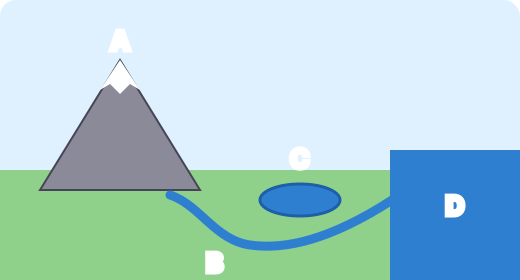
1.Which letter shows the lake?
- A
- B
- C
- D
Choose one
2.Look at the same picture. Which letter shows the river?
- A
- B
- C
- D
Choose one
3.What covers most of Earth's surface?
- Land
- Water
- Ice
Choose one
4.Split Earth's surface into 10 equal parts. About how many parts are water?
Answer with a number
5.Match each place to what kind of place it is.
- The Himalayas
- The Ganga
- Dal Lake
- The Indian Ocean
Match each to: River · Lake · Ocean · Mountains
6.You look at a map. There is a small blue shape with green all around it and no line leading away from it. What is it most likely to be?
- A lake
- An ocean
- A mountain
Choose one
Answering and checking are for registered learners. Register to do this.
Quick check
New puzzles
Use what you know about land and water in new situations.
1.An astronaut looks down at Earth from space. Which colour does she see the most?
- Blue
- Green
- Brown
Choose one
2.Rain falls high on a mountain and runs down in a stream. Streams join to make a river. Where does a river usually end up?
- Back at the top of the mountain
- In a lake or in the sea
- It flows uphill to another mountain
Choose one
3.You spin a globe, close your eyes and put a finger down. Where is it most likely to land?
- On land
- On water
- Land and water are equally likely
Choose one
4.Which of these is NOT a body of water?
- The Arabian Sea
- Dal Lake
- The Deccan Plateau
- The Brahmaputra River
Choose one
Answering and checking are for registered learners. Register to do this.
Activity
Tell it back
Your child explains, in their own words, what Earth's surface is mostly made of and how to tell a river, a lake and an ocean apart. About five minutes.
Steps
- Show a globe or a world map. Ask "If you looked at Earth from space, what would you see the most of? How do you know?"
- Ask "How is a river different from a lake? How is a lake different from an ocean?" Let your child answer in their own words.
- Ask "How can we find a mountain, a river or an ocean on a map?" Write down what your child says.
Keeping a log of the activity is for registered learners. Register to do this.
Like what you see?
Register for free to answer the quick checks, do the activities and save your work. Your work is saved on your device and syncs to your account.