Unit 6
Heating and cooling
Watch ice, chocolate and an egg change with heat, and find out which changes can be undone and which cannot.
Read
The kulfi and the egg
On a hot afternoon, Meera's kulfi started to drip down her hand. "Quick!" she said. "It is melting!"
She licked what she could and put the rest, now a sweet puddle, into a cup in the freezer. The next day the cup held a hard block of kulfi again. It was the same kulfi, made solid once more.
That evening her brother fried an egg. Meera asked, "Can we put it back in the shell?" He laughed. "No! Once an egg is cooked, it stays cooked."
Why can a melted kulfi turn solid again, but a cooked egg cannot go back? The answer is about how things change when they get hot or cold.
Heat makes some things melt
When a solid gets hot enough, it can melt. This means it changes into a liquid.
- A cube of ice melts into water.
- A piece of chocolate melts in your warm hand.
- Candle wax melts near a flame.
- Ghee, which is firm on a cold morning, goes runny in a warm pan.
Cooling makes them set
When a liquid gets cold enough, it can set. This means it turns solid again.
- Water in a freezer sets into ice.
- Melted chocolate, put in a fridge, sets hard.
- Wax that drips from a candle sets into a hard lump.
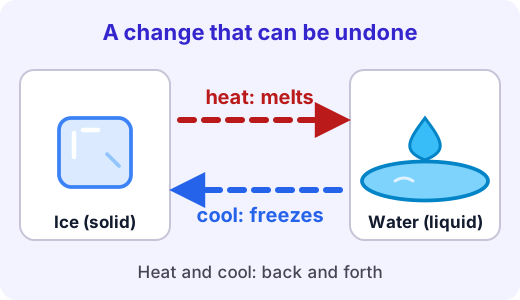
These are reversible changes. We can go one way with heat and back again with cold. The change can be undone.
Careful. Chocolate that has melted and set again may look dull or have a different shape. It is still the same chocolate, made of the same stuff.
Cooking is different
When we cook food, the heat changes it in a new way.
- A raw egg is runny. Heat turns it into a solid. Cooling it does not make it runny again.
- Soft dough turns into a firm roti on a hot tawa. A roti never turns back into dough.
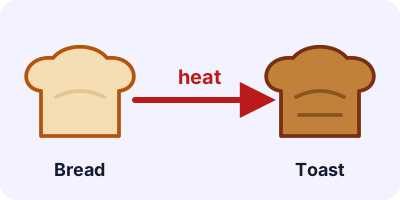
- Bread becomes toast. Toast never goes back to bread.
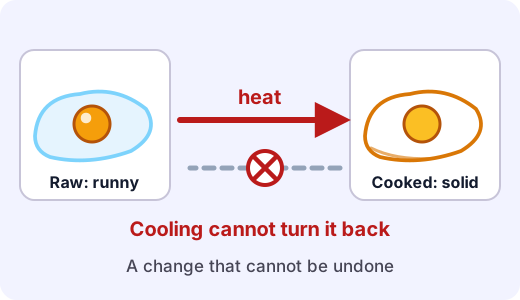
These changes cannot be undone. The food has become something new.
How to tell
Ask: "If I heat it, then cool it, does it go back to what it was?"
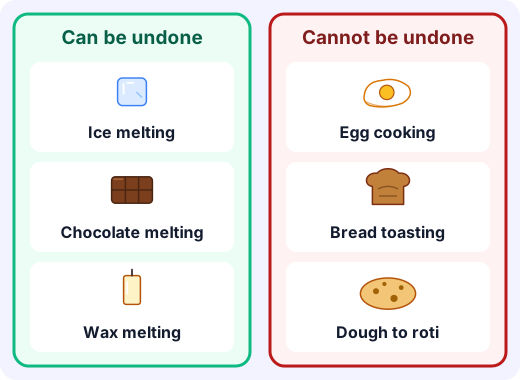
Example. A stick of butter goes soft in a warm kitchen and melts in a hot pan. When the pan cools, it sets again. This can be undone, like wax.
Example. A pakora fries in hot oil and turns crisp and golden. Cooling the pakora will not turn it back to the wet batter it started as. This cannot be undone.
Mix-ups to avoid
- "Heat always melts things." No. Heat melts ice and wax, but it makes an egg get firmer and bread get crisper.
- "Melted things have disappeared." No. The water from a melted ice cube is the same stuff as the ice, just in a different form.
- "Cooling will undo anything." No. Cooling only undoes changes like melting. It cannot undo cooking.
For the grown-up helping
Let your child try the changes with real things (see the hands-on activity), but you do the hot parts. Ask them to predict first: "What will happen if we heat it? What if we cool it again?" Mistakes are useful here, so let a prediction be wrong. Please keep children away from hot pans, hot water, open flames and microwaves. A grown-up handles all of those.
Lab
Can it be undone?
Heat and cool six materials, watch what happens, and sort each change into one that can be undone and one that cannot.
Your goals
- Heat and then cool ice, chocolate, wax, an egg, roti dough and bread, and notice what happens.
- Sort each change into "can be undone" or "cannot be undone".
The interactive lab opens once you register. Register to do this.
Activity
Melt, set and cook
Watch ice melt and chocolate melt and set, then watch an egg cook, and decide which changes can be undone. About 30 minutes, with a grown-up doing every hot step.
You'll need
- 3 ice cubes and 3 small plates
- A bar of chocolate (or ghee or butter) and a small heatproof bowl
- A larger bowl of warm water from the tap, not hot, and a spoon
- A fridge
- An egg, and a pan or pot to cook it (grown-up only)
- A watch or timer
- Paper and a pencil
Steps
- Put one ice cube on each plate. Put plate 1 in a sunny spot, plate 2 on a kitchen counter in the shade, and plate 3 in the fridge. Guess which will melt first. Check every five minutes for 20 minutes and write what you see.
- Break a few squares of chocolate into the small bowl. Grown-up fills the large bowl with warm water, floats the small bowl in it, and stirs the chocolate until it melts. Look at it. Is it a solid or a liquid?
- Grown-up takes the small bowl out and puts it in the fridge. After 15 to 20 minutes, look at the chocolate. Has it set? Does it look the same as before? Say what is the same and what is different.
- Ask your child to predict: "If I cook this egg, can I make it runny again by cooling it?" Write down the guess.
- Grown-up cracks the egg into a small bowl and shows it raw and runny. Grown-up then fries it in a pan, or boils a second egg in its shell. Let it cool completely. Look at it. Is it runny or solid? Can it go back?
- Make two lists, "Can be undone" and "Cannot be undone". Put each thing you tried in the right list, and add three other changes you know (for example ghee, a roti, a candle).
Safety
- A grown-up does every step that uses heat or hot water. Keep children away from the hot pan and the stove.
- Use warm tap water for melting chocolate, not boiling water, and keep the chocolate bowl dry so no water gets in.
- Do not give ice cubes to children under three, and do not give a child chocolate if the family avoids it or if there are allergies. Check labels for nuts.
- Do not eat raw egg. Wash hands and surfaces after touching raw egg.
- Do not use a microwave, open flame or candle for this activity. For candles, only look at pictures or watch a grown-up.
Keeping a log of the activity is for registered learners. Register to do this.
Quick check
Heating and cooling check
Six questions about heating, cooling and changes that can or cannot be undone.
1.Bread is heated in a toaster and becomes toast. Can you cool the toast to turn it back into soft bread?
- Yes, cooling turns it back into bread
- No, toasting is a change that cannot be undone
Choose one
2.Which of these changes can be undone? Pick all that apply.
- Ice melting into water
- An egg being fried
- Chocolate melting and then setting in the fridge
- Candle wax melting and then setting
- Bread being toasted
Choose all that apply
3.What does it mean when a solid melts?
- It changes into a liquid
- It disappears completely
- It gets harder
Choose one
4.Melted chocolate is put in the fridge for an hour. What happens?
- It sets and becomes solid again
- It gets even runnier
- It turns into water
Choose one
5.A frozen ice lolly is left in the sun. Put what happens in order.
- The lolly is a sticky puddle
- The lolly is hard and cold
- The lolly goes soft and starts to drip
Put these in order
6.A boiled egg has cooled down completely. What is true?
- It is still solid and cooked, because cooking cannot be undone
- It has turned runny again, because it is cold
- It is raw again
Choose one
Answering and checking are for registered learners. Register to do this.
Quick check
New puzzles
These are not the materials from the story. Use the question "does it go back?" to decide.
1.Ghee is solid on a cold winter morning and runny on a hot afternoon. Is this change one that can be undone?
- Yes, it melts when warm and sets when cool, again and again
- No, once it melts it can never be solid again
Choose one
2.Rolled-out dough is dropped into hot oil and puffs up into a puri. Can the puri be turned back into dough by cooling it?
- Yes, cooling turns it back into dough
- No, frying is a cooking change that cannot be undone
Choose one
3.Ali leaves a bar of chocolate in a hot car. It melts into a puddle in its wrapper. He puts it in the fridge and it sets. What is the best thing to say about it?
- It is solid chocolate again, but it may have a new shape and look a bit dull
- It has turned into a different material
- It cannot set again, because it was melted
Choose one
4.Three of these changes can be undone. Which one is the odd one out?
- Ice melting
- Wax melting
- Chocolate melting
- A cake baking in the oven
Choose one
Answering and checking are for registered learners. Register to do this.
Activity
Tell it back
Your child explains why ice can be frozen again but an egg cannot be uncooked. About five minutes.
Steps
- Ask "An ice cube melts into water. Can we make it into ice again? How?" Listen for "put it in the freezer" or "cool it".
- Ask "A boiled egg is solid. Can we cool it to make it runny again?" Ask "Why not?"
- Ask "How can you tell if a change can be undone?" Let your child give their own test or rule. Write down what they say, in their own words.
Keeping a log of the activity is for registered learners. Register to do this.
Like what you see?
Register for free to answer the quick checks, do the activities and save your work. Your work is saved on your device and syncs to your account.