Unit 9
How land changes
Use sand and water to see how rain and wind move land, and tell fast changes like landslides from slow ones like erosion.
Read
The hill that moved
Arjun's grandfather has a small farm on a hill. Every monsoon, the rain runs down the bare path beside the field. Every year the path gets a little deeper. This year, Arjun noticed a muddy groove as deep as his hand.
"Where did the soil go?" he asked.
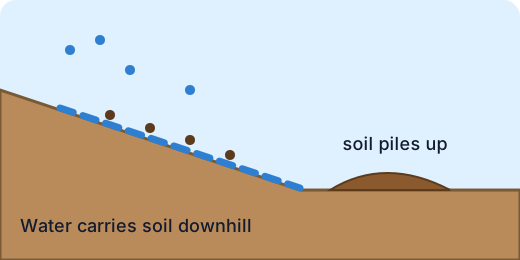
"Down the hill with the water," said his grandfather. "Look at the bottom of the field. The soil has piled up there."
Land seems to stay still. But it is always changing. Most of the time the changes are so slow that you cannot see them from one day to the next.
Water moves land
Rain runs downhill. As it runs, it picks up small bits of soil and sand and carries them away. Then it drops them somewhere lower. The wearing away and carrying off of rock and soil is called erosion.
Rivers do the same on a bigger scale. A river wears away its banks and bed, and carries the mud and sand towards the sea. Where the Ganga and the Brahmaputra reach the sea, the soil they have carried builds new land, called a delta. Waves in the sea also wear away cliffs and roll stones around until they are smooth and round.
Wind moves land
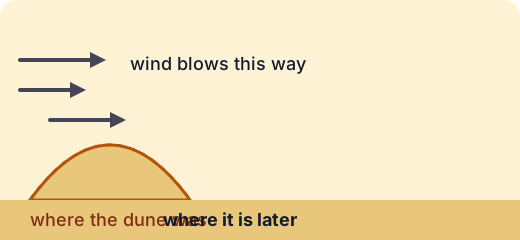
Where there is dry sand and no plants, wind picks up grains and drops them again further on. In a desert, a sand dune can slowly creep along. The wind wears sand off the side facing it and drops it on the other side.
Fast changes and slow changes
Most erosion is slow. A river may need thousands of years to cut a valley, and millions of years to carve a deep canyon like the Grand Canyon in the USA.
But some changes are fast. In a landslide, a lot of soil and rock slides down a slope all at once, in minutes. Landslides happen when a steep slope with little plant cover gets soaked with heavy rain.
Change How fast? Landslide minutes Rain cutting a gully in a bare field one rainy season River cutting a valley thousands of years River carving a canyon millions of years 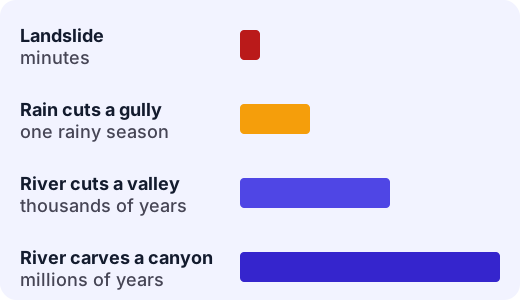
Example. Look at the muddy groove on Arjun's farm path. It took one monsoon to form: a fairly quick, small change. A big valley from the same kind of water would take far longer.
Try it: Pile sand on a tray into a slope. Pour water gently over it and watch the sand move. Do it again with grass pressed on top. Which slope loses less sand?
Plants help
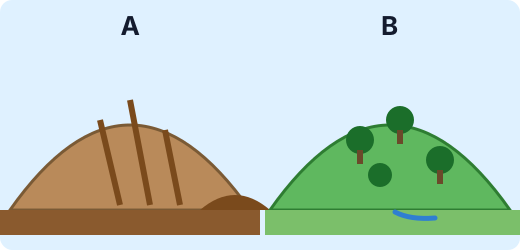
Roots hold soil together, like fingers holding sand. That is why farmers plant grass and trees on steep slopes, and why a bare hillside is more likely to slide.
A common mistake is to think that mountains and rocks never change because they feel so hard. They do change. They just change slowly.
Safety. After very heavy rain, stay away from steep slopes, cliffs and river banks. If you see mud or stones starting to move, or cracks in the ground, tell a grown-up straight away.
For the grown-up helping
Look for erosion near you: a gully by a road, mud washed to the foot of a slope, a smooth river pebble, sand blown against a wall. Ask "What moved it? How long might that have taken?" Children often think a change has to be sudden to count. Help them see small changes adding up. The hands-on tray activity makes the idea concrete.
Lab
Sand and water
Use a model hill of sand. Try rain, soaking rain and wind on bare sand and on grass, and find out which changes are slow and which are fast.
Your goals
- Run light rain on bare ground and on grass, on the same land shape, and compare how much sand moved.
- Use wind on a bare sand heap and see the sand move.
- Make a landslide with soaking rain on a steep, bare slope.
- Say which change was fastest and what helped hold the soil.
The interactive lab opens once you register. Register to do this.
Activity
Sand and water tray
Your child shows how water and wind move sand, and compares a quick landslide with slow erosion. About 30 minutes, best done outdoors or over a sink.
You'll need
- A large baking tray or shallow plastic box
- About 4 cups of damp sand or soil
- A cup of water and a spoon or small cup with a few holes poked in the bottom (adult makes the holes)
- Small clumps of grass, moss or small leaves
- A piece of folded card or a paper fan
- Paper and a pencil
Steps
- Pile the sand at one end of the tray to make a slope that goes down to the other end. Press it firm. This is your hill.
- Slowly pour water from the cup over the top of the hill, like rain. Watch where the sand goes. Where does it pile up?
- Rebuild the hill. This time press clumps of grass or small leaves on top, and pour the same amount of water. What is different?
- Rebuild a steeper hill with bare sand. Pour a lot of water quickly onto the top. Watch for sand sliding all at once. This is a model landslide.
- Dry some sand and make a small heap. Fan it gently from one side with the card, standing back so sand does not blow in anyone's face. Which way does the sand move?
- Draw your hill before and after the rain. Ask "Which change was quick? Which was slow? What helped keep the sand in place?"
Safety
- Do this outdoors or in a tray over a sink. Water spills.
- Never blow sand with your mouth. Use a fan or card, from the side, and keep sand away from eyes.
- Wash hands after touching sand and soil.
- Do not wash sand down the sink drain. Tip it into a bin or garden.
- Do not play near real steep slopes, cliffs or river banks to see erosion. Look from a safe distance with a grown-up.
Keeping a log of the activity is for registered learners. Register to do this.
Quick check
How land changes check
Seven questions about how wind and water change the land.
1.What is erosion?
- Wind or water wearing away rock and soil and carrying it somewhere else
- Plants growing and spreading across bare land
- Rain soaking into the ground and filling puddles
Choose one
2.Which of these are FAST changes? Pick all that apply.
- A hillside slipping down in minutes after heavy rain
- A river carving a canyon
- A sand dune creeping across a desert
- Rocks tumbling down a cliff in a few seconds
Choose all that apply
3.Both hillsides had the same heavy rain. Which hillside lost more soil?
- Hillside A
- Hillside B
- They lost the same
Choose one
4.Why do farmers plant grass and trees on steep slopes?
- Roots hold the soil in place
- They give shade, so the soil stays cool
- They make the slope steeper
Choose one
5.A small stream carries away 2 spoonfuls of sand from a bank every day. How many spoonfuls does it carry away in 7 days?
Answer with a number
6.Put these changes in order, from the FASTEST to the SLOWEST.
- Monsoon rain cuts a gully in a bare field (one season)
- A river cuts a small valley (thousands of years)
- A river carves a deep canyon (millions of years)
- A landslide slides down a slope (minutes)
Put these in order
7.Meera leaves a heap of dry sand in a yard. After a week of strong wind, the heap is flatter, and sand is piled against the wall. What moved the sand?
- The wind
- The sand moved by itself
- A river
Choose one
Answering and checking are for registered learners. Register to do this.
Quick check
New puzzles
Use what you know about how land changes in new places.
1.Two paths run down the same hill. One is covered in grass and the other is bare mud. After a month of heavy rain, which path will have the deeper gully?
- The bare mud path
- The grassy path
- Both the same
Choose one
2.Stones at the seashore are smooth and round. What most likely made them smooth?
- Waves rolling them around for a very long time
- Wind blowing on them for a few days
- One rain shower
Choose one
3.A farmer in a dry, windy place plants a row of trees around her sandy field. How does this help?
- The trees slow the wind and their roots hold the soil
- The trees make the wind stronger
- It does not help at all
Choose one
4.Aanya says, "Mountains never change." Dev says, "Mountains change, but very slowly." Who is right?
- Aanya
- Dev
- Neither of them
Choose one
Answering and checking are for registered learners. Register to do this.
Activity
Tell it back
Your child explains, in their own words, how wind and water change the land and how a landslide is different from erosion. About five minutes.
Steps
- Ask "How can water move land? How can wind move land?" Let your child use their tray or drawings to show you.
- Ask "What is a landslide? How is it different from the slow wearing away of land?" Listen for fast and slow.
- Ask "What can we do to stop soil washing away?" Write down what your child says, in their own words.
Keeping a log of the activity is for registered learners. Register to do this.
Like what you see?
Register for free to answer the quick checks, do the activities and save your work. Your work is saved on your device and syncs to your account.