Unit 10
Maps and directions
Find north, south, east and west, read a map key, and draw a map of your own neighbourhood.
Read
Which way is north?
Zoya is on the phone with her grandmother. "Nani, where is the bakery?"
"On your right," says Nani.
Zoya looks. She is facing the other way, and the bakery is on her left! Nani was standing on the opposite side of the street. Left and right change when you turn around. We need words that stay the same, wherever you stand.
Those words are the four directions.
North, south, east and west
The four main directions are north, south, east and west. Earth gives us a way to find them. The Sun comes up in the east and goes down in the west.
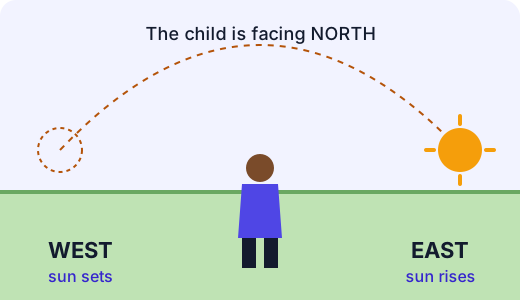
Try it: Stand outside in the morning with the rising Sun in front of you. You are facing east. Now north is on your left, south is on your right and west is behind you. (Never look straight at the Sun.)
On a map, the four directions go round like a clock. Starting at the top and going clockwise, they are North, East, South, West. Some children remember it as "Never Eat Soggy Waffles". Between them are the in-between directions, such as north-east (halfway between north and east).
A compass has a needle that points to north, even when you turn. A picture of the four directions on a map is called a compass rose.
What a map shows
A map is a drawing of a place seen from above. Mapmakers can't draw every tree and every brick, so they use symbols. A symbol is a small, simple picture that stands for something real: a square for a house, a red cross for a hospital, a wavy blue line for a river.
The map key is the little list that tells you what each symbol means. Without it, a map is a puzzle. With it, anyone can read your map, even if they have never visited the place.
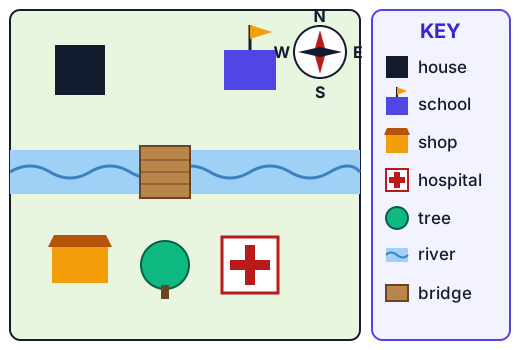
Example. Read the village map using the key and the compass rose.
- The black square is the house, in the top-left.
- The school is to the east of the house. (Go right, towards E on the compass rose.)
- The river runs east to west, south of the house and the school.
- The hospital is south of the school, on the far side of the river. The only way across is the bridge, which is to the west of the school. So you walk west to the bridge, south across it, then east to the hospital.
- The tree is between the shop and the hospital.
Common mix-ups
- "North is up." On most maps, north is at the top because mapmakers agree to draw it that way. In the real world, north is a direction on the ground, not "up". A good map shows a compass rose so you can check.
- "A map has to show everything." It doesn't. A map shows just what you need, and the key explains the rest.
- Forgetting the key. If you draw a symbol, put it in your key.
Draw your own
To map your neighbourhood: first decide where north is and draw the compass rose. Mark big things first (the road, the river, the park), then smaller ones. Use a simple symbol for each, and write every symbol in your key.
For the grown-up helping
Find north with your child using the morning Sun, then play "Which way?" around the house: "The kitchen is east of the bedroom." It is normal for children to mix up east and west at first. Help them stand and point. Let them make up their own symbols; the key is what matters.
Lab
Walk the village
Walk a child around a village map using the compass buttons (north, east, south, west). Use the key to find each place, and cross the river only at the bridge.
Your goals
- Use north, south, east and west to move from place to place on the map.
- Read the map key to find the school, the hospital, the shop, the tree park and the house.
- Finish all five trips.
The interactive lab opens once you register. Register to do this.
Activity
Map my neighbourhood
Your child finds north, takes a short walk with you, and draws a map of the neighbourhood with a compass rose and a key. About 40 minutes.
You'll need
- Large sheet of paper (or two stuck together)
- Pencil, eraser and coloured pencils
- A ruler
- A compass or a phone compass app (optional; the morning Sun works too)
Steps
- Go outside together. Work out where east is (the Sun rises there) or check with a compass. Then name north, south and west. Point to each.
- Take a short walk around your street, building or village with your child. Stop at five places that stay in one spot (a shop, a temple, mosque or church, a park, a school, a water tank, a big tree). Ask "Which direction is this from our home?"
- Back inside, draw a compass rose in one corner, with N pointing to the top of the page.
- Draw home first, then the road. Then add the five places in the right directions. Use a simple symbol for each.
- Draw a box in a corner and make the key. Write the name next to each symbol.
- Swap maps with someone at home. Ask them to find a place using only the key and directions, for example "Walk east from our home. What do you reach?"
Safety
- An adult goes on the walk. Stay on pavements and cross roads only with the adult, at safe places.
- Do not go close to water, building sites or traffic to look at something.
- Do not give the map to people outside the family if it shows your home.
Keeping a log of the activity is for registered learners. Register to do this.
Quick check
Maps and directions check
Seven questions about directions and map keys. Look at the pictures carefully.
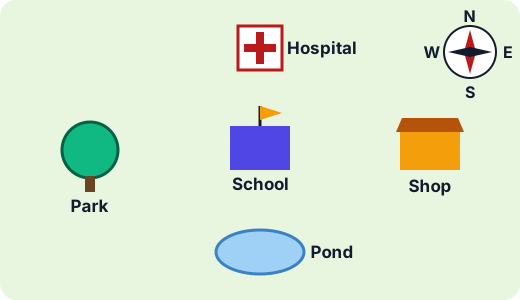
1.Look at the map. Which place is north of the school?
- The hospital
- The pond
- The shop
- The park
Choose one
2.In which direction does the Sun rise?
- North
- East
- South
- West
Choose one
3.Put the four directions in order, going clockwise round a compass rose, starting at north.
- West
- North
- East
- South
Put these in order
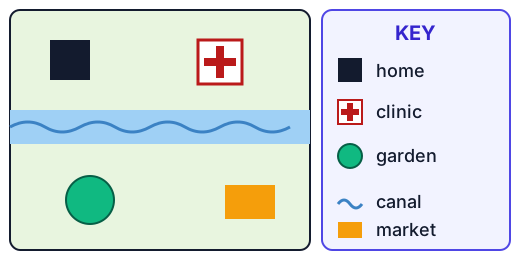
4.Use the key. What does the red cross on this map stand for?
- A home
- A clinic
- A garden
- A market
Choose one
5.Match each map word to what it means.
- Symbol
- Map key
- Compass rose
Match each to: A list that tells what the symbols mean · A small picture that stands for a real thing · A picture that shows north, south, east and west
6.You face the rising Sun in the morning. Which direction is directly behind you?
- North
- South
- East
- West
Choose one
7.You walk from the park to the shop, passing the school on the way. In which direction do you walk?
- North
- South
- East
- West
Choose one
Answering and checking are for registered learners. Register to do this.
Quick check
New puzzles
Directions and keys help in new places too. Can you use what you know?
1.Mira faces north. Then she turns to face the place where the Sun sets in the evening. Which way is she facing now?
- South
- East
- West
- North
Choose one
2.Aman walks 3 blocks north, then 2 blocks east, then 3 blocks south. Which direction should he walk to get back to where he started? (one word)
Answer with a word or phrase
3.On a school map, the library is directly south of the gym. The canteen is directly east of the library. Where is the canteen from the gym?
- North-east
- South-east
- South-west
- North-west
Choose one
4.Dev is drawing a map of his street. There is a well, but his key has no symbol for it. What should he do?
- Draw a new symbol for the well and add it to the key
- Leave the well out, because it is not in the key
- Draw the symbol on the map but not in the key, because everyone knows what a well is
Choose one
Answering and checking are for registered learners. Register to do this.
Activity
Tell it back
Your child explains why maps use directions and a key. About five minutes.
Steps
- Ask "Why do we say north and east instead of left and right when we give directions?" Wait. Let your child turn around to show what happens to left and right.
- Show your child a map with a key (a bus map, a park map or a map in a book). Ask "What does this symbol mean? How do you know?"
- Ask "If you draw a map for a friend, what two things must you put on it so they can read it?" Listen for a key and a compass rose or north.
- Write down what your child said, in their words.
Keeping a log of the activity is for registered learners. Register to do this.
Like what you see?
Register for free to answer the quick checks, do the activities and save your work. Your work is saved on your device and syncs to your account.