Unit 5
Our bodies grow
Measure how tall you are, see how much you have grown, and find out what food, sleep and moving do for a growing body.
Read
Dev's school trousers
Dev's mum took his school trousers out of the cupboard. "Try these on. They were new last year."
Dev pulled them on. The trousers stopped above his ankles. "They have shrunk!" said Dev.
"The trousers did not shrink," laughed Mum. "You grew."
Growing is slow
You cannot see yourself grow from one day to the next. But over months and years, your body gets bigger. Your bones get longer, your muscles get stronger, and you get taller. This is growth.
We can find out how much someone has grown by measuring and recording (writing down) their height. Here are Dev's heights on his birthdays.
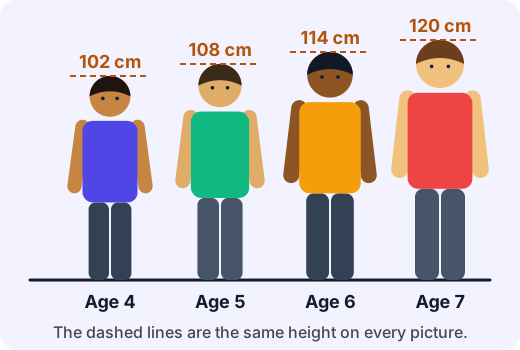
Age Height 4 102 cm 5 108 cm 6 114 cm 7 120 cm Example. How much did Dev grow between age 4 and age 7?
- Later height: 120 cm
- Earlier height: 102 cm
- Subtract:
Dev grew 18 cm in three years. That is about 6 cm in each year. Most children grow a little each year, but not by exactly the same amount every time.
How to measure your height
A fair measurement is done the same way each time.
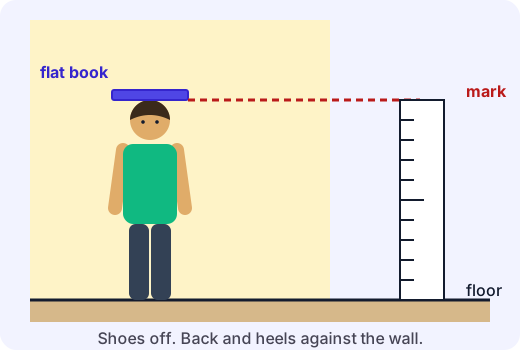
- Take your shoes off. Stand with your back and heels against a wall, looking straight ahead.
- A grown-up lays a flat book on your head, level, touching the wall.
- Mark the wall under the book with a pencil.
- Step away. Measure from the floor to the mark and write the number in centimetres (cm), with the date.
Try it: Measure someone twice. Do you get the same number? A tiny difference is normal. If you stand differently or wear shoes, the number changes. That is why we do it the same way every time.
What a growing body needs
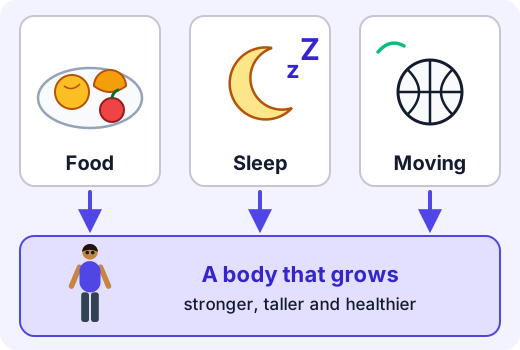
Need What it does Food Gives your body the things it builds with. Eat a mix: fruit, vegetables, rice, roti, and foods like dal, milk, eggs or fish. Drink water too. Sleep Your body rests and mends, and much of your growing happens while you sleep. Children your age usually need about 9 to 12 hours a night. Moving Running, jumping and climbing make your bones and muscles stronger. You need all three. Food without sleep or sleep without food does not do the job.
Everybody grows at their own speed
Two children who are the same age can be different heights. Families are different, and so are bodies. Being taller is not better, and being shorter is not worse. A grown-up can ask a doctor if there is ever a worry about growing.
Mix-ups to avoid
- "If I eat more and more, I will grow faster." No. Your body needs the right mix of foods, not endless food.
- "My friend is taller, so something is wrong with me." Usually not. Everyone grows at their own speed.
- "I can see myself growing every day." Growth is slow. You only see it by measuring over weeks and months.
For the grown-up helping
Measure height only, in a calm way. Please avoid talking about weight, size or shape. Keep the focus on what bodies do: run, climb, rest and get stronger. Do not compare your child with other children. If you are ever worried about your child's growth, a doctor or nurse is the right person to ask. Plan to measure again in about three months. Growth over a few weeks is too small to measure well.
Lab
The growth chart
Measure Zara's height on four birthdays by moving the marker, read the chart to see how much she grew, then plan a day with the food, moving and sleep a growing body needs.
Your goals
- Measure Zara's height at four ages and record each one.
- Work out how much she grew, and in which year she grew most.
- Choose the food, moving and sleep that help a body grow.
The interactive lab opens once you register. Register to do this.
Activity
My growth strip
Measure your child's height, make a paper growth strip, compare it with an older measurement, and keep a three-day growing diary. About 20 minutes, plus a few minutes a day for three days.
You'll need
- A flat wall or door frame
- A flat hardback book
- A pencil and masking tape (so you do not mark the wall)
- A tape measure or ruler, and string or a long paper strip
- Scissors (adult uses them)
- Paper and a pencil
Steps
- Take shoes off. Your child stands with back and heels against the wall, looking straight ahead and standing tall.
- Lay the flat book on their head, level against the wall. Stick a piece of masking tape on the wall just under the book and make a pencil mark on the tape.
- Measure from the floor to the mark and write the height in centimetres with today's date. Measure a second time. If the two numbers are different, measure a third time and write the number that came up twice.
- Cut a string or paper strip the same length as the height. Write your child's name and the date on it. This is the growth strip.
- Look for an older record of height. It could be a health card, a school record, marks on a door frame, or a photo with a known height. Work out how many centimetres have been grown since then, using subtraction. If there is no old record, compare with old clothes or shoes.
- For three days, keep a growing diary. Each evening, tick whether your child had a mix of foods, some active play and a good night's sleep. Talk about which of the three was easiest.
- Write a date about three months away on a calendar. On that day, measure again, make a new strip and put it next to the first. Look at the difference.
Safety
- Stay on the floor. Do not stand on chairs or boxes to reach the top of a door frame.
- Use masking tape for marks, or ask permission before marking a wall.
- An adult uses the scissors.
- Measure height only. Do not weigh children or talk about size and shape. Do not compare one child with another.
Keeping a log of the activity is for registered learners. Register to do this.
Quick check
Growing bodies check
Seven questions about measuring growth and what bodies need.
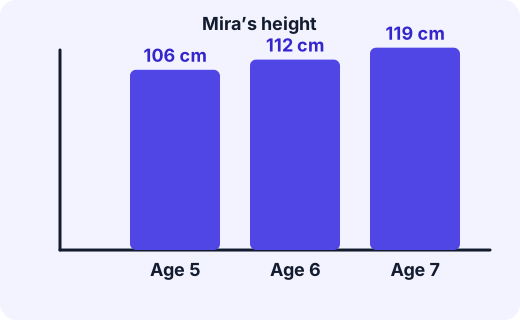
1.How many centimetres did Mira grow between age 5 and age 7?
Answer with a number
2.In which year did Mira grow the most?
- From age 5 to age 6
- From age 6 to age 7
- She grew the same amount in both years
Choose one
3.Which of these help a body to grow? Pick all that apply.
- Eating a mix of foods
- Getting enough sleep
- Running and playing
- Eating only sweets
- Staying up all night
Choose all that apply
4.Which way of measuring your height gives a fair answer every time?
- Shoes off, back and heels against the wall, measured the same way each time
- Shoes on one time and shoes off the next
- Standing on tiptoe to look taller
Choose one
5.Put the steps for measuring your height in order.
- Make a pencil mark on the wall under the book
- A grown-up lays a flat book on your head
- Stand with your back and heels against a wall
- Measure from the floor to the mark and write it down
Put these in order
6.Rani is smaller than her friend Lee, but they are both 7. What does that tell us?
- Children grow at their own speed, so being different heights is normal
- Rani must be doing something wrong
- Rani will always be smaller than Lee
Choose one
7.Match each need to what it does for a growing body.
- Food
- Sleep
- Moving
Match each to: Gives the body time to rest and mend · Gives the body what it builds with · Makes bones and muscles stronger
Answering and checking are for registered learners. Register to do this.
Quick check
New puzzles
Use what you know about measuring and growing in some new situations.
1.Kabir's height was 100 cm in January, 103 cm in June and 106 cm in December. How many centimetres did he grow from January to December?
Answer with a number
2.Sana is 117 cm tall. Her older sister is 5 cm taller. How tall is her sister, in cm?
Answer with a number
3.Ella measured herself in March with her shoes on. In June she measured herself with her shoes off and got a smaller number. She says she shrank. What is the best answer?
- She did not shrink. The two measurements were not made the same way, so they cannot be compared
- Yes, she shrank
- Her height changes every time she is measured, so no one can tell
Choose one
4.A school plans a day to help children grow. Which plan is best?
- Fruit and a proper breakfast, outdoor play at break, a lunch with dal, rice and vegetables, and an early bedtime
- No breakfast or lunch so there is more time for lessons, and a late bedtime
- Sweets for lunch, no play, and bedtime after midnight
Choose one
Answering and checking are for registered learners. Register to do this.
Activity
Tell it back
Your child explains how we know a body has grown and what a body needs in order to grow. About five minutes.
Steps
- Ask "How can we find out if someone has grown?" Listen for measuring and writing the number down, and measuring again later.
- Ask "What does a body need to grow well?" Let your child say as much as they can before you add anything.
- Ask "Why do you think sleep matters for growing?" and "What would you eat and do on a growing day?" Write down what your child says, in their own words.
Keeping a log of the activity is for registered learners. Register to do this.
Like what you see?
Register for free to answer the quick checks, do the activities and save your work. Your work is saved on your device and syncs to your account.