Unit 4
Life cycles
Follow a butterfly, a frog and a bean plant through the stages of their lives, and see why the story always goes round again.
Read
The tiny egg on the leaf
Nisha found a cabbage leaf in the garden with a few tiny yellow dots on it. "Eggs!" said her grandmother. "Watch them."
A few days later, the dots were gone. Tiny green caterpillars were munching the leaf. Then, one morning, there was a green case hanging from a twig. And a week after that, a white butterfly flew out and landed on Nisha's hand.
The little yellow dot had become a butterfly. How?
Stages
A butterfly does not grow up all in one go. It passes through stages, one after another. Each stage looks different and does a different job.
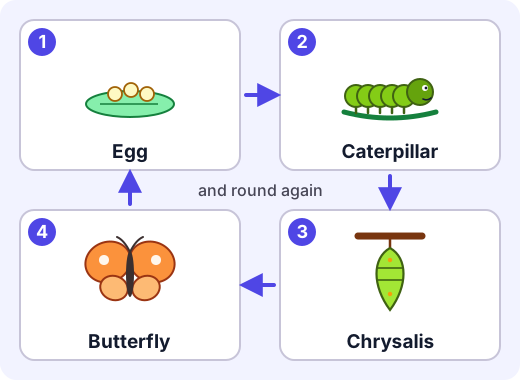
- Egg. The mother butterfly lays tiny eggs on a leaf.
- Caterpillar. A caterpillar hatches. It eats and eats, and it grows. Its skin gets too tight, so it sheds it and grows a new one.
- Chrysalis. The caterpillar hangs still and makes a hard case around itself. This is the chrysalis. It looks like nothing is happening, but inside, the body is changing a lot.
- Butterfly. The case opens. A butterfly comes out. It dries its wings, then flies off to find flowers and, later, to lay eggs.
And that last step is the clever part. The butterfly lays eggs, so the story starts again. That is why we call it a life cycle. A cycle goes round and round.
Words scientists use. A caterpillar is called a larva. A chrysalis is called a pupa. You may hear these words later.
A frog's life cycle
A frog begins in water too. It looks very different from a grown frog.
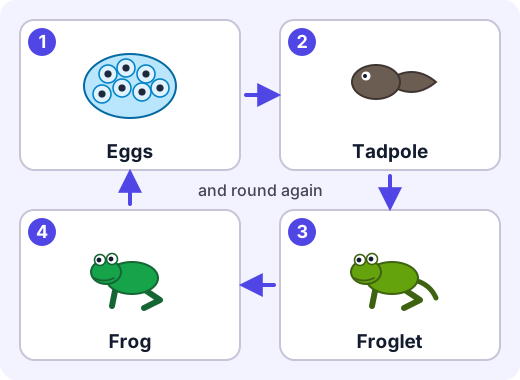
- Eggs. A frog lays soft, jelly-covered eggs in water. In India, many frogs do this when the monsoon rains fill ponds and puddles.
- Tadpole. A tadpole hatches. It has a tail, no legs, and gills for breathing in water. It swims and eats.
- Froglet. Legs grow. The tadpole grows lungs and starts to come up for air. Its tail gets shorter. Now it is a small frog with a stub of tail, called a froglet.
- Frog. The tail is gone. The frog can live in water and on land. Later, it lays eggs.
A plant's life cycle
Plants have life cycles too. A bean plant goes through four stages.
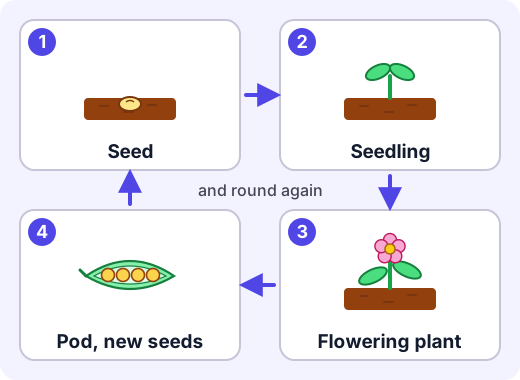
- A seed waits in the soil. With water and warmth, it sprouts.
- A seedling pushes up and opens its first leaves.
- The plant grows bigger and makes flowers.
- The flowers become pods. Inside are new seeds. Each one can start a new plant.
Try it: Say a life cycle out loud with your finger going round in a circle. Start anywhere. When you finish the last stage, say the first one again.
Mix-ups to avoid
- "A tadpole and a frog are different animals." No. They are the same animal at different stages.
- "The chrysalis is resting, so nothing happens." A lot happens inside. It is the stage where the caterpillar's body changes into a butterfly's body.
- "A life cycle stops at the grown-up." The grown-up makes eggs or seeds, and the cycle goes on. No living thing lives for ever, but its babies carry the cycle forward.
For the grown-up helping
Read this together over a few days, one cycle at a time. Ask your child to retell each cycle using the pictures, in order, with "first, next, then, last". If there is a plant, a pond or a garden nearby, go and look: look, but do not collect eggs or tadpoles from the wild. Some hairy caterpillars can irritate skin, so watch with eyes, not hands.
Lab
The cycle maker
Build the life cycle of a butterfly, a frog and a bean plant. Tap the stage cards in the order they happen, then say how each cycle starts again.
Your goals
- Put the four stages of a butterfly, a frog and a bean plant in the right order.
- Say what the grown-up makes so that each cycle can start again.
The interactive lab opens once you register. Register to do this.
Activity
Bean in a bag, and a cycle wheel
Watch a bean seed go through its first stages, draw what you see each day, then make a cycle wheel for any living thing. Ten minutes to start, then two minutes a day for about a week.
You'll need
- A clear zip-lock bag or a clear jar
- Paper towel or cotton wool
- 2 or 3 dried beans (green gram, chickpea or kidney bean), soaked in water overnight
- A spoon of water
- Tape
- A paper plate and a pencil or crayons
- A sunny window
Steps
- Fold the paper towel so it fits inside the bag. Wet it with a spoon of water so it is damp, not dripping.
- Put the soaked beans between the towel and the plastic, where you can see them. Zip the bag nearly shut and tape it to a sunny window.
- Every day, look at the beans. Draw what you see, and write the day number. Look for the seed splitting, a root coming out, then a shoot, then the first leaves.
- After about a week, sort your drawings in order. Say "seed, then root, then seedling".
- Make a cycle wheel on the paper plate. Draw lines to split it into four parts. Draw one stage in each part (a butterfly, a frog or a bean plant), with an arrow from part to part, and a last arrow back to the start.
- Point to each stage and tell the story of the cycle, ending with "and then it starts again".
- Outside, look for real life cycles. Look for eggs on leaves, a chrysalis on a twig, or frogspawn or tadpoles in a pond. Look and draw only. Do not pick anything up or take it home.
Safety
- Dried beans are a choking risk for children under three. Keep them out of reach and do not eat the soaked beans.
- If fuzzy mould grows in the bag, an adult throws the bag away without opening it, and everyone washes their hands.
- Wash hands after touching soil, beans or damp towel.
- Near ponds, an adult stays right with the child, and no one leans over the water.
- Do not touch caterpillars, especially hairy ones. They can make skin itchy.
Keeping a log of the activity is for registered learners. Register to do this.
Quick check
Life cycles check
Seven questions about butterflies, frogs and bean plants.
1.Put the stages of a butterfly's life in order, from first to last.
- Butterfly
- Egg
- Caterpillar
- Chrysalis
Put these in order
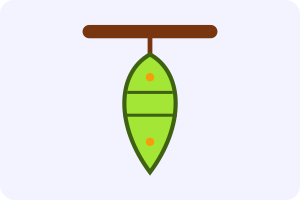
2.Which stage of a butterfly's life is this?
- Egg
- Caterpillar
- Chrysalis
- Butterfly
Choose one
3.A tadpole lives in water. Which of these does a tadpole have?
- Four strong legs and no tail
- A tail, and gills for breathing in water
- Wings
Choose one
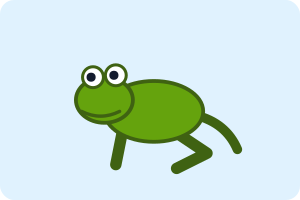
4.This young frog has four legs and a short tail. What is it called?
- A tadpole
- A froglet
- Frog eggs
Choose one
5.Which of these are stages in the life cycle of a butterfly? Pick all that apply.
- Egg
- Tadpole
- Caterpillar
- Chrysalis
- Seedling
Choose all that apply
6.Match each stage of a bean plant to what happens.
- Seed
- Seedling
- Flowering plant
- Pod
Match each to: Makes flowers that become pods · Pushes up and opens its first leaves · Sprouts when it gets water and warmth · Holds new seeds for the next plants
7.Why do we call it a life cycle?
- Because it stops when the animal is fully grown
- Because the grown-up makes eggs or seeds and the stages start again
- Because the animal walks around in a circle
Choose one
Answering and checking are for registered learners. Register to do this.
Quick check
New puzzles
These living things were not in the story. Use what you know about life cycles.
1.A ladybird starts as an egg on a leaf. The egg hatches into a spiky larva that eats tiny insects. Then the larva stops moving and becomes a pupa. Finally an adult ladybird comes out. Which stage is like the butterfly's chrysalis?
- The egg
- The larva
- The pupa
- The adult
Choose one
2.A mango tree grows tiny flowers in spring. Which comes next in the mango tree's life cycle?
- Small green mangoes (fruit) that grow bigger
- A seedling
- A bean pod
Choose one
3.A butterfly lays her eggs and flies away. What stage will the next cycle begin with?
- Egg
- Caterpillar
- Butterfly
Choose one
4.In July, Tiya sees jelly lumps with black dots in a pond. Two weeks later she sees small swimmers with tails and no legs. Later still she sees tiny frogs on the bank. Which sentence is right?
- The tiny frogs are the same animals as the swimmers, grown through the stages
- The swimmers and the frogs are two different kinds of animal
- The tiny frogs came from somewhere else and ate the swimmers
Choose one
5.A hen sits on her eggs. Each egg hatches into a chick. The chick grows into a hen, and later she lays eggs. Is this a life cycle?
- Yes, it goes round: egg, chick, hen, then eggs again
- No, it stops when the chick hatches
- No, because a chick does not change at all
Choose one
Answering and checking are for registered learners. Register to do this.
Activity
Tell it back
Your child tells the life cycle of an animal or plant in their own words, and says why it is called a cycle. About five minutes.
Steps
- Ask your child to pick a butterfly, a frog or a bean plant. Ask them to tell you its whole life, stage by stage, using "first, next, then, last". Pictures are fine to use.
- Ask "What happens after the last stage?" Listen for the idea that the cycle starts again, with eggs or seeds.
- Ask "Why do you think we call it a life cycle?" Write down what your child says, in their own words.
- If they get stuck, ask "What did it look like before that?" or "What does the grown-up make?" Do not tell them the answer.
Keeping a log of the activity is for registered learners. Register to do this.
Like what you see?
Register for free to answer the quick checks, do the activities and save your work. Your work is saved on your device and syncs to your account.