Unit 3
How seeds travel
Find out how wind, animals and water carry seeds, and how a bee carries pollen from flower to flower.
Read
Plants need a helping hand
Inaya and her father walk through a field of tall grass. When they stop, her socks are covered in tiny, prickly seeds. They stick tight.
"How did they get on me?" asks Inaya. "They hitched a ride," says her father. "That's how that plant plans to travel."
A plant cannot walk. Once it has put down roots, it stays. So how do new plants grow in new places? Plants get help.
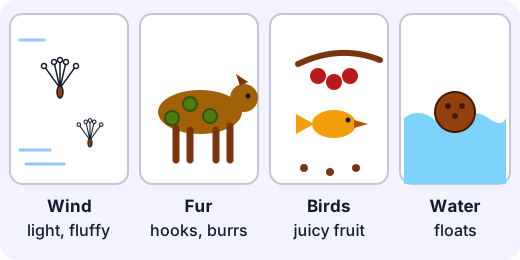
Why seeds need to travel
If every seed fell right under its parent plant, the young plants would grow crowded together. They would fight over light and water, which you know every plant needs. Seeds that travel find new space.
Four ways seeds travel
- Wind. Some seeds are very light, with fluffy hairs or thin wings. A dandelion seed is like a tiny parachute. The wind carries it far away.
- Animal fur and clothes. Some seeds have hooks or are sticky. They catch on fur, feathers and socks. The animal walks off, and the seed drops later.
- Eaten and dropped. A juicy fruit tastes good. A bird or a bat eats it and the hard seed passes out in the droppings, far from the tree. A squirrel may bury a nut and forget it.
- Water. A coconut has a thick husk full of air, so it floats. The sea can carry it to a new shore, where it may grow.
Other seeds travel by popping out of a dry pod, which snaps open and flings them away.
Pollen: help to make seeds
Before a flower can make seeds, it needs pollen. Pollen is a fine dust made in flowers. It has to reach another flower of the same kind. Plants cannot walk, so they need help here too.
A bee visits a flower for sweet nectar. Pollen sticks to its furry body. The bee flies to the next flower and some pollen rubs off. This is called pollination. Now the flower can make seeds, and often a fruit around them.
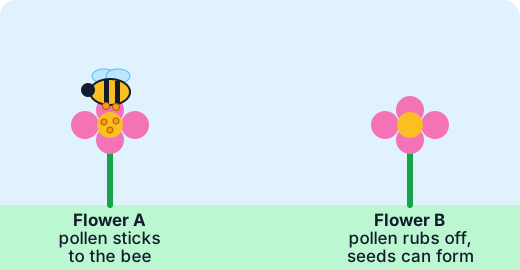
Butterflies, birds and some bats carry pollen too. Some plants, like grasses, let the wind blow their pollen around.
Example. A bee lands on pumpkin flower 1 and picks up pollen. It flies to flower 2 and some pollen rubs off, so flower 2 is pollinated. It carries on to flower 3, and flower 3 is pollinated too. The bee helped two flowers.
Watch out for these mix-ups
- Pollen is not a seed. Pollen is dust from a flower. A seed is the part that can grow into a new plant.
- The bee is not trying to help. It is collecting nectar (and some pollen to eat). Pollen sticks to its body by accident, and carrying it between flowers is a side effect that the plants benefit from.
- A seed does not need to be eaten by an animal to grow. That is only one way for it to travel.
Try it: Look at a seed or fruit. Does it have a wing, a parachute, hooks, a juicy part or a float? Guess how it travels.
For the grown-up helping
Do a seed walk in a park, field or garden. Look for the four kinds of seed helper. Ask, "How do you think this seed travels? What makes you think that?" Children often mix up pollen and seeds; show them the yellow dust on a hibiscus or mustard flower and say "this is pollen, it helps make the seeds". Keep your child away from berries and seeds they do not know. Never taste them.
Lab
The seed journey
First, choose the helper that will carry each seed far from its parent plant. Then be a bee and carry pollen between three flowers.
Your goals
- Match each of four seeds to the helper (wind, fur, a bird, or water) that carries it away from the parent plant.
- Visit the flowers in turn so that the bee carries pollen and all three flowers are pollinated.
The interactive lab opens once you register. Register to do this.
Activity
Sock walk and seed sort
Go on a seed walk, collect seeds on old socks, sort them by how they travel, and test one in the air. About 40 minutes.
You'll need
- A pair of old wool or thick cotton socks, big enough to pull over shoes
- A paper bag or small box
- A sheet of paper and a pencil
- A magnifying glass, if you have one
- Dishes of damp soil or cotton wool (optional, to see if the seeds grow)
Steps
- Pull the old socks over your shoes. Walk slowly through a patch of grass or weeds in a park, field or garden where picking plants is allowed.
- Sit down and look at your socks. Pick off the seeds that stuck and put them in a bag. Talk about why they stuck.
- Look for other seeds on the ground: fluffy seeds, winged seeds, nuts, hard fruit stones. Collect a few, but do not taste any.
- Sort all the seeds on the paper into four groups: wind, fur or clothes, eaten by animals, and water. Guess where each belongs and say why.
- Test a light seed. Drop one fluffy or winged seed and a small pebble from the same height. Which falls slower? What does that tell you about wind?
- Optional: press the sock seeds into damp soil or cotton wool in a dish. Keep it moist and in light, and look every day for a week.
Safety
- An adult goes along, picks the place, and checks it for thorns, nettles, stinging insects and snakes. Stay on paths or short grass.
- Do not put any seed, berry or fruit in your mouth; some are poisonous.
- Be careful with children who have pollen allergies or hay fever, and do not walk where pesticide has been sprayed.
- Remove the socks and check for ticks, thorns and insects when you finish. Wash hands afterwards.
- Do not collect from protected areas or from other people's gardens without asking.
Keeping a log of the activity is for registered learners. Register to do this.
Quick check
Seeds and pollen check
Six questions about how seeds and pollen travel.
1.This seed is covered in tiny hooks. How will it most likely travel?
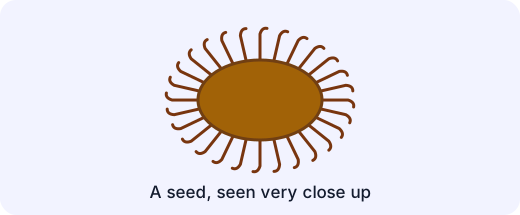
- Stuck to an animal's fur or to clothes
- Floating on the wind like a parachute
- Floating on water
Choose one
2.Match each seed to the way it travels.
- Light, fluffy dandelion seed
- Seed with sticky hooks
- Coconut with an airy husk
- Juicy berry with a seed inside
Match each to: Carried on fur · Blown by the wind · Eaten by a bird and dropped · Floats on water
3.Why is it a problem if all the seeds fall right under the parent plant?
- The young plants would be crowded and fight for light and water
- Seeds cannot grow in the same place as their parent ever
- The parent plant would be too heavy
Choose one
4.What is pollen?
- A fine dust made in flowers that helps make seeds
- A tiny baby plant
- The sweet juice that bees drink
Choose one
5.Which of these can carry pollen from one flower to another?
- Bees
- Butterflies
- Wind
- Stones
Choose all that apply
6.Put the steps in order.
- The bee flies to flower B
- A bee lands on flower A and pollen sticks to it
- Flower B can make seeds
- Pollen rubs off onto flower B
Put these in order
Answering and checking are for registered learners. Register to do this.
Quick check
New puzzles
Use what you know about seeds and pollen in new places.
1.A mango tree grows by a path, far from any other mango tree. The seed was inside a tasty, juicy fruit. How did the seed most likely get there?
- An animal ate the fruit and dropped the seed there
- The seed walked there on its own
- It stuck to a goat's fur with tiny hooks
Choose one
2.Plant A has heavy round seeds that fall straight down. Plant B has seeds with light fluffy parachutes. On a windy day, which plant's seeds will land farther away?
- Plant B
- Plant A
- Both land the same distance away
Choose one
3.A farmer's pumpkin flowers open but no pumpkins grow. There are no bees or other insects nearby. What would help most?
- Planting flowers nearby so bees come to carry pollen
- Watering the plants twice as much
- Painting the flowers a brighter colour
Choose one
4.A bee has no pollen on it. It visits 3 flowers one after another and picks up pollen at each one. How many flowers can it pollinate on this trip?
Answer with a number
Answering and checking are for registered learners. Register to do this.
Activity
Tell it back
Your child explains, in their own words, why plants need help and how seeds and pollen get around. About five minutes.
Steps
- Ask your child, "Plants cannot walk. How do their seeds get to new places?" Let them answer before you add anything.
- Ask them to name two different ways, and to say which kind of seed goes with which way. A drawing or an object (a burr, a fluffy seed, a fruit) can help.
- Ask, "What does a bee do for a flower?" Listen for pollen moving from one flower to another.
- Write down what your child said, in their words.
Keeping a log of the activity is for registered learners. Register to do this.
Like what you see?
Register for free to answer the quick checks, do the activities and save your work. Your work is saved on your device and syncs to your account.