Unit 3
Fair and unfair
Find out why sharing the same amount is not always the fair way to share.
Read
Equal is not always fair
Two cats found a roti and could not agree how to share it. A monkey said, "I will help you!" He broke the roti into two pieces, but one piece was bigger. "Oh no, it isn't equal," he said. He nibbled the big piece to make it smaller. Now the other piece was bigger! He nibbled that one. He kept nibbling and nibbling, until there was almost nothing left, and the two cats got only crumbs. The clever monkey had eaten most of it himself!
That is an old story, and nobody thinks the monkey was fair. But what is fair?
Three words
- Share means to give a part of something to someone else.
- Equal means the same amount for everyone.
- Fair means it feels right to everyone, for good reasons.
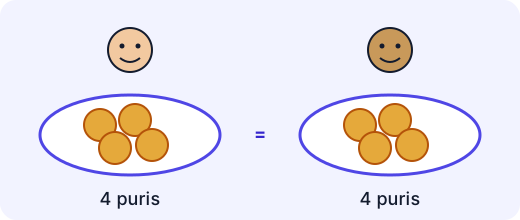
Often, sharing equally is fair. If two friends are equally hungry and there are 8 puris, 4 each is fair.
When equal is not fair
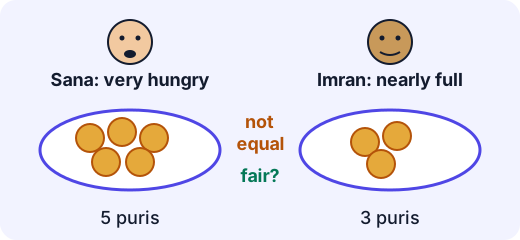
Here is a puzzle. Nani has 8 puris for her grandchildren Sana and Imran. Sana has not eaten since morning and she is very hungry. Imran just had a big lunch and is nearly full.
If Nani gives 4 puris to each, that is equal. But Sana is still hungry, and Imran leaves half of his. Nani might give Sana 5 and Imran 3. That is not equal, but is it fair? Many people would say yes, because Sana needs more.
Here is another example. Suppose a tiny baby and a big brother both get shoes of the same size. That is equal, but the shoes will not fit at least one of them. Fair means each child gets shoes that fit.
Sharing Equal? Fair? 5 sweets each for two equally hungry friends Yes Yes Same shoe size for a baby and a big brother Yes No, shoes must fit 5 puris for hungry Sana, 3 for full Imran No Many would say yes: Sana needs more A big girl takes 9 of 10 grapes and leaves 1 for her little brother, who is just as hungry No No, there is no good reason So fair does not always mean the same for everyone. But be careful. Giving more is only fair when there is a good reason, like "she is hungrier" or "he has none because his plate fell." "I like him best" or "I am bigger" are not good reasons.
Try it: Imagine 6 mangoes for you and a friend. Is there a time when it would be fair to give your friend more? What would your reason be?
The big question
If one child is hungrier, is it fair to give them more?
Some people say yes: fair means giving each person what they need. Others say no: fair means the same for everyone, or else it is too hard to decide who needs more. You can think either way, as long as you give your reason.
For the grown-up helping
Use real sharing at home (fruit, stickers, turns) to talk about fairness. Children this age often say "fair" when they mean "I got the same as my sibling." Try asking, "What would be fair if one of you was much hungrier?" Let them wonder about it; there is more than one good answer. The key is asking for a reason and noticing whether it is a good one.
Quick check
New puzzles
Think about what is fair in new situations.
1.Dad has 6 pencils to share equally between two children. How many does each child get?
Answer with a number
2.A baby and a big brother each get the same size of shoes. That is equal. Is it fair?
- Yes, because it is equal
- No, because shoes need to fit each person
Choose one
3.Which one is unfair?
- Two equally hungry friends share 10 grapes, 5 each
- A big girl takes 9 of 10 grapes and leaves 1 for her little brother, who is just as hungry
- Kiran's pencil broke, so the teacher gives him a new one
Choose one
4.Is this true or false? "Fair always means the same for everyone."
- True
- False, sometimes fair means giving each one what they need
Choose one
5.Which are good reasons to give one child more food? Pick all that apply.
- She is much hungrier
- He is my best friend
- His plate fell and he has none left
- He asked in a louder voice
Choose all that apply
Answering and checking are for registered learners. Register to do this.
Your turn
Shastrartha - the hungrier child
The question: If one child is hungrier, is it fair to give them more?
Talk it through, or write it with a grown-up's help. A grown-up may write down your words.
- Say what you think: "I think it ___ fair to give the hungrier child more."
- Give a reason: "I think this because ___."
- Give an example, such as Sana and Imran sharing 8 puris, or one from your own life.
- Say what a friend who thinks the other way might say, starting "You think ... because ...".
How it's judged
- A clear position (pratijna)
- A real reason (hetu)
- An example (udaharana)
- Fair to the other side (purvapaksha)
Writing and submitting your answer is for registered learners. Register to do this.
Activity
The fair-share test
Your child shares real snacks two ways, then explains when equal is fair and when it is not. About 15 minutes.
You'll need
- 8 small snacks that are safe for your child, such as pieces of fruit, biscuits or raisins
- Two plates
- Two soft toys or two family members
Steps
- Say "These two (toys or people) are equally hungry." Your child shares the 8 snacks between two plates. Ask "Is that equal? Is it fair? Why?"
- Now say "One is very hungry. The other has just eaten a big meal." Ask your child to share again. Let them choose, and ask for a reason.
- Ask "Is this equal now? Is it fair? What changed?"
- Ask about shoes. "A baby and a big brother get the same size of shoes. Is that fair?"
- Finally ask "Does fair always mean the same for everyone?" and write down your child's words.
Safety
- Check for allergies before choosing snacks.
- Cut round or hard snacks, like grapes, into small pieces for young children.
Keeping a log of the activity is for registered learners. Register to do this.
Like what you see?
Register for free to answer the quick checks, do the activities and save your work. Your work is saved on your device and syncs to your account.