Unit 4
Telling the truth
See how telling the truth builds trust, and how fast a lie can break it.
Read
The boy and the wolf
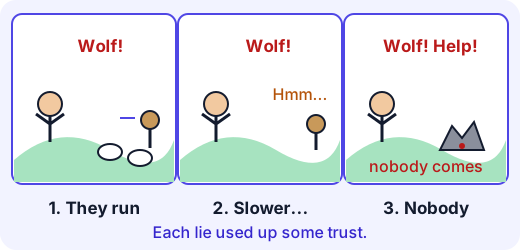
A shepherd boy looked after the village sheep on a hill. It was a long, quiet day, and he was bored. So he shouted, "Wolf! Wolf! A wolf is eating the sheep!"
The villagers dropped their work and ran up the hill. There was no wolf. The boy laughed and laughed. "That was funny!" he said.
A few days later he did it again. "Wolf! Wolf!" The villagers ran up the hill again, a little more slowly. Again there was no wolf. This time they were cross.
Then one evening a real wolf came. "Wolf! Wolf! Please help!" shouted the boy. But the villagers said, "He is fooling us again," and nobody came. The sheep were lost.
This old story comes from Aesop. It shows something important about trust.
Two words
- Truth means saying what really happened or what you really think.
- Trust means believing someone, because they have told the truth before.
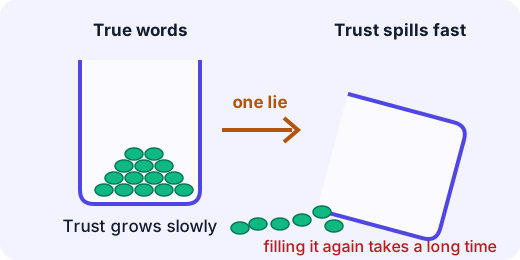
Trust is like a jar that you fill, one true word at a time. Every time you tell the truth, a little more trust goes in. A lie can tip the jar over very quickly. After that, it takes a long time to fill it up again.
What happened because of it
Look at the shepherd boy. What happened because he told lies?
- The villagers ran up the hill for nothing.
- They stopped believing him.
- When he told the truth, nobody helped.
The lie did not only trick the villagers. It hurt the boy and the sheep too.
A true boy in an old story
Long ago in India there was a boy named Satyakama. He wanted to go to a teacher to learn. The teacher asked, "What is your family name?" Satyakama went and asked his mother. She said, "I do not know. I was busy serving many people when you were young." Satyakama could have made up a family name. But he went back and told the teacher exactly what his mother had said.
The teacher was glad. "Only someone who tells the truth would say that," he said, and he took Satyakama as a pupil. (The name Satyakama means "someone who loves the truth.") Telling the truth was hard, and it was worth it.
Telling the truth is not always easy
Sometimes we are afraid. Maybe we broke a cup, or we want to keep a toy. It can feel safer to say, "It wasn't me." But then the other person might trust us less. If you tell the truth about the cup, a grown-up may be sad for a minute about the cup. But they will trust you more tomorrow.
Try it: Think of a time it was hard to tell the truth. What did you say? What happened next?
The big question
Is it ever kind not to tell the truth?
Some people say, "If my friend's drawing is not so good, I should say it is lovely. That is kind." Other people say, "A kind friend tells the truth in a gentle way: 'I like your colours. Next time, try making the cat bigger.'" You can think either way. Give your reason, and say what the other side might say.
For the grown-up helping
Read the story aloud and pause before the end: "What do you think will happen when the real wolf comes?" Children this age often tell small untruths to avoid trouble or just for play, and that is normal. Praise the truth when it comes, even when it is about something that went wrong, so your child learns that truth is safe. Avoid calling your child "a liar"; talk about what a lie did instead ("now I find it hard to know what is true"). For the big question, there is more than one good answer. Ask for a reason.
Quick check
New puzzles
Think about truth and trust in new situations.
1.Meena always tells the truth. One day she says, "I finished my homework." Her teacher believes her straight away. What do we call the teacher's belief in Meena?
- Trust
- Luck
- A trick
Choose one
2.Ravi tells his mum he did not eat the last laddoo, but he did. Later she finds the empty box. What is most likely to happen to her trust in Ravi?
- She trusts him more
- She trusts him a little less
- Nothing changes at all
Choose one
3.Zara knocked over a glass and it broke. Which is the truthful thing to say?
- "I knocked it over by mistake."
- "The cat did it." (It was not the cat.)
- Say nothing and hope nobody asks
Choose one
4.Which of these can happen when a child tells the truth about a mistake? Pick all that are often true.
- The grown-up trusts them more later
- The grown-up can help fix the problem
- Nobody ever trusts them again
Choose all that apply
5.Your friend shows you a drawing of a dog, but you can hardly tell it is a dog. Which answer tells the truth in a kind way?
- "I like the colours. Can you tell me which part is the tail?"
- "That is the ugliest dog ever."
- "That is the best drawing in the world."
Choose one
Answering and checking are for registered learners. Register to do this.
Your turn
Shastrartha - is it ever kind not to tell the truth?
The question: Is it ever kind not to tell the truth?
Talk it through, or write it with a grown-up's help. A grown-up may write down your words.
- Say what you think: "I think it ___ kind not to tell the truth."
- Give a reason: "I think this because ___."
- Give an example, such as the shepherd boy, Satyakama, a friend's drawing, or one from your own life.
- Say what a friend who thinks the other way might say, starting "You think ... because ...".
How it's judged
- A clear position (pratijna)
- A real reason (hetu)
- An example (udaharana)
- Fair to the other side (purvapaksha)
Writing and submitting your answer is for registered learners. Register to do this.
Activity
The trust jar
Your child retells a story about telling the truth, then explains what happened because of it. About 15 minutes.
You'll need
- A clear jar or glass
- A handful of dry beans, buttons or large pebbles
- A tray or large plate to work on
Steps
- Tell or reread the story of the shepherd boy and the wolf, or the story of Satyakama.
- Say "This jar is the villagers' trust in the boy." Ask your child to drop a bean in the jar for each true thing the boy could have said.
- Now ask your child to tip out the jar for the lie, and ask "What happened when the real wolf came?"
- Ask "Can you think of a time it was hard to tell the truth, in a story or in your life? What happened because of it?" Do not bring up a time your child got into trouble, unless they choose it.
- Ask the big question "Is it ever kind not to tell the truth?" and write down your child's words. Both answers are welcome, if there is a reason.
Safety
- Beans, buttons and small pebbles are choking hazards for young children. Stay with your child, and use them only if your child no longer puts things in their mouth.
- Hold the jar over the tray so nothing rolls away.
Keeping a log of the activity is for registered learners. Register to do this.
Like what you see?
Register for free to answer the quick checks, do the activities and save your work. Your work is saved on your device and syncs to your account.