Unit 3
Keeping promises
Find out why a promise is trust someone gives you, and talk through what to do when a promise is hard to keep.
Read
Kiran's Saturday promise
On Monday, Kiran said to his friend Sana, "I promise I will come to your house on Saturday and help you build your cardboard rocket." Sana smiled. She had been worrying about how to do it alone. She told her little brother, "Kiran is coming. We can start the big pieces then."
On Thursday, another friend called. "We are having a kite party on Saturday! There will be a big kite for everybody and cake!" Kiran loved kites. His tummy felt tight. He wanted to go to the party. He also remembered his promise.
What should Kiran do? Let us think about it together.
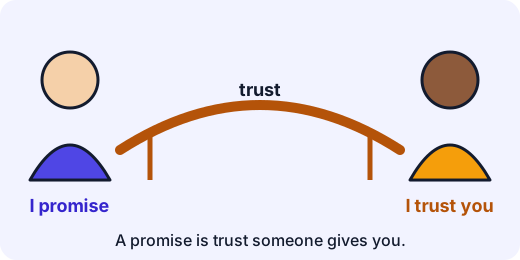
What is a promise?
A promise is when you say you will do something, and someone counts on you. And trust is what they give you when they count on you. Sana trusted Kiran. She made her plan and told her brother. If Kiran breaks his promise, Sana's plan breaks too, and she may find it hard to count on Kiran again.
A promise is trust someone gives you.
Trust grows when you keep promises, like a plant that grows a little every day. It can drop quickly when a promise is broken. That does not mean a friend can never be trusted again, but it takes time to mend.
When a promise is hard to keep
Keeping a promise is easy when nothing else is happening. A promise matters most when it is hard. Here are some of the hard reasons:
- Something more fun comes along (the kite party).
- You forget.
- You get sick or something unexpected happens.
- You realise the promise was a mistake, such as promising to keep a secret about someone being hurt.
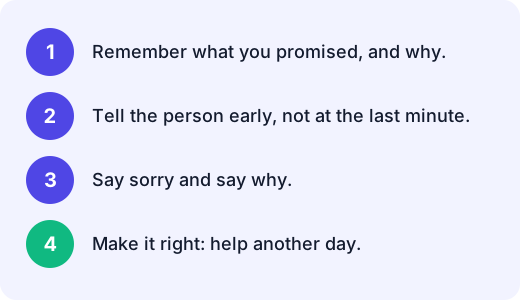
Not all of these are the same. If Kiran simply prefers the party, he should keep his promise to Sana or ask her kindly if they may move the day, and she can say yes or no. If Kiran gets a fever, he cannot come, and that is not his fault. What matters is what he does next.
Should you always keep a promise?
People think differently. Some say "yes, always: a promise is a promise, and if you break one when it is easy, nobody can trust you." Others say "not always: if keeping a promise would hurt somebody, then keeping people safe matters more." For example, if a friend makes you promise to keep a secret, and then tells you that someone is hurting them, you should tell a trusted grown-up, such as a parent or a teacher, even though you promised. A promise should never trap a friend in danger.
So what do you think? Is it always right to keep a promise? What reasons would you give?
For the grown-up helping
Read the story and stop before the ending. Ask "What could Kiran do? What might happen after each choice?" Let your child choose; there is more than one good answer if they say how Sana would feel and what trust means. Be gentle if your child admits to a promise they broke; this is a chance to talk about making things right, not to scold. Make clear to your child that a promise to keep a secret never means they cannot tell a trusted adult when someone is being hurt or frightened.
Quick check
New puzzles
Promises are everywhere. Think about them in new places.
1.Which sentence best says what a promise is?
- A guess about what might happen
- Words that say you will do something, so that someone can count on you
- A wish for something nice
Choose one
2.Joy promised to bring a book to Sam on Monday, but forgot. What is the best thing to do next?
- Say nothing and hope Sam forgets about the book too
- Say sorry, say why, and bring the book as soon as possible
- Tell Sam the book was not important anyway, so it does not matter
Choose one
3.Pick all the good things that happen when you keep your promises.
- People trust you more
- Friends feel safe relying on you
- Keeping a promise is never hard after that
Choose all that apply
4.Aarav promised to feed his neighbour's cat all week. On Wednesday he has a high fever. What is the best thing to do?
- Tell the neighbour or a grown-up straight away so that someone else can feed the cat
- Say nothing and stay in bed, because being sick is not his fault
- Wait until Friday and then tell the neighbour he is sorry
Choose one
5.Ben promised to keep a secret. Then his friend tells him that a bigger child is hurting him. What should Ben do?
- Keep the promise and tell nobody at all, because a promise is a promise
- Tell a trusted grown-up, because keeping his friend safe matters more than the secret
- Tell all the other children in the class
Choose one
Answering and checking are for registered learners. Register to do this.
Your turn
Shastrartha - should you always keep a promise?
The question: Should you always keep a promise?
Talk it through, or write it with a grown-up's help. A grown-up may write down your words.
- Say what you think: "I think you should (or should not) always keep a promise."
- Give a reason: "I think this because ___."
- Give an example from Kiran's story or from your own life.
- Say what someone who thinks the other way might say, and why they might think so.
How it's judged
- A clear position (pratijna)
- A real reason (hetu)
- An example (udaharana)
- Fair to the other side (purvapaksha)
Writing and submitting your answer is for registered learners. Register to do this.
Activity
The promise bridge
Your child builds a "trust bridge" from paper strips and talks through a story in which a promise was hard to keep. About 15 minutes.
You'll need
- Six strips of paper
- A pen
- Tape or a glue stick
- A table to build on
Steps
- Tell or reread Kiran's story, or choose a story where a promise was hard to keep. Stop before the ending.
- On each strip, write one thing that gives trust, such as "I said I would" or "I came when I said". Your child can tell you the words, and you write them.
- Build a small bridge, or a line of strips, and say "This is Sana's trust in Kiran." Ask "What happens to the bridge if Kiran does not come and does not tell her?" and take strips away while your child tells you. Then add strips back for each thing Kiran could do to make it right (tell her early, say sorry, help another day).
- Ask "What could Kiran do? What would happen after that?" Let your child tell a short ending. Then ask "What would you do?"
- Ask the big question "Should you always keep a promise?" and write down your child's words. Both answers are welcome, if there is a reason.
Safety
- An adult cuts the paper strips if scissors are needed.
- Keep tape and glue away from small children's mouths.
Keeping a log of the activity is for registered learners. Register to do this.
Like what you see?
Register for free to answer the quick checks, do the activities and save your work. Your work is saved on your device and syncs to your account.