Unit 4
Being brave
Learn how being brave is different from being reckless, and decide whether doing something dangerous is brave.
Read
Dev and the broken window
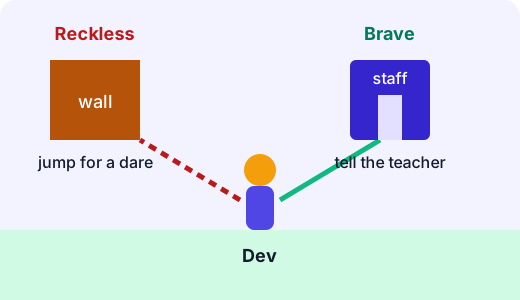
Dev and his cousin Rohan were playing catch behind the school hall. Rohan threw the ball too hard. Crash! A pane of glass in the hall window broke into pieces.
Rohan whispered, "Run! Nobody saw us!" Dev's heart went thump, thump, thump. His hands were cold. He did not want to get into trouble. But he also knew that the broken glass was lying on the grass, where a little child could cut a foot on it.
Then Rohan pointed at the old wall near the hall. "I will give you my best marble if you jump off the top of it! Do it, and nobody will think you are scared." The wall was as tall as a grown-up.
What should Dev do? What would be the brave thing?
What does brave mean?
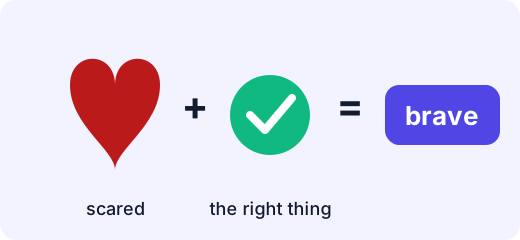
To be brave is to do the right thing even when you feel scared. Notice that the scared feeling does not go away. Dev's heart is still thumping. Brave people are not people who never feel fear. They feel it, and they act well anyway.
Bravery is doing the right thing even when you're scared.
There are two parts: scared and the right thing. Take away either one and it is no longer bravery.
What is reckless?
To be reckless is to do something risky without thinking about what could go wrong, or for a bad reason, such as showing off. Jumping off the wall to win a marble is reckless. Dev might break a leg. And the reason is not a good one. It does not help anybody. It only stops people calling him a scaredy-cat.
A reckless person may not feel scared at all, or may ignore the feeling. A scared feeling is sometimes a useful warning, like a smoke alarm. A brave person listens to it, thinks, and then decides.
Telling them apart
Ask three questions about what someone did:
- Was there a good reason? (Helping someone, telling the truth, keeping people safe.)
- Did they think about what could go wrong?
- Was it right, or only exciting?
Brave Reckless Reason To do something good or right To show off, or for a dare Thinking Thinks, then acts Does not think first Danger Takes a risk only when it is worth it Takes a risk for nothing Example Telling the teacher about the broken glass Jumping off a high wall for a marble Example. A boy sees a small dog stuck in a deep river. He cannot swim. Jumping in would be reckless: he might drown, and the dog would not be saved. The brave thing is to shout loudly for a grown-up and to point to where the dog is, staying somewhere safe. He is scared, he thinks, and he does the right thing that can really help.
Stories of bravery
In a well-known old tale, a tiny bird sees a big fire in the forest and carries water drop by drop in her beak to try to put it out. Some say she is brave because she tries to help, even though she is small and frightened. Others say it is silly, because one bird cannot stop a fire. What do you think? A good way to decide is to ask the three questions above.
A common mistake is to think "brave" means "does the most dangerous thing". But the most dangerous thing is not always the bravest. Sometimes the bravest thing is to say "no, I am not going to do that", or to say "sorry, it was me".
Back to Dev
Dev took a deep breath. He said to Rohan, "I'm not jumping. And we need to tell Mrs. Rao about the glass." His voice shook. Rohan said, "You scaredy-cat!" That hurt. But Dev walked to the staff room, knocked, and told her. Mrs. Rao thanked him and sent the caretaker to clear up the glass.
So is it brave to do something dangerous? Sometimes a dangerous thing can be brave, such as a firefighter running into a burning house to save someone, because she has a good reason, a plan and training. But doing something dangerous only to show off is reckless. What do you think? Give your reasons.
For the grown-up helping
Read the story aloud and stop before Dev decides. Ask "How is Dev feeling? Where do you feel scared in your body?" Let your child name the feeling; it is normal to feel it. Then use the three questions to sort some examples together. Avoid saying "don't be scared"; say instead "scared is okay, and brave is what you do next". Make sure your child knows that saying "no" to a dangerous dare, and telling a trusted adult when someone is hurt or in danger, is brave.
Quick check
New puzzles
Brave or reckless? Use the three questions on new stories.
1.Which sentence best says what being brave means?
- Never feeling scared
- Doing the right thing even when you are scared
- Doing the most dangerous thing you can
Choose one
2.Mia climbs onto the roof of the shed with no grown-up there, because her friends said she would not dare. Is this brave or reckless?
- Brave, because climbing a roof is very dangerous and takes nerve
- Reckless, because the reason was to show off and she did not think about falling
- Brave, because her friends watched her do it and she did not back down
Choose one
3.Lakshmi is shy and her heart is racing. She walks over to a girl sitting alone at lunch and says, 'Do you want to sit with us?' What is this?
- Brave: she is scared and still does something kind
- Reckless: she spoke to someone without planning it first
- Not brave: brave people are never shy or nervous
Choose one
4.Pick all the things that are brave.
- Telling a teacher the truth about something you did wrong, even though you are afraid of being told off
- Running across a busy road because someone dared you
- Saying 'no, I will not do that' to a friend who asks you to do something unsafe
Choose all that apply
5.A firefighter in safety gear goes into a burning building to rescue a child, after the team made a plan. A boy says, 'That is the same as jumping off a wall for fun.' What is the best reply?
- You are right, both are just dangerous
- No: the firefighter has a good reason, a plan and training; the wall jump has none of these
- No: only grown-ups can be brave
Choose one
Answering and checking are for registered learners. Register to do this.
Your turn
Shastrartha - is it brave to do something dangerous?
The question: Is it brave to do something dangerous?
Talk it through, or write it with a grown-up's help. A grown-up may write down your words.
- Say what you think: "I think it is (or is not) brave to do something dangerous."
- Give a reason: "I think this because ___."
- Give an example from Dev's story or from your own life.
- Say what someone who thinks the other way might say, and why they might think so.
How it's judged
- A clear position (pratijna)
- A real reason (hetu)
- An example (udaharana)
- Fair to the other side (purvapaksha)
Writing and submitting your answer is for registered learners. Register to do this.
Activity
Brave or reckless? Sort the cards
Your child sorts story cards into "brave" and "reckless" and explains each choice aloud. About 15 minutes.
You'll need
- Six pieces of paper or card
- A pen
- Two sheets of paper for headings
Steps
- Write BRAVE on one sheet and RECKLESS on the other. Put them on the table.
- Write one short story on each card. Ideas: "Telling the truth about a broken cup", "Climbing a high tree because a friend dared me", "Asking a new child to play", "Standing up for someone being teased", "Running into a road after a ball", "Saying no to a dare". Your child can help choose or draw.
- Read each card aloud. Ask your child to put it under a heading and say why, using the three questions (Was there a good reason? Did they think first? Was it right?). Write down their words.
- Pick one card where your child was unsure. Ask "What would make it the other way?" For example, "What if there was a grown-up and a safe plan?"
- Ask the big question "Is it brave to do something dangerous?" and write down your child's words. Both answers are welcome, if there is a reason.
Safety
- This is a talking activity only. Do not act out any dangerous example.
- If your child shares a time they felt unsafe, listen, and talk to a trusted adult together afterwards.
Keeping a log of the activity is for registered learners. Register to do this.
Like what you see?
Register for free to answer the quick checks, do the activities and save your work. Your work is saved on your device and syncs to your account.