Unit 4
Animals and their young
Match baby animals to their parents, and find out how animal parents look after their babies.
Read
Parents and babies
Every morning, Mira feeds the hens in her grandmother's yard. This week there is something new. A hen has six tiny, yellow, fluffy chicks. They follow her everywhere, peep-peep-peep!
"Why do they stay so close?" asks Mira.
"Because she keeps them safe, and she shows them what to eat," says Grandmother.
Parent and offspring
An animal that has babies is a parent. The babies are its offspring, or its young. Many young animals have their own special names.
Parent Young hen chick cow calf dog puppy cat kitten sheep lamb goat kid horse foal duck duckling 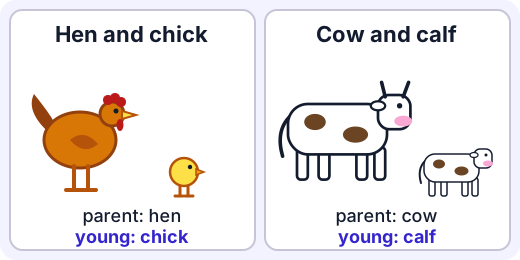
Alike, but not exactly
Look at a kitten and a cat. They both have fur, pointed ears and whiskers. They look alike. But the kitten is much smaller, and its legs and tail are short.
Look at a chick and a hen. The chick is small and fluffy. It does not have the hen's big tail feathers or her red comb yet. It will grow them.
So young look like their parents, but not exactly. They look more like their parents as they grow up.
A few young animals look very different from their parents. A tadpole lives in water and has a tail but no legs at first. It grows into a frog. A caterpillar grows into a butterfly.
How parents help their babies
Baby animals cannot look after themselves at first. Their parents help them to survive, to stay alive.
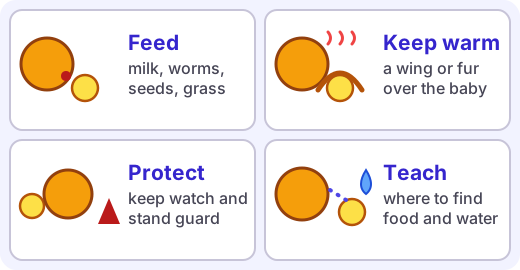
- Feed them. A cow gives her calf milk. A bird brings worms and seeds to the nest.
- Keep them warm. A hen covers her chicks with her wings. A mother dog snuggles with her puppies.
- Protect them. A mother goose will hiss at anything that comes too close to her goslings.
- Teach them. A mother cat shows her kittens how to hunt. A mother duck leads her ducklings to the water.
Try it: Next time you see an animal family (hens, a cat with kittens or birds in a tree), watch from a safe distance. What is the parent doing for the young?
Body parts and their jobs
Animals have body parts that help them live. Most young animals have the same kinds of parts as their parents.
Body part Animal What it helps with beak hen, duck picking up food wings hen, pigeon flying, or covering the chicks to keep them warm fins fish swimming legs cow, dog walking and running fur or wool cat, sheep keeping warm Example. A duck has flat, webbed feet. They work like paddles and help the duck swim. Its ducklings have the same webbed feet, so they can swim soon after they hatch.
For the grown-up helping
Use the real names (calf, kitten, foal), but also let your child say "baby cow" and then give the word. Ask "How is the baby like its mum? How is it different?" to practise comparing. When you meet an animal family, remind your child to stay back. Parents guard their young and may bite or kick. If there is no animal family nearby, a short video of a farm or a pond works well.
Lab
Who is my baby?
Match each animal parent with its baby. Each match tells you one way the parent looks after the young.
Your goals
- Match all six parents with their young.
- Read how each parent helps its baby.
The interactive lab opens once you register. Register to do this.
Activity
Animal family watch
Your child watches an animal parent with its young (hens, a cat, birds, or a video) and notes how the parent helps, and how parent and young are alike and different. About 15 minutes.
You'll need
- Paper and a pencil
- A video of an animal family (only if you cannot see a real one)
Steps
- Find an animal family you can watch from a distance (a hen with chicks, a cat with kittens, birds at a nest, ducks at a pond), or choose a short video.
- Watch quietly for ten minutes. Ask "What is the parent doing for the baby?" and write down each thing your child notices.
- Ask "How are the baby and the parent alike? How are they different?" Draw both animals side by side.
- Match what you saw to the four jobs (feed, keep warm, protect, teach). Which did you see?
Safety
- Stay well back from animal parents with babies. They guard their young and may bite, peck, kick or scratch.
- Do not touch or pick up baby animals, including ones that seem to be alone. Their parent is usually nearby.
- Do not feed wild animals. Wash hands after being near any animal.
Keeping a log of the activity is for registered learners. Register to do this.
Quick check
Animals and their young check
Seven questions about animal families.
1.Match each baby animal to its parent.
- puppy
- kitten
- calf
- chick
Match each to: cat · cow · hen · dog
2.What do scientists call an animal's babies?
- Its offspring
- Its parents
- Its pets
Choose one
3.Look at the picture. What is the small cow called?
- A calf
- A foal
- A kid
Choose one
4.Which of these do animal parents do for their babies? Pick all that are true.
- Feed them
- Keep them safe from danger
- Teach them where to find food
- Buy them toys
Choose all that apply
5.Which body part helps a fish swim?
- Wings
- Fins
- A beak
Choose one
6.A kitten sits beside its mother cat. Which sentence is true?
- They are alike in many ways, but the kitten is smaller
- They look exactly the same
- They look nothing alike
Choose one
7.A cow has 1 calf, and a hen has 6 chicks. How many baby animals is that in all?
Answer with a number
Answering and checking are for registered learners. Register to do this.
Quick check
New puzzles
Use what you know about animal families in new places.
1.A mother duck walks to the pond, with her ducklings in a line behind her. How is she helping them?
- She keeps them together and shows them where to swim
- She is giving them milk
- She is making them grow wings
Choose one
2.Which young animal looks very different from its parent?
- A puppy
- A kitten
- A tadpole
Choose one
3.Anu sees a big spotted animal and a small spotted animal walking side by side, and the small one stays very close. What can she guess?
- The small one is probably the young of the big one
- They are two grown-up animals that are friends
- The small one is a toy
Choose one
4.A duck has flat, webbed feet. What do they help it do?
- Swim
- Fly
- Hear
Choose one
Answering and checking are for registered learners. Register to do this.
Activity
Tell it back
Your child tells you about one animal parent and its young, and how the parent helps. Three minutes.
Steps
- Ask your child to pick an animal they know (a hen, a cow, a cat, a dog).
- Ask "What is its baby called? How is the baby like its parent? How is it different?"
- Ask "How does the parent look after the baby?" Write down what they say in their own words.
Keeping a log of the activity is for registered learners. Register to do this.
Like what you see?
Register for free to answer the quick checks, do the activities and save your work. Your work is saved on your device and syncs to your account.