Unit 5
What things are made of
Find out why a raincoat is plastic, a spoon is metal, and a window is glass, and test which cloth keeps water out.
Read
Why is a raincoat made of plastic?
It is raining hard. Kabir has a cotton shirt and a yellow raincoat. He puts on the shirt first and runs outside. In one minute the shirt is wet right through. He runs back in and puts on the raincoat. Now he stays dry.
Why? The two clothes are made of different materials.
Objects and materials
An object is a thing you can pick up or use, like a spoon, a sock or a window. A material is what the object is made from.
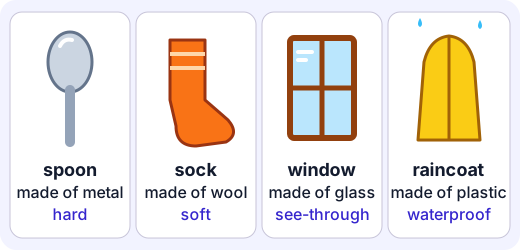
Some materials you know:
Material Where it comes from Used for wood trees tables, pencils, cricket bats metal rocks in the ground pots, spoons, keys glass melted sand windows, jars plastic made in factories buckets, raincoats cotton, wool plants, sheep clothes, blankets rubber rubber trees and factories balls, chappals paper wood and grass books, kites Describing a material
We use property words to say what a material is like.
- Hard: it does not squash when you press it. Stone and metal are hard.
- Soft: it squashes or feels gentle. A cushion and wool are soft.
- Bendy: it bends and goes back, like a rubber band or a rope.
- Waterproof: water cannot get through it. Plastic is waterproof. Cotton is not.
- Absorbent: it soaks up water, like a sponge or a towel.
- See-through: you can see through it. Clear glass is see-through.
A material is chosen for its job
Nobody picks a material by chance. People pick it because of what it can do.
- A raincoat has to keep water out, so it is made of something waterproof, like plastic.
- A towel has to dry you, so it is made of something that soaks up water, like cotton.
- A window lets light in, so it is made of see-through glass.
- A spoon for hot dal must not melt or break, so it is hard metal or wood.
Example. Why is a pillow soft? Because a pillow's job is to be comfortable for your head. A hard pillow made of stone would hurt!
Example. Why is a bicycle frame made of metal and not paper? A bicycle has to be strong enough to carry a person. Metal is hard and strong. Paper would bend and tear.
The water test
How can we find out which cloth keeps water out? We do a test.
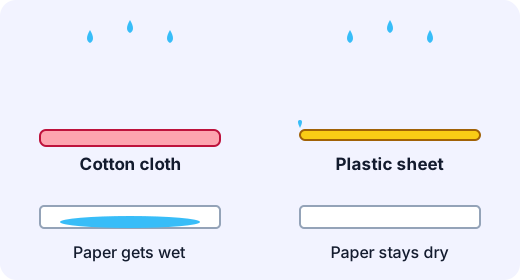
- Put a piece of paper under a cloth.
- Pour the same amount of water on top.
- Lift the cloth. Is the paper wet or dry?
If the paper is dry, the cloth kept the water out. It is waterproof. The test is fair when we use the same amount of water each time.
Try it: Find a towel, a plastic bag and a piece of paper. Which will keep water out? Guess first, then test.
Mistakes to avoid
- A heavy thing is not always hard. A bag of cotton wool is big but soft.
- A spoon is not a material. A spoon is an object. Its material is metal or wood.
- Waterproof does not mean unbreakable. A glass jar keeps water in, but it breaks if you drop it.
For the grown-up helping
Let your child handle real things and use the property words out loud: "This pan is hard and smooth." Ask "Why is it made of that?" more than "What is it made of?" Mixing up the object and its material is normal at this age. For the water test, do it at the sink or on a tray and let the child predict first; a wrong prediction is the best part of an experiment.
Lab
Which cloth keeps water out?
Test four cloths. Pour water on each one and see if the paper underneath gets wet. Then choose the cloths that are good for a raincoat.
Your goals
- Pour water on all four cloths.
- Look at the paper under each cloth.
- Pick the cloths that keep water out.
The interactive lab opens once you register. Register to do this.
Activity
Material hunt and water test
Your child finds objects around the house, sorts them by material and property, then does a real water test on cloths. About 30 minutes.
You'll need
- Eight objects from around the house (a spoon, a wooden block or pencil, a sock, a rubber band, a plastic cup, a paper cup, a sponge, a key)
- Four pieces of cloth or similar (a towel, a cotton handkerchief, a plastic bag, a piece of an old umbrella or raincoat)
- Four pieces of paper or kitchen roll
- A cup of water and a tray
Steps
- Gather eight objects. For each, say what it is made of and one word for how it feels (hard, soft, bendy).
- Make three piles on the floor, hard, soft and bendy. Some may fit two piles, and that is fine; ask why.
- Pick one object and ask "Why is it made of that? What is its job?"
- Water test. Put the tray down. Put a piece of paper under each cloth.
- Ask your child to guess which cloths will keep the paper dry. Write the guesses down.
- An adult pours the same small amount of water (two spoonfuls) on each cloth. Wait one minute.
- Lift each cloth and look at the paper. Which are dry? Were the guesses right?
Safety
- Use only soft, unbreakable objects. Leave out glass, knives, scissors and anything sharp.
- Keep small objects (keys, rubber bands) and plastic bags away from babies and toddlers. A plastic bag is never a toy.
- Wipe up spilled water so nobody slips.
Keeping a log of the activity is for registered learners. Register to do this.
Quick check
Materials check
Seven questions about materials and what they can do.
1.Which material is best for a window?
- Clear glass
- Wood
- Thick cloth
Choose one
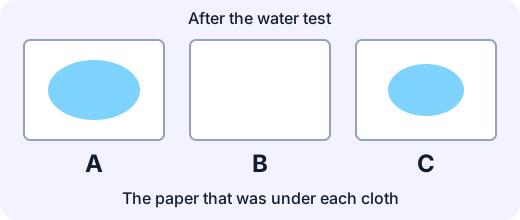
2.Anya tested three cloths for a raincoat. The picture shows the paper under each cloth. Which cloth is best for a raincoat?
- Cloth A
- Cloth B
- Cloth C
Choose one
3.Which of these are bendy? Pick all that apply.
- A rubber band
- A rope
- A brick
- A stone
Choose all that apply
4.Match each object to the material it is usually made of.
- Cricket bat
- Window pane
- Warm jumper
- Bicycle frame
Match each to: Wool · Glass · Wood · Metal
5.Chhaya wants boots to jump in muddy puddles. Which material keeps her feet dry?
- Rubber
- Paper
- Cotton cloth
Choose one
6.Why is a cushion made of soft stuff?
- So it is comfortable to sit on
- So it keeps water out
- So it looks shiny
Choose one
7.Dev tested 4 cloths. Only 3 let the water through. How many cloths kept the water out?
Answer with a number
Answering and checking are for registered learners. Register to do this.
Quick check
New puzzles
Use what you know about materials in new places.
1.Meera must carry her books to school in the rain. Which bag keeps them driest?
- A plastic bag
- A paper bag
- A cotton cloth bag
Choose one
2.Tea spills on the table. Which is best for wiping it up?
- A sponge
- A plastic sheet
- A glass plate
Choose one
3.Three of these are hard. Which one is NOT hard?
- A stone
- An iron nail
- A ball of wool
- A wooden block
Choose one
4.Sam says, "A spoon is a material." Is Sam right?
- No. A spoon is an object. It is made of a material, such as metal or wood.
- Yes. Spoon is a material.
Choose one
5.A ball must bounce when it hits the ground. Which material is best?
- Rubber
- Wet clay
- Glass
Choose one
Answering and checking are for registered learners. Register to do this.
Activity
Tell it back
Your child explains why things are made of the materials they are. Three minutes.
Steps
- Ask "Why is a raincoat made of plastic and not a towel?" Let your child answer in their own words.
- Ask "Why is a window made of glass?" Then "Could we make a window from wood? What would happen?"
- Ask them to think of one more object and say what job its material does. Write down what they say.
Keeping a log of the activity is for registered learners. Register to do this.
Like what you see?
Register for free to answer the quick checks, do the activities and save your work. Your work is saved on your device and syncs to your account.